 Back
BackQuadratic Functions: Graphing, Properties, and Applications
Study Guide - Smart Notes
 Tailored notes based on your materials, expanded with key definitions, examples, and context.
Polynomial and Rational Functions
Quadratic Functions
A quadratic function is a polynomial function of degree 2, typically written in the form , where a, b, and c are real numbers and . The graph of a quadratic function is a parabola.
Standard Form: where is the vertex.
General Form:
Axis of Symmetry: The line (in standard form) or (in general form).
Direction: If , the parabola opens upward (minimum at vertex). If , it opens downward (maximum at vertex).
Example: is a quadratic function. Its graph is a parabola.
Graphing Quadratic Functions in Standard Form
To graph a quadratic function in standard form :
Step 1: Identify , , and .
Step 2: Determine the direction of opening (up if , down if ).
Step 3: Find the vertex . The vertex is the minimum (if ) or maximum (if ).
Step 4: Find the x-intercepts by solving .
Step 5: Find the y-intercept by evaluating .
Step 6: Sketch the graph, plot the points, and draw the axis of symmetry.
Graphing Quadratic Functions in General Form
For :
Step 1: Identify , , and .
Step 2: Determine the direction of opening.
Step 3: Find the vertex using and .
Step 4: Find the x-intercepts by solving .
Step 5: Find the y-intercept ().
Step 6: Use symmetry about the axis to find additional points.
Step 7: Draw the parabola through the points found.
Example: Graphing a Quadratic Function
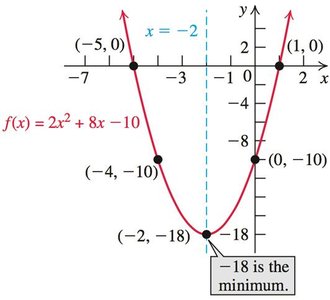
Consider .
Vertex: ,
Axis of Symmetry:
Minimum Value: at
Y-intercept:
X-intercepts: Solve
Applications: Maximum Area Problem
Quadratic functions are often used to model real-world problems involving maximum or minimum values. For example, maximizing the area of a rectangular pen with a fixed perimeter.
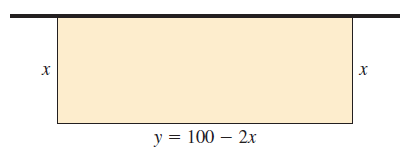
Problem: A farmer has 100 feet of fencing and uses a stone wall for one side. The other three sides use the fencing.
Let: = length of each of the two sides perpendicular to the wall, = length parallel to the wall.
Constraint:
Area:
Maximum Area: The area function is quadratic and opens downward (), so the maximum occurs at the vertex.
Vertex:
Dimensions: ft, ft
Maximum Area: ft2
Solving Quadratic Inequalities
Quadratic functions can also be used to solve inequalities, such as . The solution involves finding the values of for which the function is positive.
Step 1: Solve to find critical points.
Step 2: Test intervals between and outside the roots to determine where the function is greater than zero.
Step 3: Express the solution as an interval.
Domain and Range of Quadratic Functions
The domain of any quadratic function is all real numbers, . The range depends on the direction of the parabola:
If : Range is where is the minimum value at the vertex.
If : Range is where is the maximum value at the vertex.
