 Back
BackRational Functions and Inequalities: Asymptotes, Graphing, and Inequality Solutions
Study Guide - Smart Notes
 Tailored notes based on your materials, expanded with key definitions, examples, and context.
Rational Functions and Inequalities
Definition and Examples of Rational Functions
A rational function is any function that can be written as the ratio of two polynomials, where the denominator is not zero. In general, a rational function has the form:
General Form: , where and are polynomials and .
Examples: , ,
Rational functions are defined for all real numbers except where the denominator equals zero.
Vertical Asymptotes
Vertical asymptotes are vertical lines where the function grows without bound as approaches a certain value. For a rational function in lowest terms, a vertical asymptote occurs at if and .
Limit Notation: is a vertical asymptote if .
How to Find: Set the denominator equal to zero and solve for .
Important: Always reduce the function to lowest terms before finding vertical asymptotes.
Long-Term Behavior and Horizontal Asymptotes
To analyze the behavior of a rational function as becomes very large or very small, divide the numerator and denominator by the highest power of $x$ present in the denominator. This helps determine the horizontal asymptote (if any).
Horizontal Asymptote (HA): A horizontal line such that or .
Rules for Finding HA:
If degree of < degree of , HA is (the x-axis).
If degree of = degree of , HA is .
If degree of > degree of , there is no horizontal asymptote (but there may be an oblique asymptote).
Oblique (Slant) Asymptotes
An oblique asymptote occurs when the degree of the numerator is exactly one more than the degree of the denominator. The asymptote is a non-horizontal, non-vertical line.
How to Find: Divide by using long or synthetic division. The quotient (ignoring the remainder) gives the equation of the oblique asymptote.
Equation:
Rational Inequalities and the Test-Point Method
To solve rational inequalities, use the test-point method rather than multiplying both sides by the denominator (which can change the direction of the inequality if the denominator is negative).
Rewrite the inequality with zero on one side.
Express as a single rational expression in factored form.
Find zeros of the numerator (where the function is zero) and denominator (where the function is undefined/vertical asymptotes).
Divide the x-axis into intervals using these critical points.
Select a test point in each interval to determine the sign of the expression.
Write the solution in interval notation.
Graphing Rational Functions
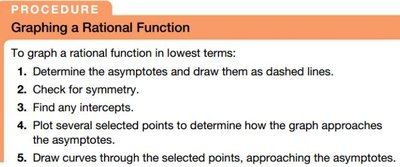
Graphing a rational function involves several systematic steps to ensure all key features are accurately represented:
1. Determine the asymptotes (vertical, horizontal, oblique) and draw them as dashed lines.
2. Check for symmetry (even, odd, or neither).
3. Find any intercepts (x-intercepts and y-intercepts).
4. Plot several selected points to determine how the graph approaches the asymptotes.
5. Draw curves through the selected points, ensuring the graph approaches the asymptotes appropriately.
Domain, Holes, and Crossing Asymptotes
Domain: The set of all real numbers except where the denominator is zero.
Holes: If a factor cancels from both numerator and denominator, the function has a hole at that x-value.
Crossing Asymptotes: Sometimes, the graph of a rational function may cross its horizontal asymptote. To check, set equal to the asymptote value and solve for .
Summary Table: Types of Asymptotes in Rational Functions
Type | How to Find | Equation |
|---|---|---|
Vertical Asymptote | Set denominator (after reducing) | |
Horizontal Asymptote | Compare degrees of numerator and denominator | |
Oblique Asymptote | Degree numerator = degree denominator + 1; use division |
Example Problems
Find the vertical asymptotes of : Set .
Find the horizontal asymptote of : Degree numerator < degree denominator, so .
Find the oblique asymptote of : Degree numerator is one more than denominator; use long division to find the equation of the slant asymptote.
Solve : Rewrite as , find zeros and test intervals.
Additional info: The above notes expand on the provided material with definitions, step-by-step procedures, and a summary table for clarity and completeness.
