 Back
BackRational Functions and Their Graphs: Study Guide
Study Guide - Smart Notes
 Tailored notes based on your materials, expanded with key definitions, examples, and context.
Rational Functions
Definition and Basic Properties
A rational function is any function that can be written as the ratio of two polynomials, i.e., , where and are polynomials and .
Domain: All real numbers except those for which the denominator is zero. These values are excluded because division by zero is undefined.
Vertical Asymptotes: Occur at values of where and and do not share a common factor.
y-intercept: Found by evaluating , provided .
x-intercepts: Found by solving , provided and do not share a common factor.
Example:
For :
Domain: All real numbers except .
Vertical asymptote at .
y-intercept: .
x-intercepts: Solve .
Vertical Asymptotes
Understanding Vertical Asymptotes
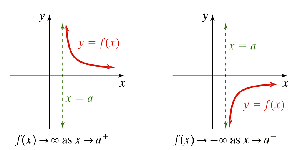
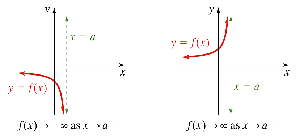
Vertical asymptotes are lines where the function approaches infinity or negative infinity as approaches from either side. They occur at the zeros of the denominator (after canceling any common factors with the numerator).
The graph of a rational function will never cross a vertical asymptote.
Behavior near vertical asymptotes depends on the sign and degree of the numerator and denominator.
Horizontal Asymptotes
Properties and Identification
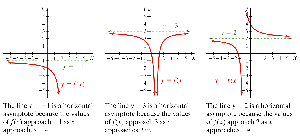
A horizontal asymptote is a horizontal line that the graph of a rational function approaches as tends to infinity or negative infinity. A rational function can have at most one horizontal asymptote.
The graph may intersect a horizontal asymptote, but not a vertical one.
Horizontal asymptotes are determined by comparing the degrees of and :
If degree of < degree of , then is the horizontal asymptote.
If degree of = degree of , then .
If degree of > degree of , there is no horizontal asymptote (but there may be a slant asymptote).
Example:
For :
Degree of numerator and denominator are equal (both 2).
Horizontal asymptote: .
Steps for Graphing Rational Functions
Systematic Approach
Graphing rational functions involves several steps to ensure all important features are captured:
Find the domain: Identify values excluded from the domain (where denominator is zero).
Find vertical asymptotes: Set denominator equal to zero and solve for .
Find the y-intercept: Evaluate .
Find x-intercepts: Solve for .
Use test values: Determine the behavior of the graph on each side of the vertical asymptotes.
Determine horizontal or slant asymptotes: Compare degrees of numerator and denominator.
Plot points: Choose values of between each intercept and on either side of all vertical asymptotes.
Example:
For :
Domain:
Vertical asymptote:
y-intercept:
x-intercept:
Horizontal asymptote: Degree of numerator and denominator are equal, so
Summary Table: Asymptotes of Rational Functions
Type of Asymptote | How to Find | Properties |
|---|---|---|
Vertical | Set denominator (after canceling common factors) | Graph never crosses; function approaches infinity |
Horizontal | Compare degrees of and | At most one; graph may cross |
Slant (Oblique) | Degree of numerator is one more than denominator | Graph approaches a line as |
Additional info: Slant asymptotes are found by performing polynomial long division when the degree of the numerator is exactly one greater than the denominator.
