Back
BackRelations and Functions: Precalculus Study Guide
Study Guide - Smart Notes
 Tailored notes based on your materials, expanded with key definitions, examples, and context.
Relations and Functions
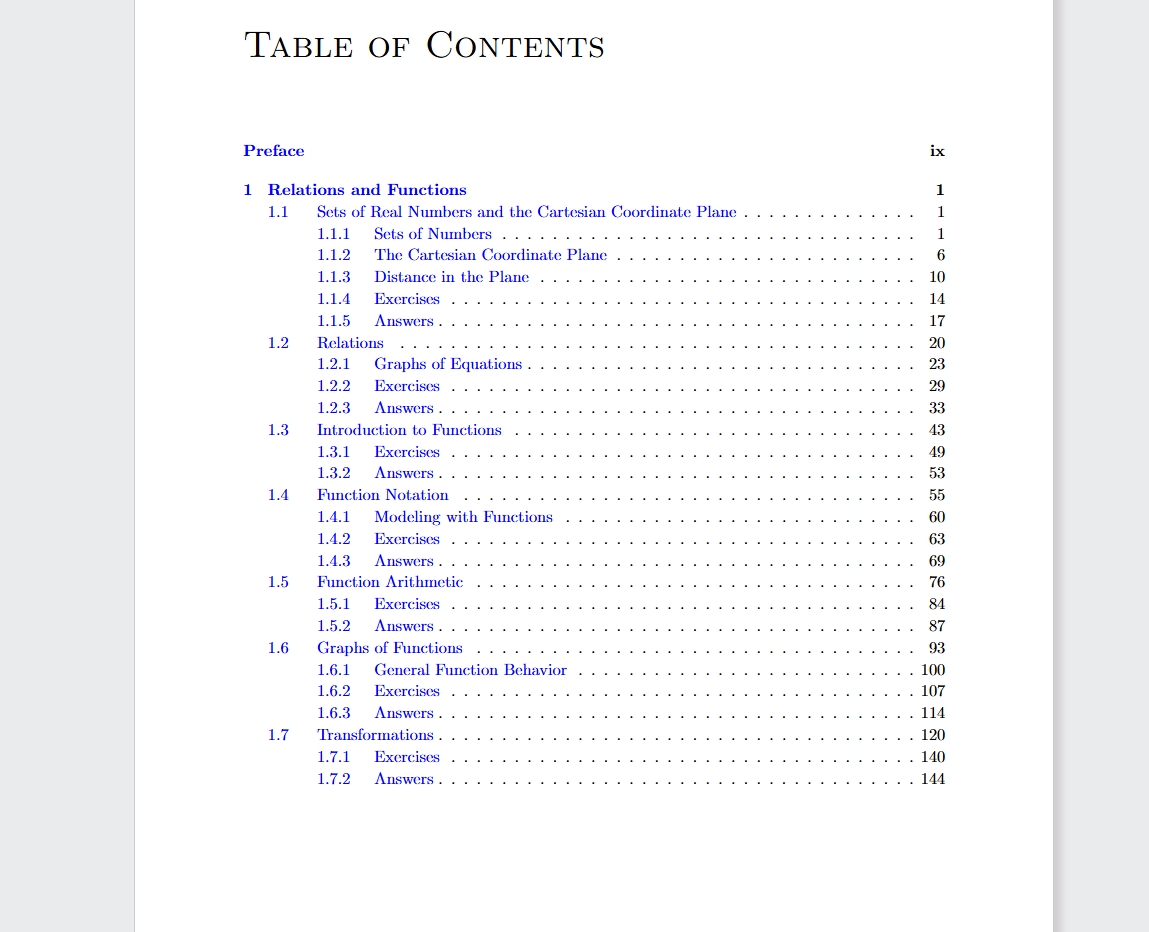
Sets of Real Numbers and the Cartesian Coordinate Plane
This section introduces foundational concepts in precalculus, including the classification of numbers and the structure of the Cartesian coordinate plane.
Sets of Numbers: The real numbers include rational and irrational numbers, integers, whole numbers, and natural numbers. Each set has unique properties and applications in mathematics.
The Cartesian Coordinate Plane: A two-dimensional plane defined by the x-axis (horizontal) and y-axis (vertical), used to graph equations and visualize relationships between variables.
Distance in the Plane: The distance between two points and is given by the formula:
Example: Find the distance between (1, 2) and (4, 6):
Relations
Relations describe connections between sets of values, often visualized as graphs or tables.
Graphs of Equations: A graph represents all solutions to an equation in the coordinate plane. For example, the graph of is a parabola.
Example: The relation is a straight line with slope 2 and y-intercept 1.
Introduction to Functions
Functions are a special type of relation where each input (domain) corresponds to exactly one output (range).
Definition: A function from set to set assigns each element in $A$ exactly one element in $B$.
Notation: denotes the output of function for input .
Example: maps each real number to its square.
Function Notation
Function notation provides a concise way to express mathematical relationships and operations.
Modeling with Functions: Functions can model real-world phenomena, such as population growth or projectile motion.
Example: If , then .
Function Arithmetic
Functions can be combined using arithmetic operations to create new functions.
Addition:
Subtraction:
Multiplication:
Division: , provided
Example: If and , then
Graphs of Functions
Graphing functions helps visualize their behavior and properties.
General Function Behavior: The shape and position of a function's graph reveal information about its domain, range, and key features (such as intercepts and asymptotes).
Example: The graph of is a cubic curve passing through the origin.
Transformations
Transformations modify the appearance of function graphs through shifts, stretches, compressions, and reflections.
Vertical Shift: shifts the graph up by units.
Horizontal Shift: shifts the graph right by units.
Reflection: reflects the graph across the x-axis.
Example: The graph of is a parabola shifted right by 2 units and up by 3 units.
Additional info: These topics form the foundation for later precalculus concepts, including polynomial, rational, exponential, and trigonometric functions.