 Back
BackRight Triangle Trigonometry and Applications
Study Guide - Smart Notes
 Tailored notes based on your materials, expanded with key definitions, examples, and context.
Right Triangle Trigonometry
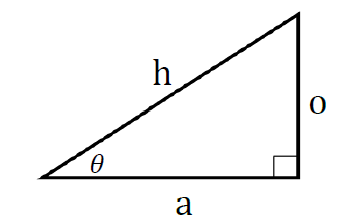
Trigonometric Ratios
Trigonometric ratios relate the angles of a right triangle to the lengths of its sides. These ratios are fundamental in precalculus and are used to solve problems involving triangles and modeling real-world situations.
Sine (sin):
Cosine (cos):
Tangent (tan):
Cosecant (csc):
Secant (sec):
Cotangent (cot):
Pythagorean Theorem
The Pythagorean Theorem is a fundamental relationship in right triangles, connecting the lengths of the sides:
Where a and b are the legs, and c is the hypotenuse.
Applications of Right Triangle Trigonometry
Rain Gutter Construction Example
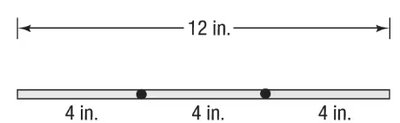
Trigonometric functions can be used to model and optimize real-world problems, such as maximizing the area of a rain gutter opening constructed from a sheet of aluminum.
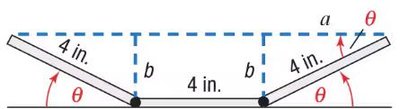
Setup: An aluminum sheet 12 inches wide is marked off with 4 inches from each edge. The sides are bent up at an angle .
Area Function: The area of the opening can be expressed as a function of using trigonometric relationships.
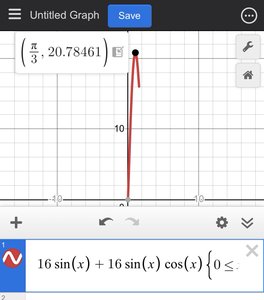
Optimization: By graphing , the angle that maximizes the area can be found, allowing the gutter to carry the most water.
Example Calculation
Let the sides be bent up at angle .
The area of the opening is (from the graph).
Maximum area occurs at , with square inches.
Complementary Angles in Right Triangles
Definition and Properties
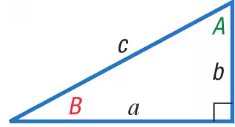
In a right triangle, the two non-right angles are complementary, meaning their sum is 90°.
Trigonometric functions of complementary angles are related:
Function | Complementary Relationship |
|---|---|
Solving Right Triangles
Finding Side Lengths and Angles
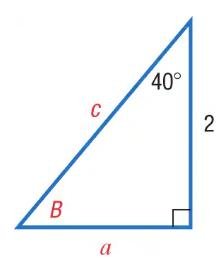
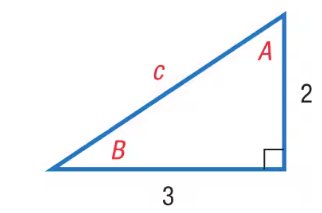
Given certain side lengths or angles, trigonometric ratios can be used to solve for unknown values in right triangles.
Use , , or depending on the known sides and angles.
Apply the Pythagorean Theorem for missing sides.
Angles of Elevation and Depression
Definitions and Applications
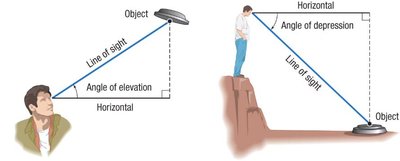
Angles of elevation and depression are used in real-world applications to measure heights and distances indirectly.
Angle of Elevation: The angle above the horizontal line of sight.
Angle of Depression: The angle below the horizontal line of sight.
Trigonometric ratios are used to solve for unknown distances or heights.
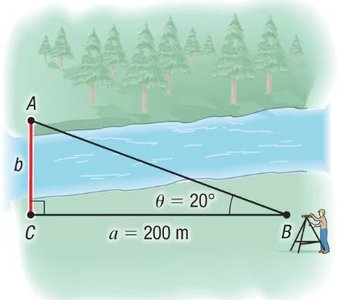
Example: Measuring Distance Across a River
Trigonometry can be used to determine the width of a river or the height of an object using indirect measurements.
Given a baseline and an angle, use to solve for the unknown side.
Example: Measuring Cloud Height
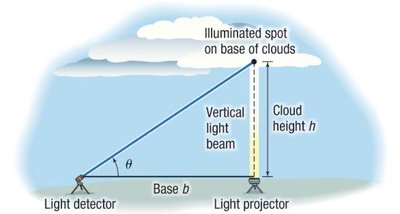
Trigonometric ratios can be applied to measure the height of clouds using a light beam and a known base distance.
Given base and angle , cloud height is .
Summary Table: Trigonometric Ratios
Function | Formula | Relationship |
|---|---|---|
Sine | Basic ratio | |
Cosine | Basic ratio | |
Tangent | Basic ratio | |
Cosecant | Reciprocal of sine | |
Secant | Reciprocal of cosine | |
Cotangent | Reciprocal of tangent |
Additional info:
Expanded explanations and formulas were added for completeness and clarity.
Images were included only when directly relevant to the explanation of the paragraph.
