 Back
BackRight Triangle Trigonometry: Trigonometric Functions of Acute Angles
Study Guide - Smart Notes
 Tailored notes based on your materials, expanded with key definitions, examples, and context.
Trigonometric Functions
Introduction to Trigonometric Functions
Trigonometric functions are fundamental in precalculus and are used to relate the angles of a right triangle to the ratios of its sides. These functions are essential for solving problems involving triangles, modeling periodic phenomena, and understanding more advanced mathematics.
Right Triangle Trigonometry
Definition of Trigonometric Functions
The six trigonometric functions of an acute angle in a right triangle are defined as ratios of the lengths of the sides of the triangle. Consider a right triangle with an acute angle \( \theta \), where:
Opposite side: The side opposite angle \( \theta \) (denoted as b).
Adjacent side: The side adjacent to angle \( \theta \) (denoted as a).
Hypotenuse: The side opposite the right angle (denoted as c).
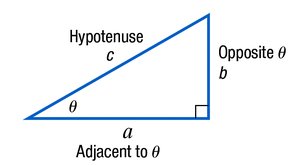
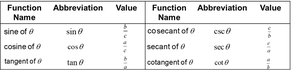
The six trigonometric functions are:
Function Name | Abbreviation | Value | Function Name | Abbreviation | Value |
|---|---|---|---|---|---|
sine of \( \theta \) | \( \sin \theta \) | \( \frac{b}{c} \) | cosecant of \( \theta \) | \( \csc \theta \) | \( \frac{c}{b} \) |
cosine of \( \theta \) | \( \cos \theta \) | \( \frac{a}{c} \) | secant of \( \theta \) | \( \sec \theta \) | \( \frac{c}{a} \) |
tangent of \( \theta \) | \( \tan \theta \) | \( \frac{b}{a} \) | cotangent of \( \theta \) | \( \cot \theta \) | \( \frac{a}{b} \) |
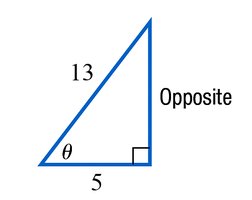
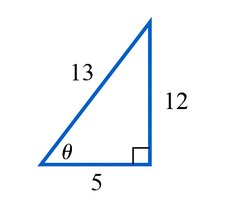
Example: Finding Trigonometric Function Values
Given a right triangle with sides 5 (adjacent), 12 (opposite), and 13 (hypotenuse), find the values of all six trigonometric functions for angle \( \theta \).
\( \sin \theta = \frac{12}{13} \)
\( \cos \theta = \frac{5}{13} \)
\( \tan \theta = \frac{12}{5} \)
\( \csc \theta = \frac{13}{12} \)
\( \sec \theta = \frac{13}{5} \)
\( \cot \theta = \frac{5}{12} \)
Fundamental Trigonometric Identities
Reciprocal and Quotient Identities
Trigonometric identities are equations involving trigonometric functions that are true for all values of the variable where both sides are defined. The most basic are the reciprocal and quotient identities:
Reciprocal Identities:
\( \sin \theta = \frac{1}{\csc \theta} \)
\( \cos \theta = \frac{1}{\sec \theta} \)
\( \tan \theta = \frac{1}{\cot \theta} \)
\( \csc \theta = \frac{1}{\sin \theta} \)
\( \sec \theta = \frac{1}{\cos \theta} \)
\( \cot \theta = \frac{1}{\tan \theta} \)
Quotient Identities:
\( \tan \theta = \frac{\sin \theta}{\cos \theta} \)
\( \cot \theta = \frac{\cos \theta}{\sin \theta} \)
Pythagorean Identities
\( \sin^2 \theta + \cos^2 \theta = 1 \)
\( 1 + \tan^2 \theta = \sec^2 \theta \)
\( 1 + \cot^2 \theta = \csc^2 \theta \)
Example: Using Identities to Find Trigonometric Values
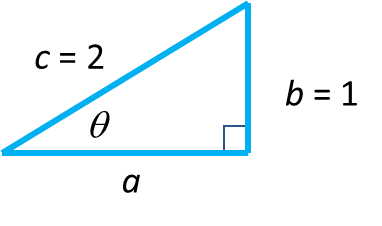
If \( \sin \theta = \frac{1}{2} \) and \( \theta \) is acute, find the other five trigonometric functions.
Draw a right triangle with opposite side 1 and hypotenuse 2.
Find the adjacent side using the Pythagorean Theorem: \( a = \sqrt{2^2 - 1^2} = \sqrt{3} \).
\( \cos \theta = \frac{\sqrt{3}}{2} \)
\( \tan \theta = \frac{1}{\sqrt{3}} = \frac{\sqrt{3}}{3} \)
\( \csc \theta = 2 \)
\( \sec \theta = \frac{2}{\sqrt{3}} = \frac{2\sqrt{3}}{3} \)
\( \cot \theta = \sqrt{3} \)
Finding Remaining Trigonometric Functions When One is Known
Method 1: Using Triangle Definitions
Draw a right triangle with the given trigonometric value.
Assign values to two sides based on the given function.
Find the third side using the Pythagorean Theorem.
Use the definitions to find the remaining functions.
Method 2: Using Identities
Use the given value and an appropriate identity (such as the Pythagorean Identity) to find another function.
Apply reciprocal and quotient identities to find the rest.
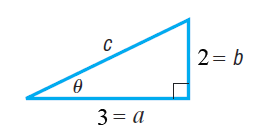
Example: Given \( \tan \theta = \frac{2}{3} \), Find All Functions
Let opposite = 2, adjacent = 3. Hypotenuse \( c = \sqrt{2^2 + 3^2} = \sqrt{13} \).
\( \sin \theta = \frac{2}{\sqrt{13}} = \frac{2\sqrt{13}}{13} \)
\( \cos \theta = \frac{3}{\sqrt{13}} = \frac{3\sqrt{13}}{13} \)
\( \tan \theta = \frac{2}{3} \)
\( \csc \theta = \frac{\sqrt{13}}{2} \)
\( \sec \theta = \frac{\sqrt{13}}{3} \)
\( \cot \theta = \frac{3}{2} \)
The Complementary Angle Theorem
Cofunction Identities
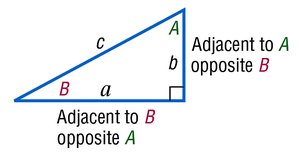
The Complementary Angle Theorem states that the trigonometric function of an angle is equal to the cofunction of its complement. In other words, for acute angles \( A \) and \( B \) such that \( A + B = 90^\circ \):
\( \sin A = \cos B \)
\( \tan A = \cot B \)
\( \sec A = \csc B \)
\( \cos A = \sin B \)
\( \cot A = \tan B \)
\( \csc A = \sec B \)
Example: Using the Complementary Angle Theorem
Find the exact value of \( \sin 30^\circ \) and \( \cos 60^\circ \). Since 30° and 60° are complementary, \( \sin 30^\circ = \cos 60^\circ = \frac{1}{2} \).
