 Back
BackStudy Guide: Graphs of Rational Functions and Polar/Complex Plots
Study Guide - Smart Notes
 Tailored notes based on your materials, expanded with key definitions, examples, and context.
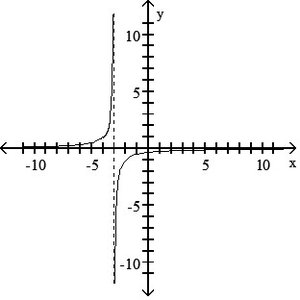
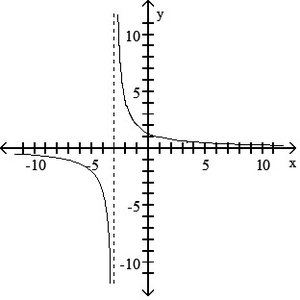
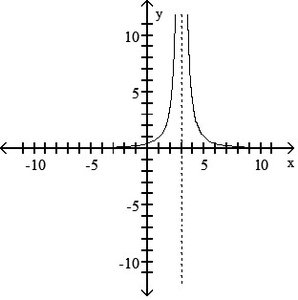
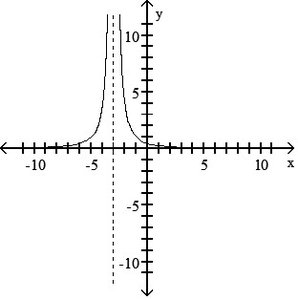
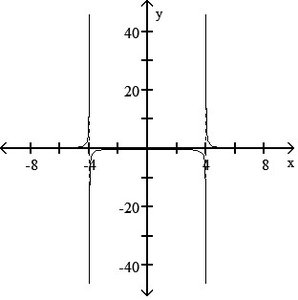
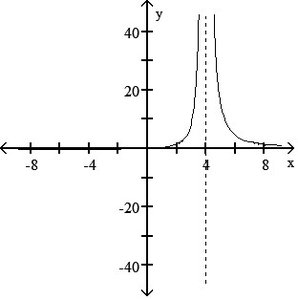
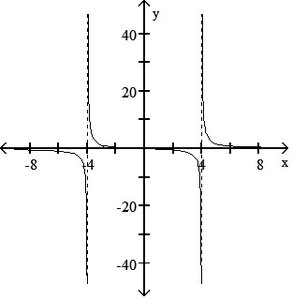
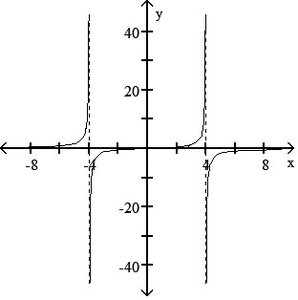
Q1. Identify the characteristics of the rational function graphs shown.
Background
Topic: Rational Functions and Their Graphs
This question is testing your ability to recognize and analyze the features of rational function graphs, such as vertical and horizontal asymptotes, and the behavior near these asymptotes.
Key Terms and Formulas:
Rational Function: A function of the form , where and are polynomials and .
Vertical Asymptote: Occurs where and .
Horizontal Asymptote: Determined by the degrees of and .
Step-by-Step Guidance
Examine the graph for vertical dashed lines. These indicate vertical asymptotes, which occur where the denominator of the rational function is zero.
Observe the behavior of the function as approaches the vertical asymptote from both sides. Does the function go to or ?
Check for horizontal asymptotes by looking at the behavior as . Does the graph approach a constant value?
Identify the general shape and symmetry of the graph. Is it similar to , , or another rational function?
Try solving on your own before revealing the answer!
Q2. Identify the points in polar coordinates and their locations.
Background
Topic: Polar Coordinates
This question is testing your understanding of polar coordinates, how to plot points, and how to interpret their locations on a polar grid.
Key Terms and Formulas:
Polar Coordinates: A point is represented as , where is the distance from the origin and is the angle from the positive -axis.
Conversion: ,
Step-by-Step Guidance
Identify the labeled points (A, B, C, D) on the polar grid.
Determine the radius for each point by counting the circles from the origin.
Estimate the angle for each point based on its position relative to the positive -axis.
Write the polar coordinates for each point as .
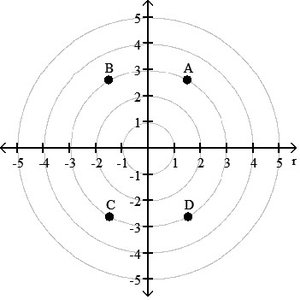
Try solving on your own before revealing the answer!
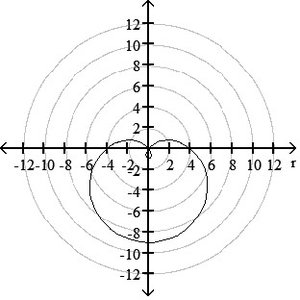
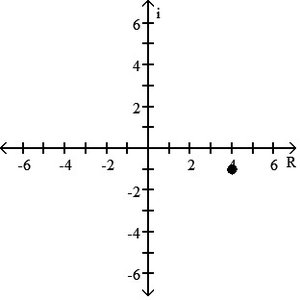
Q3. Plot and interpret points in the complex plane.
Background
Topic: Complex Numbers and the Complex Plane
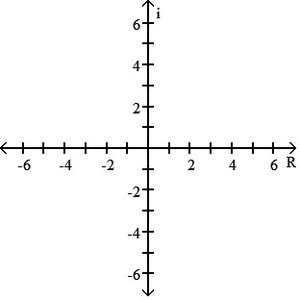
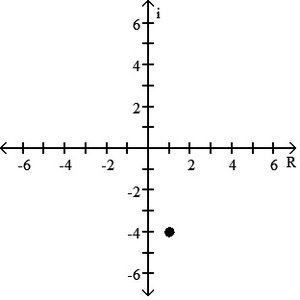
This question is testing your ability to plot complex numbers as points in the complex plane, where the horizontal axis represents the real part and the vertical axis represents the imaginary part.
Key Terms and Formulas:
Complex Number: , where is the real part and is the imaginary part.
Complex Plane: The -axis is the real axis, and the -axis is the imaginary axis.
Step-by-Step Guidance
Identify the coordinates of the point on the complex plane.
Determine the real part () and the imaginary part () from the axes.
Write the complex number in the form .
Try solving on your own before revealing the answer!
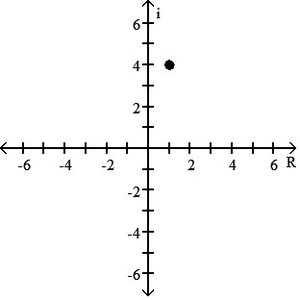
Q4. Vector representation and operations on a grid.
Background
Topic: Vectors in the Plane
This question is testing your understanding of vectors, their graphical representation, and basic vector operations such as addition and subtraction.
Key Terms and Formulas:
Vector: An object with both magnitude and direction, represented as .
Vector Addition:
Vector Subtraction:
Step-by-Step Guidance
Identify the initial and terminal points of each vector on the grid.
Calculate the components of each vector by subtracting the coordinates of the initial point from the terminal point.
Use vector addition or subtraction formulas to combine vectors as needed.
Try solving on your own before revealing the answer!
