 Back
BackStudy Guide: Rational, Exponential, and Logarithmic Functions (Chapters 3 & 4)
Study Guide - Smart Notes
 Tailored notes based on your materials, expanded with key definitions, examples, and context.
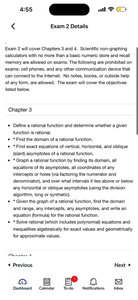
Rational Functions and Their Properties
Definition and Domain
A rational function is any function that can be written as the ratio of two polynomials, i.e., , where . The domain of a rational function consists of all real numbers except those for which the denominator is zero.
Key Point: To determine the domain, set the denominator equal to zero and solve for excluded values.
Example: For , the domain is all real numbers except .
Graphs and Asymptotes
Rational functions often have vertical asymptotes at values excluded from the domain and may have horizontal or oblique asymptotes depending on the degrees of the numerator and denominator.
Vertical Asymptotes: Occur at zeros of the denominator.
Horizontal Asymptotes: Determined by comparing degrees of numerator and denominator.
Oblique Asymptotes: Occur when the degree of the numerator is one higher than the denominator.
Example: has a vertical asymptote at and an oblique asymptote.
Intercepts and Applications
x-intercepts: Set numerator equal to zero.
y-intercepts: Evaluate .
Applications: Rational functions model rates, concentrations, and other real-world ratios.
Exponential Functions
Definition and Properties
An exponential function has the form , where , , and . Exponential functions model rapid growth or decay.
Key Point: The base determines growth () or decay ().
Example: is exponential growth; is exponential decay.
Graphing and Intercepts
Graph: Exponential functions are always positive and increase or decrease rapidly.
x-intercept: May not exist for standard exponential functions.
y-intercept: .
Solving Exponential Equations
Exact Solutions: Use properties of exponents or logarithms.
Decimal Approximations: Estimate solutions to desired accuracy.
Example: Solve ; .
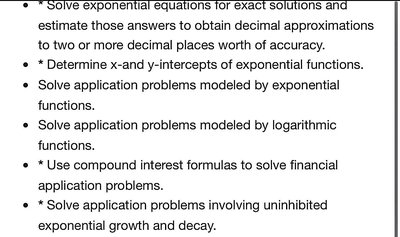
Applications
Compound Interest:
Uninhibited Growth/Decay:
Example: Population growth, radioactive decay.
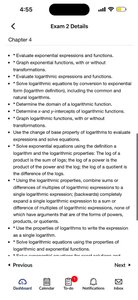
Logarithmic Functions
Definition and Properties
A logarithmic function is the inverse of an exponential function: , where , . Logarithms answer the question: "To what exponent must be raised to get ?"
Key Point: and .
Example: because .
Graphing Logarithmic Functions
Domain:
Range: All real numbers
Vertical Asymptote: At
Logarithmic Equations and Properties
Product Rule:
Quotient Rule:
Power Rule:
Change of Base:
Solving Logarithmic Equations
Isolate the logarithm and rewrite in exponential form.
Example: Solve ; .
Applications
Modeling: Logarithmic functions are used in pH, sound intensity, and population models.
Financial Applications: Used in compound interest and exponential decay.
Summary Table: Exponential vs. Logarithmic Functions
Function Type | General Form | Domain | Range | Key Properties |
|---|---|---|---|---|
Exponential | All real numbers | Rapid growth/decay, y-intercept at | ||
Logarithmic | All real numbers | Inverse of exponential, vertical asymptote at |
Additional info:
These notes are based on exam objectives for Chapters 3 and 4, covering rational, exponential, and logarithmic functions, their properties, graphs, and applications.
Images included are directly relevant to the exam objectives and reinforce the study content.
