 Back
BackStudy Notes: Circles in the Cartesian Plane (Precalculus Chapter 1.4)
Study Guide - Smart Notes
 Tailored notes based on your materials, expanded with key definitions, examples, and context.
Chapter 1: Graphs
Section 1.4: Circles
This section introduces the concept of circles in the Cartesian plane, focusing on their equations, properties, and methods for graphing. Understanding circles is fundamental for precalculus students, as it connects algebraic equations to geometric figures.
Definition of a Circle
A circle is the set of all points in the Cartesian plane that are a fixed distance r (the radius) from a fixed point (h, k) (the center of the circle).
Radius (r): The constant distance from the center to any point on the circle.
Center (h, k): The fixed point from which all points on the circle are equidistant.
Example: The point (x, y) lies on the circle if its distance from (h, k) is exactly r.
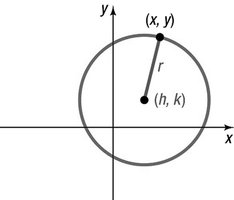
Standard Form of the Equation of a Circle
The standard form of the equation of a circle with center (h, k) and radius r is derived from the distance formula:
Distance formula:
Standard form:
Example: Write the equation for a circle with radius 6 and center (4, -7):
Theorem: Circle at the Origin
If the center of the circle is at the origin (0, 0), the equation simplifies to:
Standard form:
Definition: Unit Circle
The unit circle is a circle with radius r = 1 and center at the origin (0, 0). Its equation is:
Unit circle:
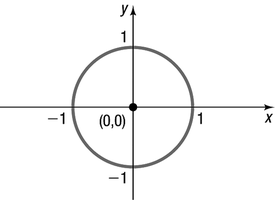
Graphing a Circle
To graph a circle, identify its center (h, k) and radius r from the equation. Plot the center and use the radius to draw the circle.
Center: (h, k)
Radius: r
Example: Graph the circle : Center: (4, -2), Radius: 5
Finding the Intercepts of a Circle
To find the x- and y-intercepts of a circle, set y = 0 or x = 0 in the equation and solve for the other variable.
x-intercepts: Set y = 0 and solve for x.
y-intercepts: Set x = 0 and solve for y.
Example: For , x-intercepts are at (5, 0) and (-5, 0); y-intercepts are at (0, 5) and (0, -5).
General Form of the Equation of a Circle
The general form of a circle's equation is:
Usually, A = 1 for circles, so:
To convert the general form to standard form, use completing the square for both x and y terms.
Completing the Square Example
Given :
Group x and y terms:
Complete the square for each group:
Now, the center is (4, -2) and the radius is 2.
Classification of General Form Equations
Depending on the values, the general form can represent:
A circle (if radius squared is positive)
A single point (if radius squared is zero)
No graph (if radius squared is negative)
Summary Table: Forms of Circle Equations
Form | Equation | Center | Radius |
|---|---|---|---|
Standard Form | (h, k) | r | |
Origin Form | (0, 0) | r | |
Unit Circle | (0, 0) | 1 | |
General Form | Completing the square required | Completing the square required |
Additional info: Academic context and examples were added to clarify the process of completing the square and interpreting the general form of a circle's equation.
