 Back
BackTransformations of Functions: Precalculus Study Guide
Study Guide - Smart Notes
 Tailored notes based on your materials, expanded with key definitions, examples, and context.
Section 1.6: Transformations of Functions
Graphs of Common Functions
Understanding the basic graphs of common functions is essential for analyzing transformations. These functions serve as the foundation for shifts, reflections, stretches, and shrinks.
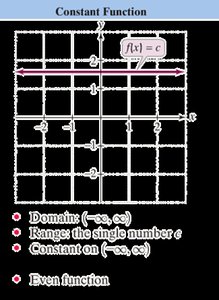
Constant Function: $f(x) = c$ - Domain: $(-\infty, \infty)$ - Range: The single number $c$ - Constant on $(-\infty, \infty)$ - Even function
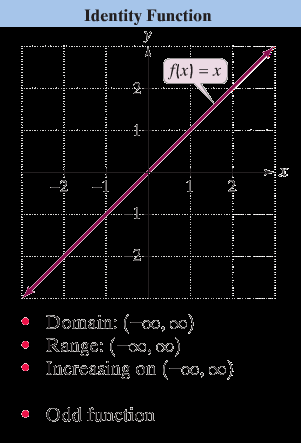
Identity Function: $f(x) = x$ - Domain: $(-\infty, \infty)$ - Range: $(-\infty, \infty)$ - Increasing on $(-\infty, \infty)$ - Odd function
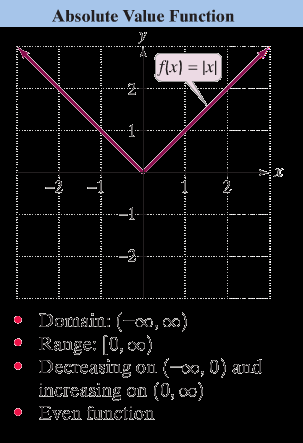
Absolute Value Function: $f(x) = |x|$ - Domain: $(-\infty, \infty)$ - Range: $[0, \infty)$ - Decreasing on $(-\infty, 0)$, increasing on $(0, \infty)$ - Even function
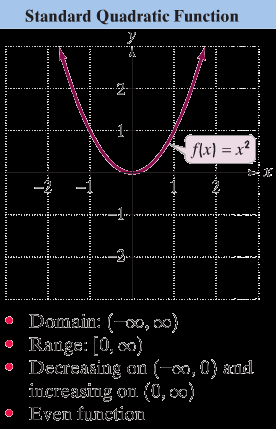
Standard Quadratic Function: $f(x) = x^2$ - Domain: $(-\infty, \infty)$ - Range: $[0, \infty)$ - Decreasing on $(-\infty, 0)$, increasing on $(0, \infty)$ - Even function
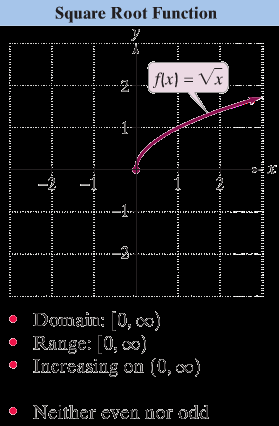
Square Root Function: $f(x) = \sqrt{x}$ - Domain: $[0, \infty)$ - Range: $[0, \infty)$ - Increasing on $(0, \infty)$ - Neither even nor odd
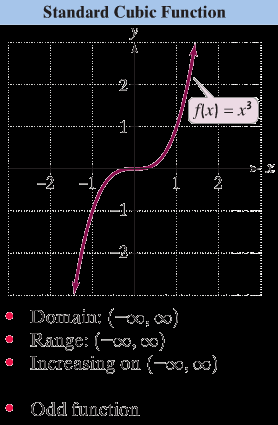
Standard Cubic Function: $f(x) = x^3$ - Domain: $(-\infty, \infty)$ - Range: $(-\infty, \infty)$ - Increasing on $(-\infty, \infty)$ - Odd function
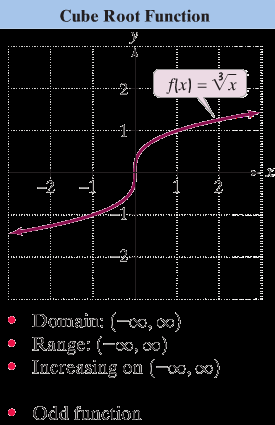
Cube Root Function: $f(x) = \sqrt[3]{x}$ - Domain: $(-\infty, \infty)$ - Range: $(-\infty, \infty)$ - Increasing on $(-\infty, \infty)$ - Odd function
Shifts
Vertical Shifts
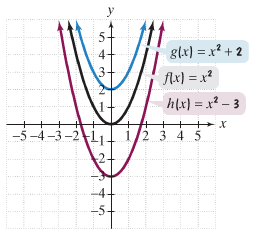
Vertical shifts move the graph up or down. The transformation $y = f(x) + c$ shifts the graph of $y = f(x)$ up $c$ units, while $y = f(x) - c$ shifts it down $c$ units.
Example: $f(x) = x^2$, $g(x) = x^2 + 2$, $h(x) = x^2 - 3$ - $g(x)$ is shifted up 2 units. - $h(x)$ is shifted down 3 units.
Horizontal Shifts
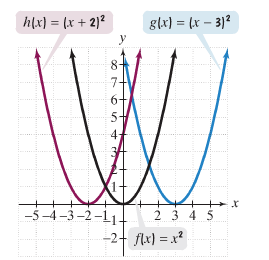
Horizontal shifts move the graph left or right. The transformation $y = f(x + c)$ shifts the graph of $y = f(x)$ left $c$ units, while $y = f(x - c)$ shifts it right $c$ units. The direction is opposite to the sign inside the function.
Example: $f(x) = x^2$, $g(x) = (x + 2)^2$, $h(x) = (x - 3)^2$ - $g(x)$ is shifted left 2 units. - $h(x)$ is shifted right 3 units.
Reflections of Graphs
Reflection about the x-axis
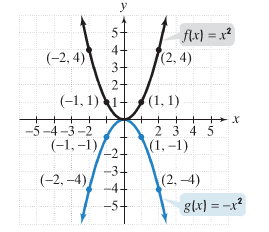
Reflecting a graph about the x-axis changes the sign of all y-values. The transformation $y = -f(x)$ reflects $y = f(x)$ about the x-axis.
Example: $f(x) = x^2$, $g(x) = -x^2$ - Each point $(x, y)$ becomes $(x, -y)$.
Reflection about the y-axis
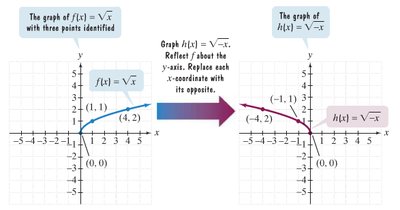
Reflecting a graph about the y-axis changes the sign of all x-values. The transformation $y = f(-x)$ reflects $y = f(x)$ about the y-axis.
Example: $f(x) = \sqrt{x}$, $h(x) = \sqrt{-x}$ - Each point $(x, y)$ becomes $(-x, y)$.
Stretching and Shrinking
Vertical Stretching and Shrinking
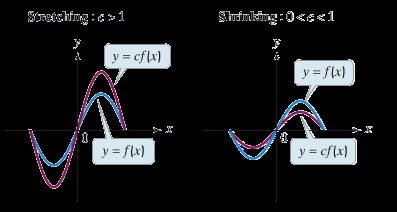
Vertical stretching multiplies all y-values by $c$ ($c > 1$), making the graph taller. Vertical shrinking multiplies all y-values by $c$ ($0 < c < 1$), making the graph shorter.
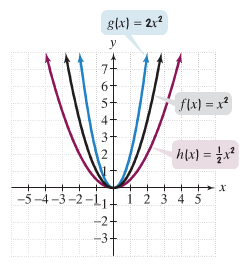
Example: $f(x) = x^2$, $g(x) = 2x^2$, $h(x) = \frac{1}{2}x^2$ - $g(x)$ is vertically stretched. - $h(x)$ is vertically shrunk.
General illustration:
Horizontal Stretching and Shrinking
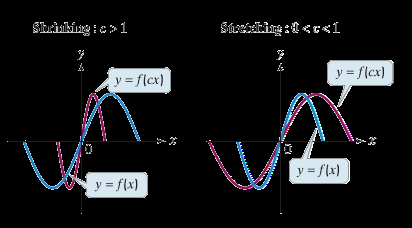
Horizontal stretching divides all x-values by $c$ ($0 < c < 1$), making the graph wider. Horizontal shrinking divides all x-values by $c$ ($c > 1$), making the graph narrower.
General illustration:
Example: $g(x) = f(2x)$ is a horizontal shrink by a factor of 2. $h(x) = f(\frac{1}{2}x)$ is a horizontal stretch by a factor of 2.
Sequences of Transformations
Order of Transformations
When multiple transformations are applied to a function, the order matters. Typically, transformations are applied in the following sequence:
Horizontal shifting
Horizontal stretching/shrinking and reflection
Vertical stretching/shrinking and reflection
Vertical shifting
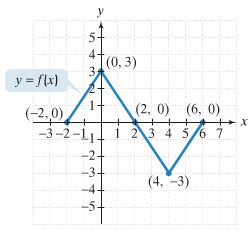
Example: $g(x) = 2(x-1)^2 + 3$ - Shift right by 1 - Vertical stretch by 2 - Shift up by 3
Summary Table: Types of Transformations
Transformation | Equation | Effect |
|---|---|---|
Vertical Shift | $y = f(x) + c$ | Up $c$ units |
Vertical Shift | $y = f(x) - c$ | Down $c$ units |
Horizontal Shift | $y = f(x + c)$ | Left $c$ units |
Horizontal Shift | $y = f(x - c)$ | Right $c$ units |
Vertical Stretch | $y = c f(x)$, $c > 1$ | Taller |
Vertical Shrink | $y = c f(x)$, $0 < c < 1$ | Shorter |
Horizontal Stretch | $y = f(cx)$, $0 < c < 1$ | Wider |
Horizontal Shrink | $y = f(cx)$, $c > 1$ | Narrower |
Reflection x-axis | $y = -f(x)$ | Mirror over x-axis |
Reflection y-axis | $y = f(-x)$ | Mirror over y-axis |
Key Formulas
Vertical Shift: $y = f(x) + c$
Horizontal Shift: $y = f(x + c)$
Vertical Stretch/Shrink: $y = c f(x)$
Horizontal Stretch/Shrink: $y = f(cx)$
Reflection about x-axis: $y = -f(x)$
Reflection about y-axis: $y = f(-x)$
Additional info: The study of transformations is foundational for understanding more advanced topics in precalculus, such as composition of functions, inverse functions, and graphing complex equations.
