 Back
BackTrigonometric Functions: Angles, Right Triangles, and the Unit Circle
Study Guide - Smart Notes
 Tailored notes based on your materials, expanded with key definitions, examples, and context.
Trigonometric Functions
Angles, Arc Length, and Circular Motion
Trigonometry begins with the study of angles and their measurement, which is foundational for understanding circular motion and the trigonometric functions. This section introduces the definitions, properties, and applications of angles, including their measurement in degrees and radians, and their use in describing circular motion.
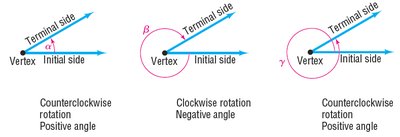
Angle: Formed by two rays with a common vertex. The initial side is fixed, and the terminal side is rotated to form the angle.
Positive Angle: Formed by counterclockwise rotation.
Negative Angle: Formed by clockwise rotation.
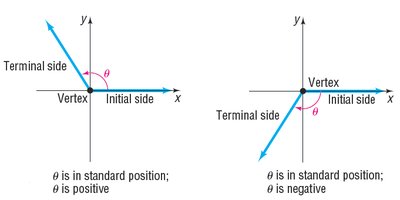
Standard Position: An angle is in standard position if its vertex is at the origin and its initial side lies along the positive x-axis.
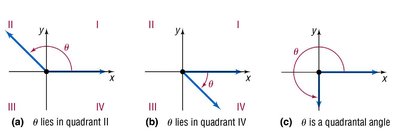
Quadrantal Angle: An angle whose terminal side lies on the x-axis or y-axis.
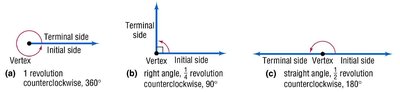
Degree Measure: One degree (1°) is 1/360 of a full revolution. Key angles include 90° (right angle), 180° (straight angle), and 360° (complete revolution).
Radians: The radian is the standard unit of angular measure. One revolution is radians, and radians.
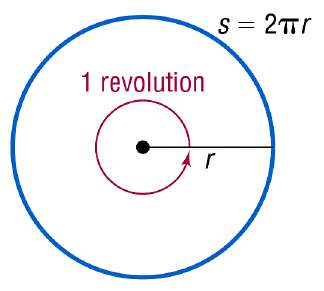
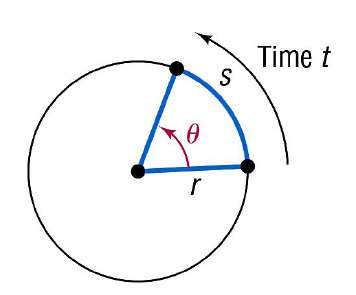
Arc Length: For a circle of radius and central angle (in radians), the arc length is given by .
Area of a Sector: The area of a sector with radius and angle (in radians) is .
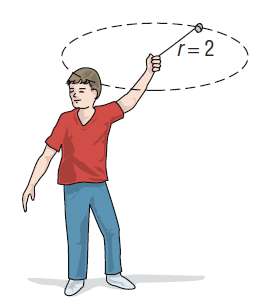
Linear Speed: If an object travels a distance in time along a circle, its linear speed is .
Angular Speed: The angular speed is , where is in radians.
Relationship: .
Right Triangle Trigonometry
Trigonometric Functions of Acute Angles
Trigonometric functions are defined using right triangles. For an acute angle in a right triangle with sides (adjacent), (opposite), and hypotenuse :
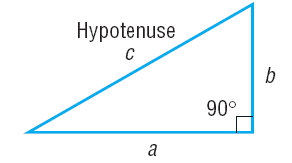
Sine:
Cosine:
Tangent:
Cosecant:
Secant:
Cotangent:
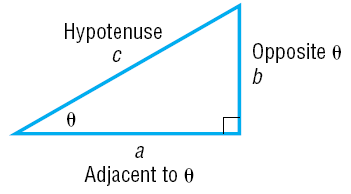


Mnemonic: SOH-CAH-TOA helps remember the definitions: Sine = Opposite/Hypotenuse, Cosine = Adjacent/Hypotenuse, Tangent = Opposite/Adjacent.
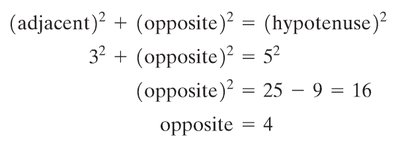
Finding Trigonometric Values from One Function
If one trigonometric function value is known for an acute angle, the remaining values can be found using the Pythagorean Theorem and trigonometric identities.
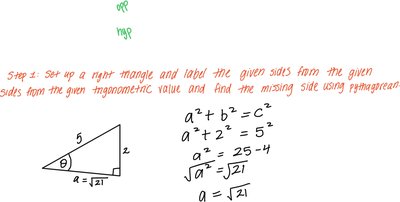
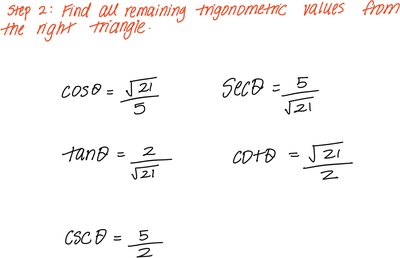
Method 1: Draw a right triangle, assign side lengths, use the Pythagorean Theorem to find the missing side, and compute all six functions.
Method 2: Use trigonometric identities to solve for the unknown values.

Trigonometric Functions: Unit Circle Approach
The Unit Circle and Trigonometric Functions
The unit circle is a circle of radius 1 centered at the origin. The coordinates of a point on the unit circle corresponding to an angle (in radians) are used to define the trigonometric functions for all real numbers.
Sine:
Cosine:
Tangent: ,
Cosecant: ,
Secant: ,
Cotangent: ,
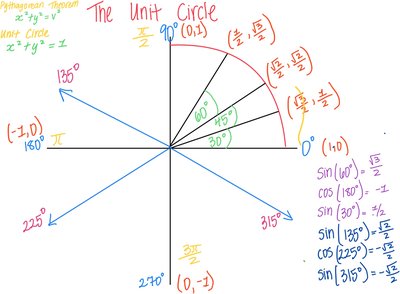
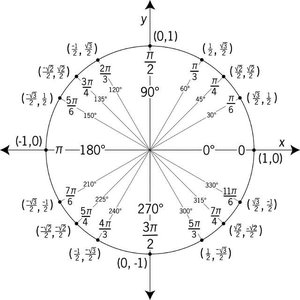
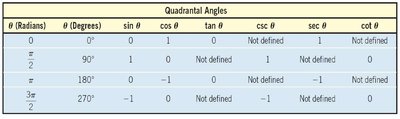
Quadrantal Angles and Special Values
Quadrantal angles are multiples of ( radians). The trigonometric functions at these angles have special values.
(Radians) | (Degrees) | ||||||
|---|---|---|---|---|---|---|---|
0 | 0° | 1 | 0 | 0 | Not defined | 1 | Not defined |
90° | 0 | 1 | Not defined | 1 | Not defined | 0 | |
180° | –1 | 0 | 0 | Not defined | –1 | Not defined | |
270° | 0 | –1 | Not defined | –1 | Not defined | 0 |
Trigonometric Identities and Properties
Fundamental Identities

Even-Odd Properties
Applications and Examples
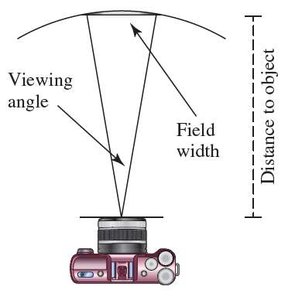
Field of View Example
For small angles, the arc length subtended by a central angle is approximately equal to the chord length. This is used in applications such as determining the field width of a camera lens.
Finding All Trigonometric Functions from One Value
Given one trigonometric value, use the Pythagorean Theorem and identities to find the remaining five functions. For example, if and is acute, construct a right triangle, find the missing side, and compute all functions.
Summary Table: Trigonometric Functions in Right Triangles
Function Name | Abbreviation | Value |
|---|---|---|
Sine of | ||
Cosine of | ||
Tangent of | ||
Cosecant of | ||
Secant of | ||
Cotangent of |
Additional info: This guide covers the foundational concepts of trigonometric functions, including their definitions via right triangles and the unit circle, key identities, and methods for finding all trigonometric values from one known value. Applications such as circular motion and field of view are included to illustrate practical uses.
