 Back
BackTrigonometric Functions Extended: Angles, Unit Circle, and Periodicity
Study Guide - Smart Notes
 Tailored notes based on your materials, expanded with key definitions, examples, and context.
Trigonometric Functions Extended
Angles and Their Representation
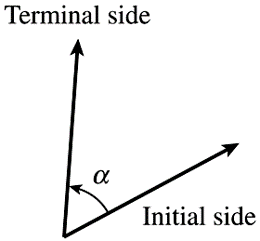
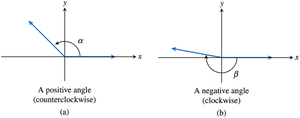
In trigonometry, angles are not just static geometric objects but are viewed dynamically as rotations. An angle is formed by rotating a ray (the initial side) about its endpoint (the vertex) to a new position (the terminal side). The measure of an angle quantifies the amount of rotation from the initial side to the terminal side. Positive angles are generated by counterclockwise rotations, while negative angles are generated by clockwise rotations.
Initial Side: The starting position of the angle.
Terminal Side: The position after rotation.
Vertex: The common endpoint of the initial and terminal sides.
Standard Position: The angle's vertex is at the origin, and its initial side lies along the positive x-axis.
Coterminal Angles
Coterminal angles are angles that share the same initial and terminal sides but have different measures. They are found by adding or subtracting integer multiples of (or radians) to a given angle.
Formula: If is an angle, then (or ) for any integer gives coterminal angles.
Example: and are coterminal because .
Trigonometric Functions of Any Angle
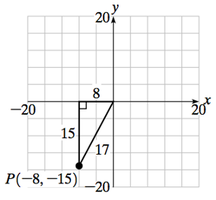
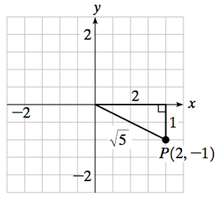
Trigonometric functions can be defined for any angle, not just those in right triangles. For an angle in standard position, and a point on its terminal side (other than the origin), the distance from to the origin is . The six trigonometric functions are defined as follows:
Sine:
Cosine:
Tangent:
Cosecant:
Secant:
Cotangent:
Example: If is on the terminal side of , then .
Evaluating Trig Functions of Nonquadrantal Angles
To evaluate trigonometric functions for angles not aligned with the axes (nonquadrantal), follow these steps:
Draw the angle in standard position, placing the terminal side in the correct quadrant.
Label a point on the terminal side.
Draw a perpendicular from to the x-axis to form a reference triangle.
Use the triangle's sides to determine the coordinates of , assigning signs based on the quadrant.
Apply the definitions to find the six trigonometric functions.
Quadrantal Angles
Quadrantal angles are those whose terminal sides lie along the coordinate axes (e.g., , , , ). For these angles, the reference triangle does not exist, but it is easy to select a point on the axis.
Example: For , ; for , .
Using One Trig Ratio to Find the Others
If one trigonometric ratio is known, the others can be determined by constructing a reference triangle and using the Pythagorean theorem. The signs of the ratios depend on the quadrant in which the terminal side lies.
Example: If and is in the second quadrant, then , , etc.
The Unit Circle and Trigonometric Functions of Real Numbers
The Unit Circle
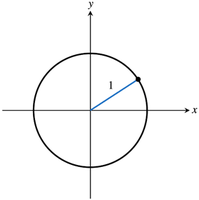
The unit circle is a circle of radius 1 centered at the origin. It is fundamental in defining trigonometric functions for all real numbers.
Equation:
Key property: Any point on the unit circle satisfies this equation.
Wrapping Function
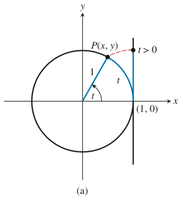
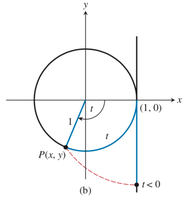
The wrapping function maps real numbers (arc lengths) onto the unit circle. The arc length corresponds to a point on the circle, where $t$ is measured from along the circumference.
For : Move counterclockwise.
For : Move clockwise.
Trigonometric Functions of Real Numbers (Circular Functions)
For any real number , the point on the unit circle corresponding to $t$ gives the values of the trigonometric functions:
(where )
These are called circular functions because they are defined using the unit circle.
Periodic Functions
A function is periodic if there exists a positive number such that for all in the domain. The smallest such $c$ is called the period of the function.
Example: The sine and cosine functions have period .
The 16-Point Unit Circle
The 16-point unit circle is a diagram showing key angles (in degrees and radians) and their corresponding coordinates on the unit circle. This is essential for evaluating trigonometric functions at standard angles.
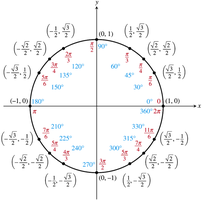
Angle (Degrees) | Angle (Radians) | Coordinates (x, y) |
|---|---|---|
0° | 0 | (1, 0) |
90° | (0, 1) | |
180° | (-1, 0) | |
270° | (0, -1) | |
360° | (1, 0) | |
45° | ||
135° | ||
225° | ||
315° |
