 Back
BackTrigonometric Functions of Acute Angles: Exact Values, Calculator Approximations, and Applications
Study Guide - Smart Notes
 Tailored notes based on your materials, expanded with key definitions, examples, and context.
Trigonometric Functions of Acute Angles
Introduction
This section explores the computation of trigonometric function values for acute angles, both exactly and approximately, and demonstrates their application in solving real-world problems involving right triangles. The focus is on understanding the relationships between the sides and angles of right triangles and using trigonometric identities and calculators for practical computations.
Computing Exact Values of Trigonometric Functions
Special Right Triangles
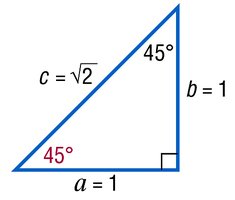
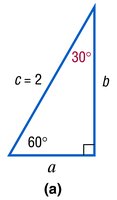
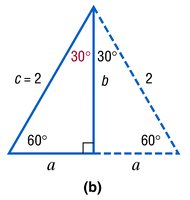
Exact values of trigonometric functions for certain angles can be found using properties of special right triangles, such as the 45°-45°-90° and 30°-60°-90° triangles.
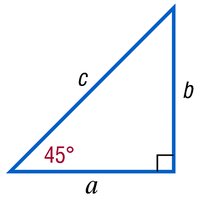
45°-45°-90° Triangle: Both legs are equal, and the hypotenuse is \( \sqrt{2} \) times the length of a leg.
30°-60°-90° Triangle: The sides are in the ratio 1 : \( \sqrt{3} \) : 2.
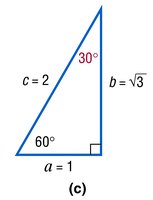
Using the Pythagorean Theorem
The Pythagorean Theorem, \( a^2 + b^2 = c^2 \), is used to determine unknown side lengths in right triangles, which are then used to compute trigonometric ratios.
Trigonometric Ratios for Special Angles
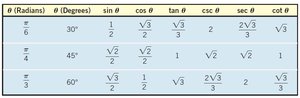
The six trigonometric functions (sine, cosine, tangent, cosecant, secant, cotangent) for 30°, 45°, and 60° can be summarized as follows:
\( \theta \) (Radians) | \( \theta \) (Degrees) | \( \sin \theta \) | \( \cos \theta \) | \( \tan \theta \) | \( \csc \theta \) | \( \sec \theta \) | \( \cot \theta \) |
|---|---|---|---|---|---|---|---|
\( \frac{\pi}{6} \) | 30° | \( \frac{1}{2} \) | \( \frac{\sqrt{3}}{2} \) | \( \frac{1}{\sqrt{3}} \) | 2 | \( \frac{2}{\sqrt{3}} \) | \( \sqrt{3} \) |
\( \frac{\pi}{4} \) | 45° | \( \frac{\sqrt{2}}{2} \) | \( \frac{\sqrt{2}}{2} \) | 1 | \( \sqrt{2} \) | \( \sqrt{2} \) | 1 |
\( \frac{\pi}{3} \) | 60° | \( \frac{\sqrt{3}}{2} \) | \( \frac{1}{2} \) | \( \sqrt{3} \) | \( \frac{2}{\sqrt{3}} \) | 2 | \( \frac{1}{\sqrt{3}} \) |
Calculator Approximations of Trigonometric Functions
Using a Calculator
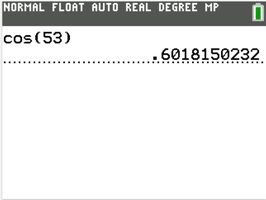
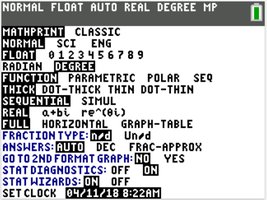
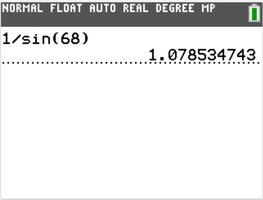
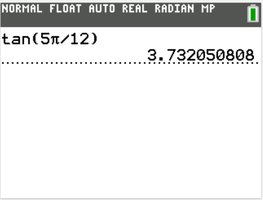
Trigonometric functions can be approximated using a scientific calculator. It is important to set the calculator to the correct mode (degrees or radians) depending on the angle's unit.
Degree Mode: Used for angles measured in degrees.
Radian Mode: Used for angles measured in radians.
For functions like cosecant, secant, and cotangent, use their reciprocal identities (e.g., \( \csc \theta = 1/\sin \theta \)).
Applications of Trigonometric Functions in Right Triangles
Modeling and Solving Applied Problems
Trigonometric functions are widely used to solve real-world problems involving right triangles, such as determining heights, distances, and optimal dimensions.
Example: Constructing a Rain Gutter
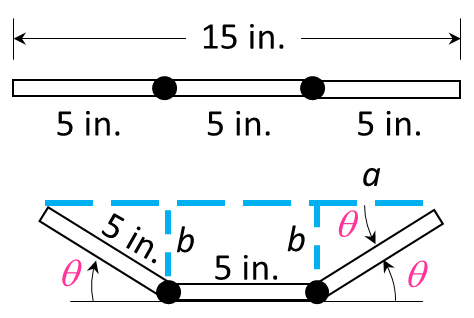
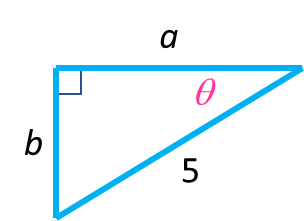
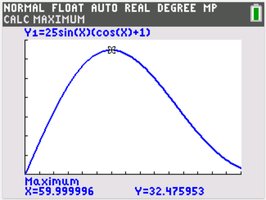
A rain gutter is formed by bending the sides of an aluminum sheet at an angle \( \theta \). The area of the opening can be modeled as a function of \( \theta \):
Area formula:
Maximum area occurs at \( \theta = 60° \), with square inches.
Example: Finding the Width of a River
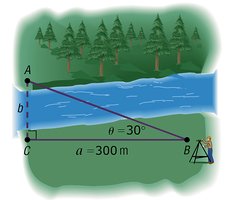
By measuring a baseline and an angle, the width of a river can be found using the tangent function:
Given: Baseline \( a = 300 \) m, angle \( \theta = 30° \)
Width: meters
Example: Finding the Height of a Cloud
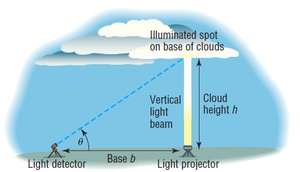
Meteorologists use a ceilometer to determine cloud height by measuring the angle of elevation and the horizontal distance:
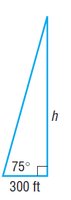
Given: Distance = 275 ft, angle = 75°
Height: ft
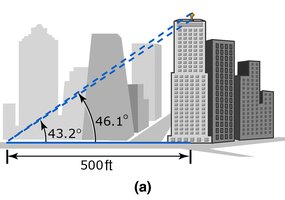
Example: Finding the Height of a Statue on a Building
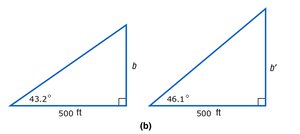
By measuring angles of elevation to the base and top of a statue from a known distance, the height of the statue can be determined:
Given: Distance = 500 ft, angles = 43.2° (base), 46.1° (top)
Height of statue: , where ,
Summary
Exact values of trigonometric functions for special angles can be found using properties of special right triangles.
Calculators are useful for approximating trigonometric values, but correct mode selection is essential.
Trigonometric functions are powerful tools for solving applied problems involving right triangles in various real-world contexts.
