 Back
BackTrigonometric Functions of Acute Angles: Right Triangle Approach
Study Guide - Smart Notes
 Tailored notes based on your materials, expanded with key definitions, examples, and context.
Chapter 6: The Trigonometric Functions
Section 6.1: Trigonometric Functions of Acute Angles
This section introduces the six trigonometric functions, their definitions using right triangles, and their values for specific acute angles. It also covers the relationships between trigonometric functions, the concept of cofunctions, and practical applications.
Acute Angles and Right Triangles
Definition of Acute Angles
An acute angle is an angle whose measure is greater than 0° and less than 90°. Greek letters such as θ (theta), α (alpha), and β (beta) are commonly used to denote angles in mathematics.
Parts of a Right Triangle
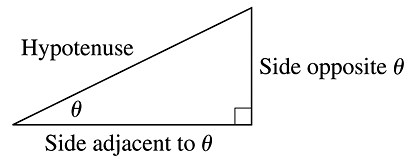
In a right triangle, the side opposite the right angle is called the hypotenuse. The other two sides are referenced relative to the acute angle: the side opposite θ and the side adjacent to θ.
Trigonometric Ratios
Definition of the Six Trigonometric Functions
The six trigonometric functions are defined using the ratios of the sides of a right triangle:
Sine (sin θ): Ratio of the length of the side opposite θ to the hypotenuse.
Cosine (cos θ): Ratio of the length of the side adjacent to θ to the hypotenuse.
Tangent (tan θ): Ratio of the length of the side opposite θ to the side adjacent to θ.
Cosecant (csc θ): Reciprocal of sine: hypotenuse divided by side opposite θ.
Secant (sec θ): Reciprocal of cosine: hypotenuse divided by side adjacent to θ.
Cotangent (cot θ): Reciprocal of tangent: side adjacent to θ divided by side opposite θ.
Formulas:
Examples: Finding Trigonometric Function Values
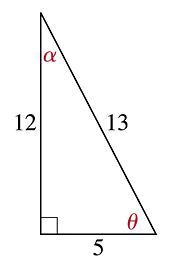
Example: Right Triangle with Sides 5, 12, 13
Given a right triangle with sides 5 (adjacent), 12 (opposite), and 13 (hypotenuse), find the six trigonometric function values for angle θ.
Reciprocal Relationships
Reciprocal Functions
Each trigonometric function has a reciprocal function:
and
and
and
For example, .
Similar Triangles and Trigonometric Functions
Properties of Similar Triangles
Triangles are similar if their corresponding angles are equal. In similar triangles, the ratios of corresponding sides are equal, so the trigonometric function values for a given angle are the same regardless of the triangle's size.
Key Point: Trigonometric function values depend only on the measure of the angle, not the size of the triangle.
Function Values of 30°, 45°, and 60°
Special Right Triangles
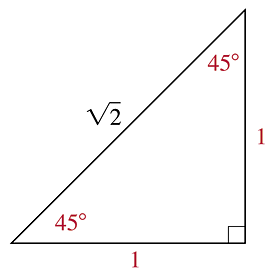
For a 45°-45°-90° triangle (isosceles), both legs are equal and the hypotenuse is times the leg length.
For a 30°-60°-90° triangle, the sides are in the ratio 1 : : 2.
Applications of Trigonometric Functions
Example: Height of a Fireworks Display
A 6-inch shell launched at an angle of 60° travels a horizontal distance of 390 feet. To find the height, use the tangent ratio:
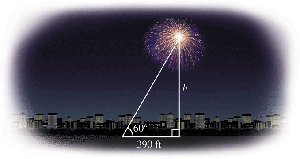
feet
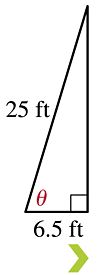
Example: Ladder Safety
A ladder is extended to 25 feet and positioned 6.5 feet from the wall. To find the angle θ with the ground, use the cosine function:
Function Values of Any Acute Angle
Using a Calculator
To find trigonometric function values for any acute angle, use a calculator in degree mode. Angles may be given in degrees, minutes, and seconds, or in decimal degrees.
Example:
Example:
Example:
Cofunctions and Complements
Definition of Cofunctions
Two angles are complementary if their sum is 90°. In a right triangle, the two acute angles are always complementary. The trigonometric function values of complementary angles are related as cofunctions.
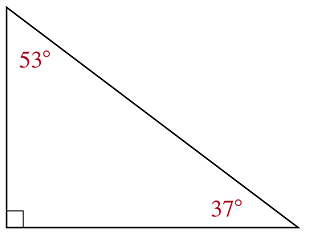
These relationships are called cofunction identities.
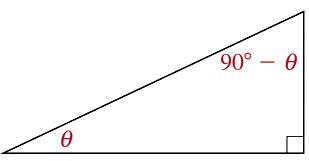
Summary Table: Trigonometric Functions and Cofunctions
Function | Cofunction Identity |
|---|---|
Practice Example
Finding Trigonometric Function Values
Given an angle, such as 72°, use a calculator or triangle ratios to find all six trigonometric function values.
Additional info: Values can be found using a scientific calculator or by constructing a right triangle with the given angle.
