 Back
BackTrigonometric Functions of Any Angle and Reference Angles
Study Guide - Smart Notes
 Tailored notes based on your materials, expanded with key definitions, examples, and context.
Trigonometric Functions of Any Angle
Definitions and Fundamental Concepts
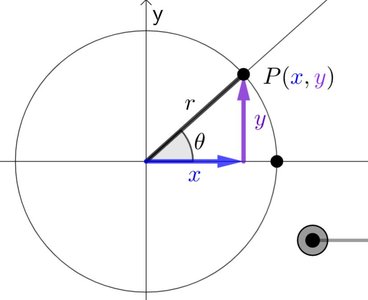
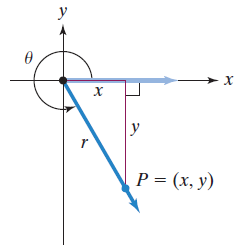
Trigonometric functions can be defined for any angle, not just acute angles in right triangles. For an angle θ in standard position, with a point P(x, y) on its terminal side and r = \sqrt{x^2 + y^2}, the six trigonometric functions are defined as follows:
sin θ = \frac{y}{r}
cos θ = \frac{x}{r}
tan θ = \frac{y}{x}
csc θ = \frac{r}{y}
sec θ = \frac{r}{x}
cot θ = \frac{x}{y}
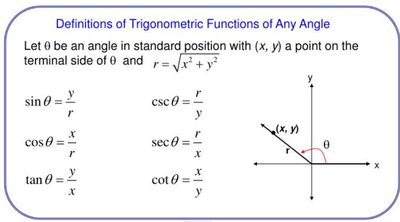
These definitions allow us to evaluate trigonometric functions for any angle, including those whose terminal sides lie in different quadrants.
Evaluating Trigonometric Functions for a Given Point
Given a point P(x, y) on the terminal side of θ, you can find all six trigonometric functions by first calculating r and then applying the definitions above.
Example: Let P = (1, –3). Find x, y, r, and each trigonometric function of θ.
x = 1, y = –3
r = \sqrt{1^2 + (-3)^2} = \sqrt{1 + 9} = \sqrt{10}
sin θ = \frac{-3}{\sqrt{10}}
cos θ = \frac{1}{\sqrt{10}}
tan θ = \frac{-3}{1} = -3
csc θ = \frac{\sqrt{10}}{-3}
sec θ = \frac{\sqrt{10}}{1} = \sqrt{10}
cot θ = \frac{1}{-3} = -\frac{1}{3}
Trigonometric Functions of Quadrantal Angles
Definition and Evaluation
Quadrantal angles are angles whose terminal sides lie on the x- or y-axis (0°, 90°, 180°, 270°, etc.). The values of trigonometric functions at these angles can be found by considering the coordinates of the corresponding points on the unit circle.
At θ = 0° (0 radians): P = (1, 0)
cos 0° = 1
csc 0° is undefined (since y = 0)
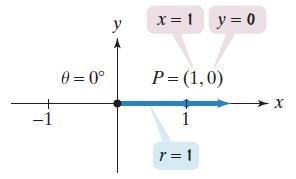
At θ = 90° (\frac{\pi}{2} radians): P = (0, 1)
cos 90° = 0
csc 90° = 1
At θ = 180° (\pi radians): P = (–1, 0)
cos 180° = –1
csc 180° is undefined (since y = 0)
At θ = 270° (\frac{3\pi}{2} radians): P = (0, –1)
cos 270° = 0
csc 270° = –1
Signs of Trigonometric Functions in Each Quadrant
Understanding Signs by Quadrant
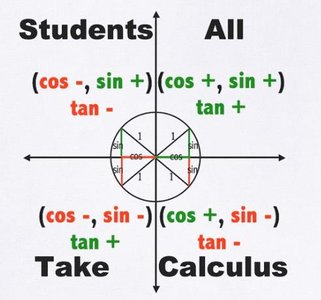
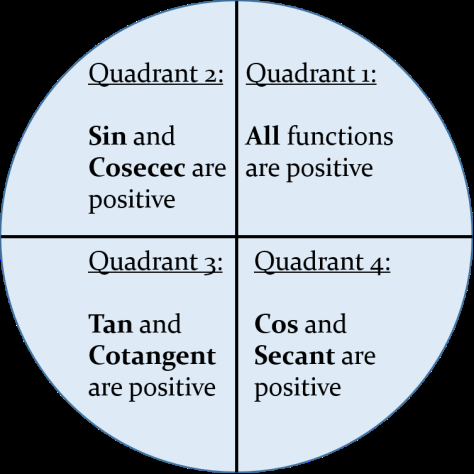
The sign of a trigonometric function depends on the quadrant in which the terminal side of the angle lies. The mnemonic "All Students Take Calculus" helps remember which functions are positive in each quadrant:
Quadrant I: All functions are positive
Quadrant II: Sine and cosecant are positive
Quadrant III: Tangent and cotangent are positive
Quadrant IV: Cosine and secant are positive
Determining the Quadrant from Function Signs
Given the signs of sine, cosine, or tangent, you can determine the quadrant in which the angle lies:
If sin θ < 0 and cos θ > 0, θ is in Quadrant IV.
If sin θ > 0 and cos θ < 0, θ is in Quadrant II.
If tan θ < 0 and cos θ > 0, θ is in Quadrant IV.
If sin θ > 0 and tan θ > 0, θ is in Quadrant I.
If sin θ < 0 and cos θ < 0, θ is in Quadrant III.
Reference Angles
Definition and Properties
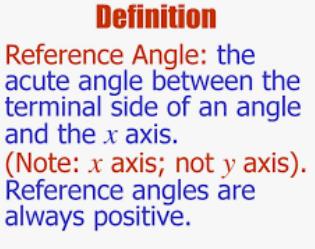
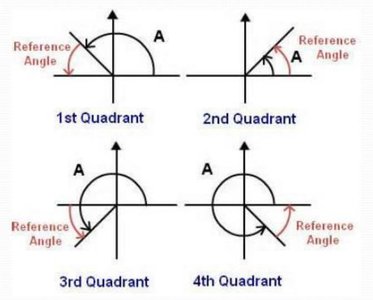
A reference angle is the acute angle formed between the terminal side of a given angle and the x-axis. Reference angles are always positive and are used to simplify the evaluation of trigonometric functions for any angle.
Finding Reference Angles
The reference angle θ' for an angle θ depends on the quadrant:
Quadrant | Reference Angle Formula |
|---|---|
I | θ' = θ |
II | θ' = 180° – θ |
III | θ' = θ – 180° |
IV | θ' = 360° – θ |
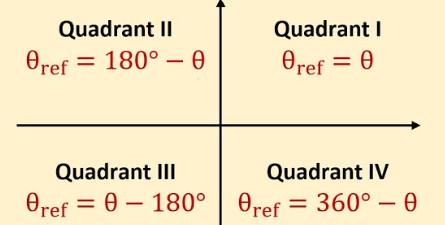
Example: Find the reference angle for θ = 210°.
θ is in Quadrant III, so θ' = 210° – 180° = 30°.
Example: θ = –240°
Add 360°: –240° + 360° = 120°, which is in Quadrant II. θ' = 180° – 120° = 60°.
Example: θ = \frac{7\pi}{4}
θ is in Quadrant IV, so θ' = 2\pi – \frac{7\pi}{4} = \frac{8\pi}{4} – \frac{7\pi}{4} = \frac{\pi}{4}.
Reference Angles for Angles Greater Than 360° or Less Than –360°
For angles outside the range [0°, 360°], first find a coterminal angle by adding or subtracting multiples of 360° (or 2π radians) until the angle is within one full rotation. Then, use the quadrant rules above to find the reference angle.
Example: θ = 665°
665° – 360° = 305°, which is in Quadrant IV. θ' = 360° – 305° = 55°.
Example: θ = \frac{15\pi}{4}
\frac{15\pi}{4} – 2\pi = \frac{15\pi}{4} – \frac{8\pi}{4} = \frac{7\pi}{4}, which is in Quadrant IV. θ' = 2\pi – \frac{7\pi}{4} = \frac{\pi}{4}.
Using Reference Angles to Evaluate Trigonometric Functions
The value of a trigonometric function for any angle θ is the same as the value for its reference angle θ', except possibly for the sign, which is determined by the quadrant in which θ lies.
Procedure:
Find the reference angle θ'.
Evaluate the trigonometric function for θ'.
Assign the correct sign based on the quadrant of θ.
Example: Find sin 300°.
Reference angle: 360° – 300° = 60°. sin 60° = \frac{\sqrt{3}}{2}. 300° is in Quadrant IV, where sine is negative, so sin 300° = –\frac{\sqrt{3}}{2}.
Example: Find tan \frac{5\pi}{4}.
Reference angle: \frac{5\pi}{4} – \pi = \frac{\pi}{4}. tan \frac{\pi}{4} = 1. \frac{5\pi}{4} is in Quadrant III, where tangent is positive, so tan \frac{5\pi}{4} = 1.
