 Back
BackTrigonometric Functions of Any Angle: Signs, Reference Angles, and Calculator Use
Study Guide - Smart Notes
 Tailored notes based on your materials, expanded with key definitions, examples, and context.
Trigonometric Functions of Any Angle
Angles in Standard Position
An angle in standard position has its vertex at the origin of the coordinate plane and its initial side along the positive x-axis. The terminal side is determined by the angle's measure, and the coordinates (x, y) of a point on the terminal side are used to define trigonometric functions for any angle. The distance from the origin to the point (x, y) is denoted as r, where and is always positive.
Trigonometric Functions Defined for Any Angle
For an angle in standard position with a point (x, y) on its terminal side and , the six trigonometric functions are defined as:
Sine:
Cosine:
Tangent:
Cosecant:
Secant:
Cotangent:
These definitions allow the evaluation of trigonometric functions for any angle, not just acute angles in right triangles.
Finding Trigonometric Functions from a Point
Given a point (x, y) on the terminal side of an angle, you can find all six trigonometric functions by first calculating , then applying the definitions above.
Example: For the point (-8, 15): , , , , ,
Signs of Trigonometric Functions in Each Quadrant
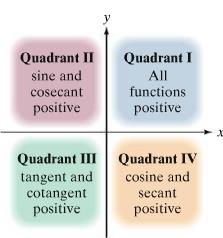
The sign of each trigonometric function depends on the quadrant in which the terminal side of the angle lies. The mnemonic "All Students Take Calculus" helps remember which functions are positive in each quadrant:
Quadrant I: All functions are positive.
Quadrant II: Sine and cosecant are positive.
Quadrant III: Tangent and cotangent are positive.
Quadrant IV: Cosine and secant are positive.
Reference Angles
A reference angle is the acute angle formed by the terminal side of a given angle and the x-axis. Reference angles are always positive and less than 90°, and they are used to find the values of trigonometric functions for angles outside the first quadrant by relating them to their corresponding acute angles.
Example: The reference angle for 300° is 60°, since 300° is in Quadrant IV and .
Trigonometric Functions for Angles on the Axes
When the terminal side of an angle lies on one of the axes, the point on the unit circle is (1, 0), (0, 1), (-1, 0), or (0, -1). In these cases, , and the trigonometric functions take on values of 0, 1, or -1.
Example: For , the point is (0, 1): , , is undefined.
Using a Calculator to Evaluate Trigonometric Functions
To evaluate trigonometric functions for arbitrary angles, use a scientific calculator. Ensure the calculator is set to the correct mode (degrees or radians) and round answers to four decimal places as required.
Example:
Example:
Finding Angles Given a Trigonometric Value
To find angles that correspond to a given trigonometric value, use the inverse trigonometric functions and consider all possible solutions within the specified interval (e.g., or radians). Remember to check which quadrants the solutions lie in, based on the sign of the value.
Example: Find such that for : and (Quadrants III and IV).
