 Back
BackUnit Circle Approach and Properties of Trigonometric Functions
Study Guide - Smart Notes
 Tailored notes based on your materials, expanded with key definitions, examples, and context.
Trigonometric Functions and the Unit Circle
Definition of Trigonometric Functions Using the Unit Circle
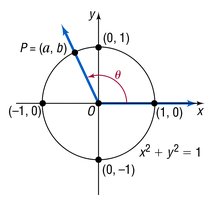
The six trigonometric functions can be defined using the unit circle, which is a circle of radius 1 centered at the origin in the coordinate plane. For a real number t, let P = (a, b) be the point on the unit circle corresponding to t (where t is the length of the arc from (1, 0) to P, measured in radians).
Sine: (the y-coordinate of P)
Cosine: (the x-coordinate of P)
Tangent: , provided
Cosecant: , provided
Secant: , provided
Cotangent: , provided
Trigonometric Functions of an Angle
If radians, then the six trigonometric functions of the angle are defined as:
Finding Trigonometric Function Values Using the Unit Circle
Example: Using a Point on the Circle
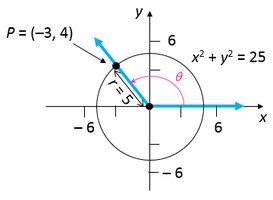
Given a point on the terminal side of an angle in standard position, and the circle , the trigonometric functions are:
,
,
,
,
Example: If is on the circle , then .
Special Triangles and the Unit Circle
45-45-90 and 30-60-90 Triangles
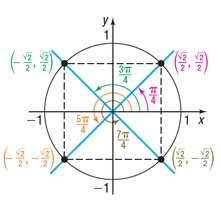
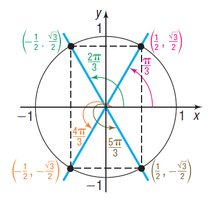
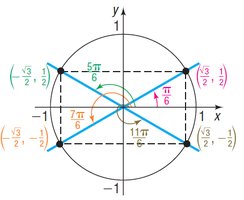
Special right triangles are used to find exact values of trigonometric functions for common angles. The 45-45-90 triangle has side ratios 1:1:, and the 30-60-90 triangle has side ratios 1::2. These triangles correspond to points on the unit circle for angles such as , , and .
Domain and Range of Trigonometric Functions
Domain and Range
The domain and range of the six trigonometric functions are as follows:
Sine: Domain: all real numbers; Range:
Cosine: Domain: all real numbers; Range:
Tangent: Domain: all real numbers except odd multiples of ; Range:
Cosecant: Domain: all real numbers except integer multiples of ; Range:
Secant: Domain: all real numbers except odd multiples of ; Range:
Cotangent: Domain: all real numbers except integer multiples of ; Range:
Periodic Properties of Trigonometric Functions
Definition of Periodic Function and Fundamental Period
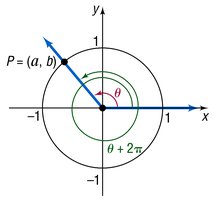
A function is periodic if there is a positive number such that for all in the domain of . The smallest such $p$ is called the fundamental period.
Sine and Cosine: Period is
Tangent and Cotangent: Period is
Even-Odd Properties of Trigonometric Functions
Theorem: Even-Odd Properties
Trigonometric functions have specific symmetry properties:
Even functions: ,
Odd functions: , , ,
Using Symmetry and the Unit Circle to Find Exact Values
Examples with the Unit Circle
By using the symmetry of the unit circle and the coordinates of special points, you can find the exact values of trigonometric functions for common angles such as , , , , , etc.
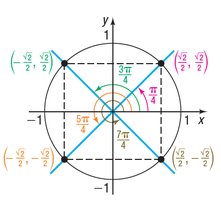
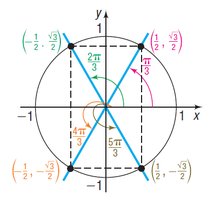
Additional info: The images reinforce the geometric interpretation of trigonometric functions and their properties on the unit circle, as well as the use of symmetry and periodicity in evaluating trigonometric expressions.
