 Back
BackAdolescent Cognitive Development and Schooling: Key Concepts and Challenges
Study Guide - Smart Notes
 Tailored notes based on your materials, expanded with key definitions, examples, and context.
Emergent Cognitive Abilities
Development of Cognitive Skills in Adolescence
Adolescence is marked by significant improvements in cognitive abilities, enabling more complex reasoning and decision-making. However, these emergent skills are still developing, and adolescents often receive corrective feedback through experimentation and experience.
Emergent abilities: Adolescents begin to demonstrate advanced reasoning, abstract thinking, and problem-solving skills.
Developmental mismatch: Adults may overestimate teens’ cognitive maturity, leading to inappropriate expectations.
Corrective feedback: Experimentation with new abilities helps adolescents learn from mistakes and refine their skills.
The Dual Process Model
Understanding Adolescent Decision-Making
The dual process model explains adolescent behavior as the result of two interacting systems: a cognitive control system and a reward system. The imbalance between these systems in early adolescence can lead to increased risk-taking.
Cognitive control system: Sometimes called "cool cognition," this system is responsible for logical, deliberate decision-making.
Reward system: Known as "hot cognition," this system is sensitive to rewards, emotions, and peer influence.
Imbalance: Early adolescents often have a more active reward system relative to their cognitive control system, contributing to risky behaviors.
Evidence: Research supports the dual process model but suggests it is only part of the explanation for adolescent risk-taking.
Adolescent Schooling
Transition to Secondary School
The move from elementary to secondary school is a major milestone, with both benefits and challenges. Students’ adjustment depends on individual, social, and institutional factors.
Historical context: High schools became common in the 19th century; middle schools emerged in the 1960s to bridge elementary and high school.
Middle school vs. junior high: Despite intentions, middle schools often resemble junior highs in structure and demands.
Developmental readiness: Critics argue that middle schools may impose academic and social demands for which some students are not prepared.
Achievement declines: Students often experience a drop in academic performance during the transition, possibly due to shifting academic goals.
Academic Goals and School Climate
Students’ academic goals and perceptions of school climate influence their adjustment and achievement during school transitions.
Task goals: Focused on personal improvement and mastery; associated with positive attitudes and a sense of control.
Ability goals: Focused on outperforming others; associated with increased stress and less positive attitudes.
School climate: Classrooms emphasizing task goals foster higher achievement and better socioemotional outcomes.
Transition to High School
The early high school experience often sets the trajectory for academic success or failure. Parental involvement and self-regulation skills are critical for managing new challenges.
Parental involvement: Can buffer negative effects of academic and social challenges.
Self-regulation: Skills such as time management and stress coping are essential for balancing demands.
Risks: Students lacking these skills may feel overwhelmed and powerless.
Sex, Race, Ethnicity, and Achievement in Science and Math
Gender Differences in Achievement
Achievement patterns in reading, math, and science differ by gender, with implications for educational interventions.
Reading: Females consistently outperform males at all grade levels; the gap widens in high school.
Math: Males outperform females across all grades and ethnic groups; the gap is largest among the most talented students.
Science: Females are at greater risk for achievement losses after transitioning to high school.
Influence of peers: Females with friends interested in math are more likely to pursue advanced coursework.
Racial and Ethnic Group Differences
Achievement gaps widen through high school, with Asian and White students more likely to enroll in advanced courses. Institutional factors and educator attitudes contribute to these disparities.
Course access: Asian and White students have greater access to advanced math and science courses.
Instructional approaches: Community-focused math instruction may help reduce achievement gaps.
Institutional factors: School resources and teacher expectations play a role in achievement differences.
Dropping Out of High School
Trends and Risk Factors
The high school dropout rate in the U.S. has declined, but certain groups remain at higher risk. Multiple factors, including academic history, behavior, and socioeconomic status, influence dropout rates.
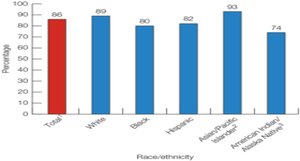
Current rates: 86% of students graduate on time; including late graduates, the rate rises to 93%.
Risk factors: Academic failure, absenteeism, behavioral issues, and poor decisions about risky behavior increase dropout risk.
Sex, Race, Ethnicity, and Socioeconomic Status
Dropout rates vary by gender, race, ethnicity, and family income. Males, students from lower-income families, and certain racial/ethnic groups are at higher risk.
Gender: Males are more likely to drop out, often due to discipline issues, lower school engagement, and difficulty adjusting to new schools.
Socioeconomic status: Lower family income, parental education, and aspirations are linked to higher dropout rates.
Academic History and Dropout Prevention
Students who drop out often have a history of academic struggles and behavioral issues. Effective interventions focus on the importance of education and address mental health needs.
Academic history: Early academic failure, tardiness, absenteeism, and rule violations are predictors of dropping out.
Mental health: Emotional difficulties, depression, and trauma-related sleep problems can contribute to academic failure and dropout risk.
Prevention: Counseling and interventions that link education to future economic well-being are effective in reducing dropout rates.
Chapter Summary
Key Points
Brain development: Continues through adolescence, influencing cognition and behavior.
Puberty: Involves hormonal changes, growth spurts, and psychological effects; timing varies by individual.
Sexual activity: Influenced by social and individual factors; protective factors include academic achievement and parental communication.
Risk behaviors: Linked to sensation seeking, brain development, and social influences.
Mental health: Depression and suicidal thoughts are more common in adolescence, especially among females.
Cognitive development: Formal operational thinking emerges, but is not universal or consistently applied.
School transitions: Can lead to self-esteem losses and changes in goal orientation; early academic failure increases dropout risk.
Achievement gaps: Persist by gender, race, and socioeconomic status; interventions and supportive environments can improve outcomes.
