 Back
BackAdolescent Sexuality, Gender Diversity, and Health: A Developmental Psychology Overview
Study Guide - Smart Notes
 Tailored notes based on your materials, expanded with key definitions, examples, and context.
Adolescent Sexuality and Development
Peer Influences and Pubertal Timing
Peer contexts play a significant role in shaping how adolescents experience puberty and its associated changes. The timing of puberty can affect social interactions, self-esteem, and risk behaviors, with peer groups often amplifying or mitigating these effects.
Adolescent Sexuality
Hormonal, Psychological, and Social Components
Puberty triggers hormonal changes that underlie sexual attraction and behavior. However, adolescent sexuality is not solely determined by biology; psychological and social factors are equally influential. Adolescents' experiences of sexuality are shaped by their environments, beliefs, and peer groups.
Patterns of Adolescent Sexual Behavior in the United States
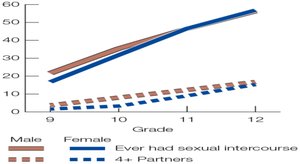
Most individuals have their first sexual experience during their mid- to late teens. There is considerable variation in the frequency of sexual activity and number of partners among teens. Males are generally more sexually active than females until the end of high school, and overall rates of sexual activity have declined over the past three decades.
First Sexual Encounter: Typically occurs in mid- to late teens.
Gender Differences: Males report higher sexual activity than females until grade 12.
Trends: Decline in sexual activity among teens over recent decades.
Factors Associated with Sexual Behavior
Social Factors: More predictive of sexual activity than hormones.
Poverty: Early sexual activity is more common in areas with higher poverty rates.
School Problems: Sexually active females are more likely to have experienced early menarche and school difficulties.
Moral Beliefs: Influence decisions about sexual activity.
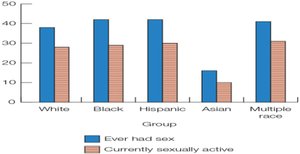
Race, Ethnicity, and Sexual Activity
Sexual activity rates differ across racial and ethnic groups. These differences reflect a combination of cultural, socioeconomic, and community factors.
Sex Education
There is no clear consensus on the most effective approach to sex education. Most states require "abstinence-plus" curricula, but program content varies by students' sexual status and age. Programs for younger teens focus on healthy relationships, while those for older teens provide more direct information about contraception and STI prevention.
Abstinence-Plus: Most common curriculum, combining abstinence with information about contraception.
Developmental Focus: Younger teens learn about relationships; older teens receive practical information.
Skill Training: Effective programs include decision-making and social skills training.
Contraceptive Use
High Usage: Nearly 90% of sexually active high school students report using contraception.
Trends: Increased condom use; decreased oral contraceptive use among teens.
Recommendations: Experts advocate for comprehensive sex education including STI and pregnancy prevention.
Teen Pregnancy
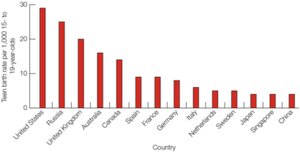
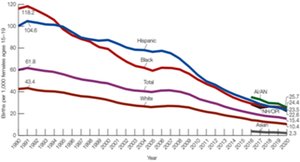
Teen pregnancy rates are calculated by adding births, miscarriages, and abortions among teens, though only birth statistics are reliably reported. The adolescent birth rate in the U.S. has declined dramatically in recent decades, but rates remain higher than in many other developed countries.
Risk Factors: Poverty, history of child maltreatment, and having a mother who gave birth as a teen increase risk.
Protective Factors: Academic success and strong educational ambitions lower risk.
Sexual and Gender Diversity in Adolescence
Development of Sexual Orientation and Gender Identity
Adolescence is a critical period for the emergence of sexual attraction and identity. While most teens identify as heterosexual, a significant minority identify as homosexual, bisexual, or are questioning their orientation. The development of sexual orientation is influenced by both biological and environmental factors.
Sexual Orientation: 91% of male teens and 78% of female teens identify as exclusively heterosexual; 2-3% as exclusively homosexual; 3.5% as bisexual.
Questioning: 3% of males and 6% of females are unsure of their orientation.
Biological Basis: Twin studies suggest a genetic component, but no single gene determines orientation.
Environmental Factors: Not fully understood; family and peer acceptance are important.
Sexual and Gender Minority (SGM) Groups
Group | Description |
|---|---|
Homosexual | Attraction to same-sex partners |
Bisexual | Attraction to both same- and different-sex partners |
Transgender | Psychological gender differs from assigned sex at birth |
Nonbinary | Does not identify with either male or female gender |
Questioning | Uncertain about sexual orientation or gender identity |
Other | Includes additional identities (e.g., genderqueer, pansexual) |
Additional info: Table inferred from context as Table 11.4 was referenced but not provided in the text.
Challenges for Sexual and Gender Minority Adolescents
Peer Acceptance: Teens with same-sex or bisexual orientation often feel isolated and are at higher risk for victimization.
Mental Health: Increased risk of depression, anxiety, and suicidal thoughts among SGM youth.
Supportive Environments: Mental health professionals recommend fostering acceptance in schools and communities.
Gender Diverse Adolescents
Gender diverse individuals express gender traits differently from most peers. Transgender adolescents experience a psychological gender that differs from their assigned sex at birth, while nonbinary individuals do not identify with either gender. Many transgender adolescents experience distress during puberty, especially when physical changes do not align with their gender identity.
School Safety: Over a quarter of transgender students feel unsafe at school, contributing to stress and mental health challenges.
Suicidality: Over half of transgender high school students have considered suicide; 35% have attempted it at least once.
Gender Dysphoria: A psychological disorder marked by significant distress about one's gender identity.
Gender-Affirming Care: Includes education, psychological support, and, when appropriate, medical interventions such as puberty blockers or surgeries.
Adolescent Health and Risk Behaviors
Overview of Adolescent Health
Adolescent health research often focuses on risky sexual behavior and substance abuse. Adolescents are in a developmental period where they seek independence and social connection, but are also vulnerable to health risks due to ongoing brain development and social pressures.
Sensation Seeking
Sensation seeking is the desire to experience increased levels of arousal and novel experiences. This trait is heightened during adolescence and is associated with increased risk-taking, accidents, and injuries. Peer acceptance and media messages can amplify sensation-seeking behaviors, and neurological immaturity in the prefrontal cortex may contribute to poor impulse control.
Drugs, Alcohol, and Tobacco Use
Adolescents' decisions regarding substance use can have lifelong consequences, as this is a sensitive period for brain development. Studies show that heavy substance use during adolescence is associated with lasting changes in brain structure and function.
Ecological Context of Adolescent Development
Adolescent development is influenced by multiple layers of context, from immediate family and peer groups to broader cultural and socioeconomic factors. Bronfenbrenner's ecological systems theory illustrates how these nested contexts interact to shape individual development.
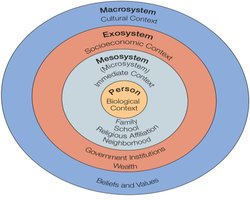
Microsystem: Immediate context (family, school, peers)
Mesosystem: Interconnections among microsystems
Exosystem: Socioeconomic context (parental workplace, community)
Macrosystem: Cultural context (beliefs, values, laws)
