 Back
BackAttraction and Relationships: From First Impressions to Close Relationships
Study Guide - Smart Notes
 Tailored notes based on your materials, expanded with key definitions, examples, and context.
Attraction and Relationships: From First Impressions to Close Relationships
What Causes Attraction?
Understanding why people are attracted to each other is a central question in social psychology. Attraction is influenced by several key factors, including proximity, similarity, reciprocal liking, and physical attractiveness.
Propinquity Effect (Proximity): The likelihood of forming relationships increases with physical closeness. This is explained by the mere exposure effect, where repeated exposure to a person increases our liking for them.
Similarity: People are more likely to be attracted to others who share similar attitudes, values, and interests. This effect is strongest for attitudes and values, and less so for personality traits.
Reciprocal Liking: We tend to like people who express that they like us, which can sometimes override the effects of similarity.
Physical Attractiveness: Physical appearance plays a significant role in first impressions and attraction, with cross-cultural agreement on what is considered attractive.
Misattribution of Arousal: Sometimes, physiological arousal from unrelated sources can be misattributed to attraction toward another person.

Making Connections in the Digital World
Technological advances have transformed how people form and maintain relationships. Online platforms and social media have expanded the pool of potential friends and romantic partners, but also introduce new challenges and risks.
Online Dating: Online dating apps are now a primary method for meeting romantic partners. While they increase opportunities for connection, they also raise concerns about authenticity and safety.
Social Compensation vs. Social Enhancement Hypotheses: The social compensation hypothesis suggests that online platforms benefit those who struggle with face-to-face interactions, while the social enhancement hypothesis posits that socially skilled individuals use technology to further expand their social networks. Evidence tends to support the latter.
Authenticity and Deception: Online interactions can facilitate self-disclosure but also make it easier to present idealized or deceptive versions of oneself.

Forming Close Relationships
Close relationships are shaped by cultural, personality, and biological factors. Social psychologists distinguish between different types of love and examine how these are experienced and valued across cultures and genders.
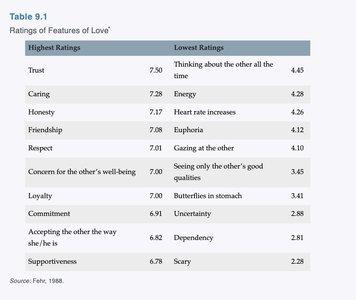
Types of Love: Companionate love (intimacy and affection) and passionate love (intense longing and arousal) are the two primary forms. Most people emphasize companionate love as the essence of lasting relationships.
Gender Differences: Men tend to endorse more romantic, passionate views of love, while women emphasize companionate aspects. However, both genders value companionate love highly.
Cultural Differences: Individualist cultures (e.g., North America) place greater value on passionate love, while collectivist cultures (e.g., East Asia) emphasize companionate love and family approval.
Evolutionary Theory: Suggests that attraction and mate selection are influenced by reproductive strategies, with men prioritizing physical attractiveness and women prioritizing resources and status.
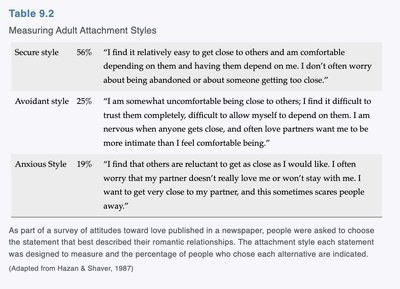
Attachment Theory: Early relationships with caregivers shape expectations and behaviors in adult relationships. Three main attachment styles are identified: secure, avoidant, and anxious/ambivalent.
Highest Ratings | Lowest Ratings |
|---|---|
Trust (7.50) | Thinking about the other all the time (4.45) |
Caring (7.28) | Energy (4.28) |
Honesty (7.17) | Heart rate increases (4.26) |
Friendship (7.08) | Euphoria (4.12) |
Respect (7.01) | Gazing at the other (4.10) |
Concern for the other's well-being (7.00) | Seeing only the other's good qualities (3.45) |
Loyalty (7.00) | Butterflies in stomach (3.41) |
Commitment (6.91) | Uncertainty (2.88) |
Accepting the other the way she/he is (6.82) | Dependency (2.81) |
Supportiveness (6.78) | Scary (2.28) |
Attachment Style | Description | Percentage |
|---|---|---|
Secure | Comfortable with closeness and trusting others | 56% |
Avoidant | Uncomfortable with closeness, difficulty trusting | 25% |
Anxious | Worried about partner's love and closeness | 19% |
Maintaining Close Relationships
Several theories explain how relationships are maintained over time, focusing on the balance of rewards and costs, fairness, and the role of commitment and positive perceptions.
Social Exchange Theory: Relationship satisfaction is determined by the balance of rewards and costs, expectations (comparison level), and perceived alternatives.
Investment Model: Commitment to a relationship depends on satisfaction, quality of alternatives, and investment in the relationship.
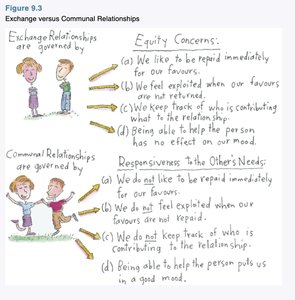
Equity Theory: People are happiest in relationships perceived as fair, where contributions and benefits are balanced.
Exchange vs. Communal Relationships: Exchange relationships involve keeping track of contributions, while communal relationships are based on mutual care and responsiveness to needs.
Commitment: High commitment leads to greater relationship maintenance, including resisting attractive alternatives and increased forgiveness.
Positive Illusions: Idealizing one's partner can increase satisfaction and stability, but may not be helpful in the face of serious problems.
Self-Expansion Model: Relationships are maintained by engaging in novel and exciting activities together, which helps prevent boredom.
Ending Close Relationships
Relationships may end for various reasons, including dissimilarity, loss of initial attraction, inequity, or boredom. The process of breaking up can be painful and is influenced by the roles each partner plays in the decision, as well as the availability of alternatives and the level of investment in the relationship.
Reasons for Ending: Dissimilarity, fatal attractions, inequity, and boredom are common reasons for dissolution.
Breakup Process: People often use passive strategies (e.g., avoidance), but direct communication is more common in romantic relationships.
Experience of Breaking Up: The initiator of the breakup typically experiences less distress than the person being rejected. Over time, most people recover from the emotional impact of a breakup.
Summary Table: Key Theories and Concepts
Theory/Concept | Main Idea |
|---|---|
Propinquity Effect | Physical proximity increases likelihood of relationship formation |
Mere Exposure Effect | Repeated exposure increases liking |
Similarity | Shared attitudes and values foster attraction |
Reciprocal Liking | Liking is mutual and reinforcing |
Physical Attractiveness | Appearance strongly influences first impressions |
Attachment Theory | Early caregiver relationships shape adult attachment styles |
Social Exchange Theory | Relationships are evaluated based on rewards, costs, and alternatives |
Equity Theory | Fairness and balance are key to satisfaction |
Self-Expansion Model | Relationships help individuals grow and expand their experiences |
Additional info: These notes synthesize research findings and theoretical perspectives from social psychology, providing a comprehensive overview of attraction and relationships for college-level psychology students.
