 Back
BackChapter 10: Prosocial Behaviour – Why Do People Help?
Study Guide - Smart Notes
 Tailored notes based on your materials, expanded with key definitions, examples, and context.
Prosocial Behaviour: Why Do People Help?
Introduction to Prosocial Behaviour
Prosocial behaviour refers to any act performed with the goal of benefiting another person. Psychologists study why people sometimes act heroically and selflessly, while at other times they ignore those in need. This chapter explores the motives, personal qualities, and situational factors that influence helping behaviour, as well as strategies to increase prosocial actions.
Why Do People Help?
Basic Motives for Helping
There are three primary theoretical perspectives on why people help others:
Evolutionary Psychology: Helping is seen as an instinctive reaction to promote the welfare of those genetically similar to us (kin selection and the norm of reciprocity).
Social Exchange Theory: People help to maximize rewards and minimize costs; helping is in our self-interest if the benefits outweigh the costs.
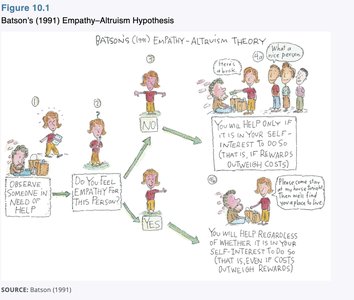
Empathy–Altruism Hypothesis: Under some conditions, powerful feelings of empathy for others prompt selfless giving, even at a cost to oneself.
Evolutionary Psychology: Instincts and Genes
Kin Selection: Behaviours that help genetic relatives are favoured by natural selection, as they increase the likelihood of gene survival.
Norm of Reciprocity: The expectation that helping others increases the likelihood of being helped in the future.
Learning Social Norms: Humans are genetically predisposed to learn social norms, including those that value helping others.
Social Exchange Theory: Costs and Rewards
Helping is motivated by the desire to maximize social rewards (e.g., social approval, self-worth) and minimize costs (e.g., danger, embarrassment).
True altruism, according to this theory, does not exist; all helping is ultimately self-interested.
Empathy–Altruism Hypothesis
Empathy: The ability to put oneself in another's shoes and experience their emotions.
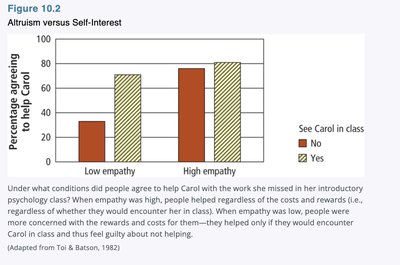
When empathy is high, people help regardless of personal gain; when empathy is low, helping is based on self-interest.
Example: In Batson's studies, participants were more likely to help a student in need when they felt empathy, regardless of whether they would see her again or not.
Personal Determinants of Prosocial Behaviour
Why Do Some People Help More Than Others?
Individual differences, such as personality, gender, socioeconomic status, culture, religion, and mood, influence the likelihood of helping.
Individual Differences: The Altruistic Personality
People with altruistic personalities tend to show empathy, sympathy, and a sense of social responsibility.
Genetic factors play a role, but situational factors are also important.
Gender Differences
Men are more likely to help in heroic or chivalrous situations; women are more likely to help in nurturing, long-term relationships.
Socioeconomic Status (SES)
Lower SES individuals are generally more helpful and generous, possibly due to greater compassion for those in need.
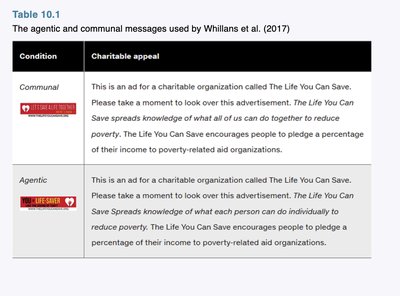
Charitable appeals can be tailored to match self-concepts: communal messages for lower SES, agentic messages for higher SES.
Condition | Charitable Appeal |
|---|---|
Communal | This is an ad for a charitable organization called The Life You Can Save. Please take a moment to look over this advertisement. The Life You Can Save spreads knowledge of what all of us can do together to reduce poverty. The Life You Can Save encourages people to pledge a percentage of their income to poverty-related aid organizations. |
Agentic | This is an ad for a charitable organization called The Life You Can Save. Please take a moment to look over this advertisement. The Life You Can Save spreads knowledge of what each person can do individually to reduce poverty. The Life You Can Save encourages people to pledge a percentage of their income to poverty-related aid organizations. |
Cultural Differences
People are more likely to help in-group members due to empathy, and out-group members when there is a benefit to themselves.
Interdependent cultures emphasize helping in-group members more than individualist cultures.
Religion and Prosocial Behaviour
Religious people are more likely to help, especially within their own group, and when religiosity is primed.
Morality primes can also increase prosocial behaviour.
The Effects of Mood
People are more likely to help when in a good mood (feel good, do good effect) and sometimes when in a bad mood (e.g., guilt, sadness) to alleviate negative feelings (negative-state relief hypothesis).
Situational Determinants of Prosocial Behaviour
When Will People Help?
Situational factors, such as the environment, presence of others, and clarity of the emergency, strongly influence helping behaviour.
Environment: Rural vs. Urban
People are more likely to help in small towns than in large cities, possibly due to the urban-overload hypothesis (city dwellers avoid overload by keeping to themselves).
Residential Mobility
People who have lived longer in one place are more likely to help, due to greater community attachment and concern for reputation.
Bystander Intervention and the Bystander Effect
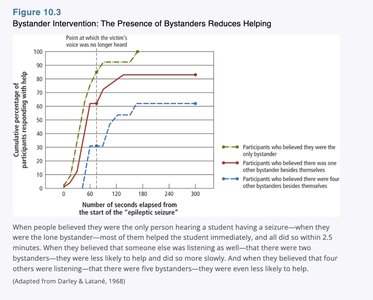
The presence of more bystanders reduces the likelihood that any one person will help (bystander effect).
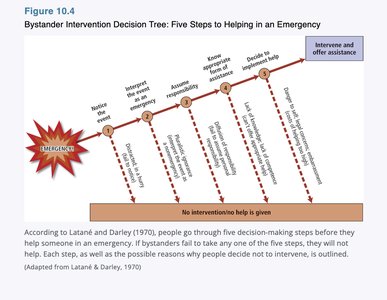
Latané and Darley's model outlines five steps to helping in an emergency: notice the event, interpret it as an emergency, assume responsibility, know how to help, and decide to implement help.
Barriers to Helping
Pluralistic Ignorance: When bystanders assume nothing is wrong because others appear unconcerned.
Diffusion of Responsibility: Each bystander feels less personal responsibility as the number of witnesses increases.
Costs of Helping: Fear of embarrassment, making mistakes, or personal danger can inhibit helping.
How Can Helping Be Increased?
Promoting Prosocial Behaviour
Teaching people about the barriers to helping (e.g., bystander effect) increases the likelihood of intervention.
Programs such as "Bringing in the Bystander" train individuals to overcome barriers and intervene in emergencies.
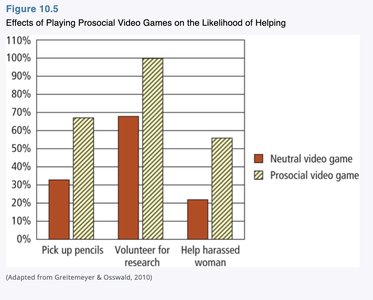
Exposure to prosocial video games and music increases empathy and the accessibility of helping-related thoughts, leading to more helping behaviour.
Rewarding prosocial behaviour (with praise, not excessive external rewards) and modeling helping behaviour (by parents and adults) encourages children and adults to act prosocially.
Summary Table: Theories and Determinants of Prosocial Behaviour
Theory/Determinant | Key Points |
|---|---|
Evolutionary Psychology | Kin selection, norm of reciprocity, learning social norms |
Social Exchange Theory | Maximize rewards, minimize costs; helping is self-interested |
Empathy–Altruism Hypothesis | Empathy leads to altruistic helping, regardless of self-interest |
Personality | Altruistic personality, empathy, social responsibility |
Gender | Men: heroic/chivalrous; Women: nurturing/long-term |
SES | Lower SES: more communal, more generous |
Culture | In-group vs. out-group helping, interdependent vs. individualist |
Religion | Increases helping, especially within group and when primed |
Mood | Good and some bad moods increase helping |
Situational Factors | Urban/rural, residential mobility, bystander effect, clarity of emergency |
Practical Applications
To increase helping, make your need clear, single out individuals for help, and educate others about the bystander effect.
Model and reward prosocial behaviour in children and adults to foster a more helpful society.
