 Back
BackComprehensive Study Notes on Group Therapy in Psychology
Study Guide - Smart Notes
 Tailored notes based on your materials, expanded with key definitions, examples, and context.
Group Therapy
Definition
Group psychotherapy is a therapeutic modality in which a professionally trained leader organizes and guides a collection of individuals to work together toward achieving both individual and collective therapeutic goals. This approach leverages the dynamics of group interaction to facilitate psychological growth and healing.
History of Group Psychotherapy
Origins: Began in America in 1905, first conducted by Joseph H. Pratt with tuberculosis patients, focusing on shared physical and psychological distress.
Key Contributors:
Samuel Slavson: Founded the American Group Psychotherapy Association (1948), emphasized analytic group psychotherapy, especially with children.
Wolf and Schwartz: Applied psychoanalytic principles to adult groups in the 1930s and 1940s.
Jacob L. Moreno: Introduced role-playing and role-training methods in Europe (1910).
Kurt Lewin: Developed field theory and coined "group dynamics" (1939), viewing the group as more than the sum of its parts.
Helen Durkin & Henrietta Glatzer: Integrated systems theory and group dynamics, emphasizing member-to-member interaction.
Principles and Theories of Group Psychotherapy
Major Theoretical Orientations
Psychodynamic (Psychoanalytic Spectrum): Focuses on unconscious processes, emotional attachments, and unresolved issues. Includes object relations and self-psychology.
Ego Psychology: Emphasizes defense mechanisms, peer and authority transferences, and the therapist's countertransference.
Interpersonal Theories: Centers on "here and now" group interactions (Irvin Yalom), addressing existential dilemmas and fostering group cohesion.
Psychodrama: Uses dramatization and role-play to resolve issues, followed by group feedback.
Cognitive and Behavioral Approaches: Structured, time-limited, and manual-driven, focusing on learning theory and symptom relief.
Systems-Oriented Approaches: Views the group as an entity with dynamic interactions, emphasizing roles and boundaries.
Transactional Analysis (TA): Founded by Eric Berne, replaces Freud's id-ego-superego with Parent, Adult, and Child ego states; aims to change maladaptive "life scripts."
Self-Help Groups: Leaderless, composed of individuals with shared issues (e.g., Alcoholics Anonymous), providing social support and therapeutic benefit.
Comparison of Major Group Therapy Orientations
Orientation | Frequency (times/wk) | Screening | Group Size | Goals | Indications | Group Focus | Therapist Activity | Therapeutic Factors |
|---|---|---|---|---|---|---|---|---|
Supportive | 1–5 | Usually | 8–15 | Better adaptation to daily living | Crisis, severe emotional disorders | Here and now; environmental factors | Active structuring | Cohesion, universality, reality testing |
Psychodynamic | 1 or 2 | Always | 5–9 | Reconstruction of personality dynamics | Neuroses, mild personality disorders | Past and present; intragroup/extragroup dynamics | Active interpretation | Cohesion, catharsis, family replay |
Self-Help | 7 | Never | No limit | Social support | Shared life experiences | Education, emotional sharing | No formal leader | Cohesion, universality, education |
Cognitive/Behavioral | 1–3 | Always | 5–10 | Relief of specific symptoms | Phobias, anxiety disorders | Training in symptom control methods | Active teaching | Cohesion, universality, education |
Therapeutic Factors in Group Psychotherapy
Abreaction: Reliving repressed experiences with emotional release and insight.
Acceptance: Feeling accepted and tolerated by the group.
Altruism: Helping others and learning the value of giving.
Catharsis: Emotional release through expression of suppressed material.
Cohesion: Sense of unity and shared purpose; crucial for positive outcomes.
Consensual Validation: Reality confirmation through comparison with others.
Contagion: Emotional expression in one member stimulates similar feelings in others.
Corrective Familial Experience: Group recreates family dynamics for psychological resolution.
Empathy: Understanding another's psychological perspective.
Identification & Imitation: Adopting qualities or behaviors of others (role modeling).
Insight: Awareness of one's own psychodynamics and maladaptive behaviors.
Inspiration: Installation of hope and optimism.
Interaction: Open exchange of ideas and feelings.
Interpretation: Leader helps members understand resistance and defenses.
Learning: Acquisition of new knowledge and skills.
Reality Testing: Objective evaluation of self and others.
Transference: Projecting feelings onto the therapist or other members.
Universalization: Realizing one's problems are shared by others.
Ventilation: Expressing suppressed feelings and secrets (self-disclosure).
Theoretical Bases and Group Boundaries
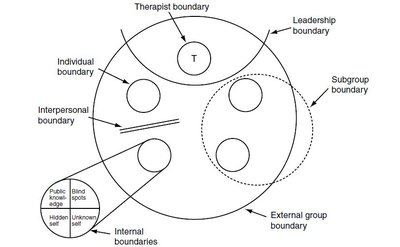
Group therapy is grounded in general systems theory, emphasizing the dynamic interactions among group members. The group is more than the sum of its parts, and its properties are defined by the relationships and boundaries within and around it.
Boundaries: Can be physical (e.g., closed door) or psychological (awareness of differences and transactions).
Types of Boundaries: Therapist, leadership, subgroup, individual, interpersonal, internal member, and external group boundaries.
Pre-Group Preparation
Clarifying goals and purpose
Determining group composition
Defining the leader's role
Setting rules (attendance, confidentiality, fees)
Arranging the therapy setting and time factors
Managing member loss/addition and extragroup socialization
Stages of Group Development
Forming/Preaffiliation: Initial concerns about inclusion, acceptance, and group norms. Leader focuses on cohesion and education.
Storming/Power and Control: Members test boundaries, negotiate differences, and experiment with self-disclosure. Leader mediates conflicts and maintains group focus.
Norming/Intimacy: Increased mutuality and acceptance, with more open interaction. Leader encourages self-sufficiency but remains vigilant.
Performing/Differentiation: Mature group with high self-disclosure and responsibility sharing. Leader guides and prevents countertherapeutic detours.
Adjourning/Separation: Termination phase marked by denial, regression, and closure. Leader helps members process emotions and plan for post-group life.
Clinical Applications
Combined Individual and Group Therapy
Some conditions require both modalities for optimal outcomes.
Combined therapy can be conducted by the same or different therapists, with unique clinical considerations (e.g., risk of splitting in personality disorders).
Group provides a safe space to apply insights from individual therapy.
Groups for Mood Disorders
Group therapy is effective for mood disorders, offering support, education, and structured problem-solving (e.g., life goals group for bipolar disorder).
Focus on psychoeducation, cognitive-behavioral skills, and reframing to counter stigma.
Groups for Personality Disorders
Interpersonal group psychotherapy and dialectical behavioral therapy (DBT) are effective for borderline personality disorder and related conditions.
Groups help address affective dysregulation, interpersonal deficits, and maladaptive coping.
CBT groups are used for anxiety disorders, providing skills, role modeling, and peer feedback.
Group Therapy with Patients With and Without Psychosis
Patients with Psychosis | Patients without Psychosis | |
|---|---|---|
Composition | Homogeneous for function | Homogeneous (brief), Heterogeneous (long-term) |
Functional Capacity | Poor ego strengths, interpersonal deficits | Can learn from feedback, empathy, altruism |
Goals | Crisis intervention, stabilization, social skills | Improved self-perception, interpersonal function, personality resolution |
Therapeutic Factors | Reality testing, identification, social support | Cohesion, challenging defenses, transference |
Leader Role | Active structuring, avoids aggressive themes | Catalyst for process, encourages confrontation |
Medication | Almost always included | May or may not be included |
Group Focus | Present and future | Here and now, historical focus |
Socialization | Strongly encouraged | Generally discouraged |
Time Span | Brief and long-term models | Brief (symptom focus), long-term (personality/behavior change) |
Participation | Involuntary and voluntary | Voluntary |
Research Issues and Future Directions
Group psychotherapy is now supported by scientific research, with evidence for its effectiveness as a primary psychiatric treatment.
Key factors for positive outcomes: pre-group selection, early structure, balance of individual and group factors, active leadership, and strong therapeutic alliance.
Future trends include eclectic, integrative approaches, technical innovation, and increased patient responsibility for change.
Additional info: These notes integrate and expand upon the provided material with academic context, definitions, and structured comparisons to ensure completeness and clarity for psychology students.
