 Back
BackEarly Childhood Socioemotional Development: Emotional, Social, and Moral Growth
Study Guide - Smart Notes
 Tailored notes based on your materials, expanded with key definitions, examples, and context.
Early Childhood: Socioemotional Development
Emotional Development
Emotional development in early childhood involves the increasing ability to understand, express, and regulate emotions. This period is marked by significant advances in emotional regulation, which is the ability to control when and how emotions are expressed. These advances are closely linked to the maturation of the limbic system and prefrontal cortex.
Emotion regulation: The capacity to manage emotional responses, considered the most important psychosocial accomplishment between ages 2 and 6.
Effortful control: The ability to regulate one’s emotions and actions through conscious effort, rather than automatic responses.
Culture and Emotional Control: Different cultures emphasize the regulation of specific emotions (e.g., overcoming fear in the U.S., modifying anger in Puerto Rico, tempering pride in China).

Additional info: Emotional regulation is foundational for later social competence and mental health.
Initiative versus Guilt (Erikson's Third Psychosocial Crisis)
According to Erik Erikson, children in early childhood face the challenge of initiative versus guilt. They are eager to undertake new skills and activities, but may feel guilty if they fail or are discouraged.
Initiative: The drive to begin new projects and activities.
Guilt: Feelings of self-blame or inadequacy when efforts are unsuccessful or criticized.

Motivation in Early Childhood
Types of Motivation
Motivation is the impulse that propels someone to act. In early childhood, motivation can be intrinsic or extrinsic.
Intrinsic motivation: Comes from within the individual, such as curiosity or the desire to master a skill.
Extrinsic motivation: Comes from external rewards or pressures, such as praise or avoidance of punishment.
Example: A child may practice drawing because they enjoy it (intrinsic) or to receive a sticker from a teacher (extrinsic).
Play and Social Development
The Role of Play
Play is a universal and essential activity in early childhood, providing opportunities for emotional regulation, social learning, and cognitive growth. The form and complexity of play evolve with age and cultural context.
Playmates: Peers of similar age and social status who provide practice in emotional regulation, empathy, and social understanding.
Play with peers is preferred over play with adults and is crucial for developing positive social skills.
Types of Social Play
Solitary play: Playing alone, unaware of others nearby.
Onlooker play: Watching others play without participating.
Parallel play: Playing with similar toys in proximity but not interacting.
Associative play: Interacting and sharing materials, but not fully coordinating play.
Cooperative play: Playing together with shared goals or roles.
Other types of play:
Sociodramatic play: Pretend play that allows children to explore social roles and practice emotional regulation.
Rough-and-tumble play: Physical play that mimics aggression but is not intended to harm, common among young males.
Parenting Styles and Their Effects
Dimensions of Caregiving
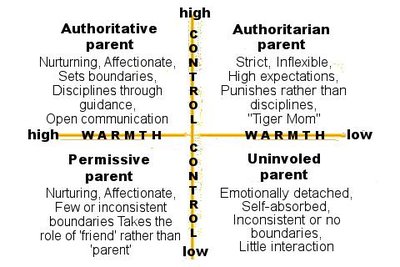
Parenting styles are characterized by varying degrees of warmth, control (discipline), communication, and expectations for maturity.
Baumrind’s Styles of Caregiving
Diana Baumrind identified three main parenting styles, with a fourth added later:
Style | Description |
|---|---|
Authoritarian | High behavioral standards, strict punishment, little communication |
Permissive | High nurturance and communication, little discipline or control |
Authoritative | Set limits and enforce rules, but are flexible and listen to children |
Neglectful/Uninvolved | Indifferent and unaware of children’s lives |
Long-Term Effects of Parenting Style
Authoritarian: Children tend to be obedient but less happy, may feel guilty or depressed, and may rebel in adolescence.
Permissive: Children may lack self-control, be immature, and have difficulty with friendships.
Authoritative: Children are generally successful, happy, and well-liked.
Neglectful/Uninvolved: Children may experience emotional and social difficulties due to lack of guidance and support.
Additional info: The effects of parenting styles are influenced by the child’s temperament, the parent’s personality, and the broader social context. No single style is universally best across all cultures and situations.
Moral Development in Early Childhood
Components of Morality
Moral development involves affective (emotional), cognitive (thought), and behavioral (action) components. As children mature, they develop more complex moral values, judgments, and behaviors, supported by social bonds and theory of mind.
Prosocial behavior: Actions intended to help others without obvious benefit to oneself; increases from ages 3 to 6.
Empathy: Understanding and sharing the feelings of another person.
Antisocial behavior: Deliberately hurtful or destructive actions; tends to decline after age 2.
Types of Aggression
Researchers identify four general types of aggression in early childhood:
Instrumental aggression: Used to obtain something, not necessarily to harm.
Reactive aggression: Impulsive retaliation for another’s action.
Relational aggression: Nonphysical acts aimed at harming social relationships.
Bullying aggression: Unprovoked, repeated attacks on vulnerable individuals.
Additional info: Early intervention and supportive social environments can reduce the development of chronic aggressive behaviors.
