 Back
BackLifespan Theories: Major Theories of Development in Psychology
Study Guide - Smart Notes
 Tailored notes based on your materials, expanded with key definitions, examples, and context.
Lifespan Theories in Developmental Psychology
Introduction
Lifespan theories in psychology provide frameworks for understanding how humans grow and change from infancy through adulthood. This section covers major theories including Freud’s psychosexual development, Erikson’s psychosocial stages, Piaget’s cognitive development, Vygotsky’s sociocultural theory, and theories of moral development by Kohlberg and Gilligan.
Freud’s Psychosexual Theory of Development
Overview
Sigmund Freud proposed that personality develops through a series of childhood stages in which the pleasure-seeking energies of the id become focused on certain erogenous zones. This process is known as psychosexual development.
Discontinuous Development: Freud believed development occurs in distinct stages.
Fixation: If a stage is not properly resolved, individuals may become fixated, affecting adult personality.
Stages: Oral, Anal, Phallic, Latency, and Genital (detailed in personality chapters).
Modern View: While Freud’s specific stages lack empirical support, his emphasis on early childhood’s impact on personality remains influential.
Erikson’s Psychosocial Theory of Development
Overview
Erik Erikson expanded Freud’s ideas, emphasizing social and cultural influences across the entire lifespan. His psychosocial development theory outlines eight stages, each defined by a central conflict that must be resolved for healthy personality development.
Trust vs. Mistrust (0–1 year): Developing trust when caregivers provide reliability, care, and affection.
Autonomy vs. Shame/Doubt (1–3 years): Developing a sense of personal control and independence.
Initiative vs. Guilt (3–6 years): Asserting control and power over the environment through directing play and social interactions.
Industry vs. Inferiority (7–11 years): Coping with new social and academic demands, leading to a sense of competence.
Identity vs. Role Confusion (12–18 years): Developing a personal identity and sense of self.
Intimacy vs. Isolation (19–29 years): Forming intimate, loving relationships with others.
Generativity vs. Stagnation (30–64 years): Creating or nurturing things that will outlast oneself, contributing to society.
Integrity vs. Despair (65+ years): Reflecting on life and feeling a sense of fulfillment or regret.
Stage | Age (years) | Developmental Task | Description |
|---|---|---|---|
1 | 0–1 | Trust vs. Mistrust | Trust (or mistrust) that basic needs will be met |
2 | 1–3 | Autonomy vs. Shame/Doubt | Develop independence in many tasks |
3 | 3–6 | Initiative vs. Guilt | Take initiative; may develop guilt when unsuccessful |
4 | 7–11 | Industry vs. Inferiority | Develop self-confidence or sense of inferiority |
5 | 12–18 | Identity vs. Role Confusion | Experiment with and develop identity and roles |
6 | 19–29 | Intimacy vs. Isolation | Establish intimacy and relationships |
7 | 30–64 | Generativity vs. Stagnation | Contribute to society and family |
8 | 65+ | Integrity vs. Despair | Assess life and meaning of contributions |
Piaget’s Cognitive Theory of Development
Overview
Jean Piaget proposed that children move through four stages of cognitive development, each characterized by different ways of thinking and understanding the world. He introduced the concepts of assimilation and accommodation as mechanisms for cognitive growth.
Schema: Mental models used to categorize and interpret information.
Assimilation: Incorporating new information into existing schemas.
Accommodation: Modifying schemas in response to new information.
Age (years) | Stage | Description | Developmental Issues |
|---|---|---|---|
0–2 | Sensorimotor | World experienced through senses and actions | Object permanence, stranger anxiety |
2–6 | Preoperational | Use words and images; lack logical reasoning | Pretend play, egocentrism, language development |
7–11 | Concrete Operational | Logical thinking about concrete events | Conservation, mathematical transformations |
12+ | Formal Operational | Abstract reasoning | Abstract logic, moral reasoning |
Object Permanence: Understanding that objects continue to exist even when out of sight.
Egocentrism: Difficulty in seeing things from another’s perspective (preoperational stage).
Conservation: Understanding that quantity remains the same despite changes in shape or appearance.
Reversibility: Understanding that objects can be changed and then returned to their original form.
Example: A child who believes that cutting a pizza into more pieces means there is more pizza demonstrates a lack of conservation.
Vygotsky’s Sociocultural Theory of Development
Overview
Lev Vygotsky emphasized the role of social interaction and culture in cognitive development. He introduced the concept of the Zone of Proximal Development (ZPD) and the importance of scaffolding in learning.
Zone of Proximal Development (ZPD): The gap between what a learner can do independently and what they can do with guidance.
Scaffolding: Temporary support provided by a more knowledgeable other to help the learner achieve tasks within their ZPD.
Private Speech: Self-talk used by children to guide their actions and thoughts, which becomes internalized as silent inner speech.
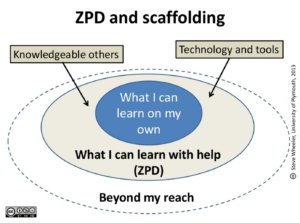
Application: Teachers and peers can facilitate learning by providing appropriate support and gradually removing it as the learner becomes more competent.
Theories of Moral Development
Kohlberg’s Theory of Moral Development
Lawrence Kohlberg proposed that moral reasoning develops in three levels, each with two stages. He used moral dilemmas to assess the reasoning behind moral decisions.
Pre-conventional Morality: Behavior driven by obedience and self-interest (avoiding punishment, seeking rewards).
Conventional Morality: Behavior driven by social approval and maintaining social order.
Post-conventional Morality: Behavior driven by internal moral principles and recognition of universal ethical values.
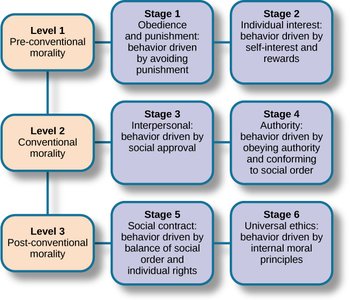
Example: The Heinz dilemma is used to evaluate the reasoning behind moral choices, not the choices themselves.
Gilligan’s Theory: Morality of Care
Carol Gilligan critiqued Kohlberg’s theory for being gender-biased and developed her own framework, emphasizing the morality of care. She argued that women’s moral reasoning often focuses on relationships and care for others.
Moral Position | Definition of What is Morally Good |
|---|---|
Survival Orientation | Action that considers one’s personal needs only |
Conventional Care | Action that considers others’ needs or preferences, but not one’s own |
Integrated Care | Action that coordinates one’s own needs with those of others |
Key Point: Gilligan emphasized that both male and female approaches to moral reasoning are valuable and complementary.
Glossary of Key Terms
Assimilation: Adjustment of a schema by adding information similar to what is already known.
Accommodation: Adjustment of a schema by changing it to incorporate new information.
Egocentrism: Difficulty in taking the perspective of others (preoperational stage).
Object Permanence: Understanding that objects continue to exist even when not seen.
Zone of Proximal Development (ZPD): The distance between what a learner can do alone and what they can do with help.
Scaffolding: Temporary support to help a learner master a task.
Psychosocial Development: Erikson’s theory of social tasks mastered across eight stages of life.
Psychosexual Development: Freud’s theory of stages focused on different erogenous zones.
Schema: Mental model for categorizing and interpreting information.
Conservation: Understanding that quantity remains the same despite changes in shape or appearance.
Reversibility: Understanding that objects can be changed and returned to their original form.
Summary
Major lifespan theories in psychology provide insight into how humans develop cognitively, socially, and morally. Freud, Erikson, Piaget, Vygotsky, Kohlberg, and Gilligan each contributed unique perspectives that continue to influence research and practice in developmental psychology.
