 Back
BackMoral Development, Intersectionality, and Social Relationships in Adolescence
Study Guide - Smart Notes
 Tailored notes based on your materials, expanded with key definitions, examples, and context.
Intersectionality and Ethnic-Racial Identity Development
Intersectionality and Identity Formation
Intersectionality is a framework for understanding how various aspects of a person's identity—such as gender, sexual orientation, ethnicity, and temperament—interact to shape their experiences. Rather than viewing these categories as separate, intersectionality emphasizes their interactive effects on identity development.
Interactive Influences: Identity is shaped by the interplay of multiple categorical influences, not simply by adding them together.
Situational Variables: Contextual factors, such as environment and social setting, also play a role in identity development.
Unique Experiences: Multiethnic-multiracial and immigrant adolescents often face distinct challenges and experiences in their identity development.
Marginalization: Individuals with multiple marginalized identities (e.g., transgender and gender-diverse teens) may experience minority stress, which includes anxieties resulting from being stigmatized or treated as insignificant. This can undermine protective factors that typically support healthy development.
Kohlberg’s Approach to Moral Development
Kohlberg’s Theory of Moral Reasoning
Lawrence Kohlberg expanded on Piaget’s work to propose a theory of moral development, focusing on the reasoning behind moral decisions rather than the decisions themselves. Kohlberg identified three levels of moral development, each with two substages, forming a sequence through which individuals progress as their moral reasoning matures.
Three Levels: Preconventional, Conventional, and Postconventional Morality.
Stage Progression: Each stage builds upon the previous one, reflecting increasingly sophisticated moral reasoning.
Measurement: Kohlberg assessed moral reasoning by presenting moral dilemmas and analyzing the reasoning used to justify choices.
Preconventional Morality
At this level, moral judgments are based on external consequences and authority figures. Most children, about half of adolescents, and some adults reason at this level.
Stage 1: Punishment and Obedience Orientation – Right and wrong are determined by physical consequences (punishment or reward).
Stage 2: Individualism, Instrumental Purpose, and Exchange – Actions are guided by self-interest and reciprocal benefit.


Basis of Judgments: Authority figures and consequences of actions.
Conventional Morality
At this level, individuals internalize the rules and norms of their group or society. Moral reasoning is based on social approval and maintaining social order. Many adolescents and most adults reason at this level.
Stage 3: Mutual Interpersonal Expectations, Relationships, and Interpersonal Conformity – Emphasis on living up to social expectations and roles.
Stage 4: Social System and Conscience (Law-and-Order Orientation) – Importance of obeying laws and fulfilling duties to maintain social order.


Basis of Judgments: Community standards, social acceptability, rules, and laws.
Postconventional Morality
This level is characterized by reasoning based on abstract principles that transcend specific societal rules. Only a minority of adults reach this level.
Stage 5: Social Contract Orientation – Recognition that laws and rules are flexible and can be changed for the greater good.
Stage 6: Universal Ethical Principles Orientation – Moral reasoning is guided by self-chosen ethical principles, such as justice, dignity, and equality, even if they conflict with laws and rules.




Basis of Judgments: Balancing individual and societal rights, moral standards underlying laws, and resolving conflicts between moral principles.
Influences on Moral Development
Progression through Kohlberg’s stages is correlated with age and cognitive development. The decline of egocentrism and the ability to take others’ perspectives (role-taking) are crucial for advanced moral reasoning. Supportive social environments, especially parental guidance, further facilitate moral development.
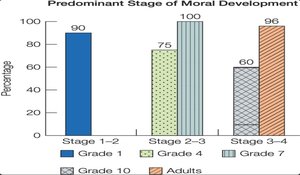
Cognitive Development: Advanced reasoning requires the ability to see situations from multiple perspectives.
Social Support: Parental understanding and responsiveness are important for moral growth.
Criticisms of Kohlberg’s Theory
While influential, Kohlberg’s theory has faced several criticisms:
Stage 6 Questioned: Some doubt whether the highest stage is commonly reached or even exists.
Underemphasis on Family and Culture: The theory focuses more on justice than on other moral values, such as care or empathy, and may not fit non-Western cultures well.
Alternative Orientations: Carol Gilligan proposed two moral orientations: justice (emphasized by Kohlberg) and care (emphasized in relationships and empathy).
Empathy: Both a cause and consequence of moral development, empathy is essential for understanding others’ perspectives and acting morally.
Moral Development and Antisocial Behavior
Adolescents who engage in antisocial behavior, such as cyberbullying, often display lower levels of moral reasoning. Their actions are influenced by situational factors rather than stable moral traits.
Callous-Unemotional Traits: These individuals show less remorse, guilt, and empathy, and have difficulty recognizing others’ emotions.
Cyberbullying: A form of aggression using electronic communication to intentionally harm others; associated with lack of empathy and remorse.
Social Relationships in Adolescence
Relationships with Parents
Adolescents strive to balance autonomy with maintaining emotional connections to their parents. Conflicts may increase in frequency and intensity, but underlying attachments remain important for well-being.
Autonomy: Adolescents seek independence from parental control.
Relatedness: Maintaining emotional bonds with parents is crucial for healthy development.
Attachment Quality: Strong attachments predict better social competence and lower risk behaviors, while insecure attachments are linked to more difficulties.
Friendships in Adolescence
Peer relationships become increasingly significant during adolescence, surpassing the importance of friendships in earlier childhood. Adolescents’ friendships are characterized by greater intimacy, loyalty, and emotional support.
Peer Importance: Adolescents rely more on friends for social and emotional support.
Intimacy and Loyalty: Friendships become more intimate and emotionally significant.
Variation: Teens differ in their ability to form and maintain close friendships.
Smartphones and Peer Communication
Smartphones have transformed adolescent peer communication, serving as central tools for social interaction and self-presentation.
Prevalence: Most adolescents own smartphones and use them extensively for social media and communication.
Social Comparison: Social media facilitates global comparisons, but authenticity of online personas can be difficult to assess.
Therapeutic Potential: Smartphone apps are being used for mental health interventions among adolescents.
Popularity
The importance of popularity and peer acceptance peaks in early adolescence. Over time, the quality of friendships becomes more important than popularity itself.
Popularity: Adolescents place high value on being accepted by peers, especially in early adolescence.
Relationship Quality: As adolescents mature, the depth and quality of friendships become more significant than popularity.
