 Back
BackPersonality Psychology: Psychoanalytic and Humanistic Theories
Study Guide - Smart Notes
 Tailored notes based on your materials, expanded with key definitions, examples, and context.
Personality Psychology
Introduction to Personality Psychology
Personality psychology investigates the sources and measurement of enduring patterns of individual thought, feeling, and behavior. It is distinct from other branches of psychology due to its focus on comprehensive models of human psychology and its close relationship with clinical psychology, psychometrics, and theories of learned behavior.
Clinical Psychology: Many contributors to personality psychology were also psychiatrists or psychotherapists. Case studies are common, but critics question their generalizability.
Psychometrics: Focuses on measuring individual traits (e.g., intelligence, attitudes, agreeableness, introversion-extroversion). Correlational research is used to link traits to genetics, though personality tests often poorly predict individual behavior.
Learning and Cognitive Styles: Uses experimental studies to examine learned behaviors and cognitive styles, but often only short-term effects are studied.
Personality psychologists often develop "grand theories" to explain the complexities of the human psyche, including psychoanalysis, humanistic psychology, behaviorism, social and cognitive learning theory, and trait psychology. The contemporary consensus is that personality is best understood as bio-psycho-social in nature.
Psychoanalytic Theory: Freud
Freud's Contributions and Central Concepts
Sigmund Freud is credited with developing the first comprehensive psychological model of personality. His theories have significantly influenced both academic psychology and popular culture.
Depth Hypothesis: Freud proposed three layers of consciousness: the conscious, preconscious, and unconscious. Most mental activity occurs beneath conscious awareness.
Structural Hypothesis: The psyche is divided into three parts: Id (primal, pleasure-driven), Ego (reality-driven, mediates between Id and reality), and Superego (internalized moral standards).
Psychosexual Development: Personality forms during early childhood through the resolution of universal developmental challenges, each associated with a distinct stage.
Freud's Depth and Structural Models
Conscious Mind: Current awareness and perceptions.
Preconscious: Memories and experiences easily brought to awareness.
Unconscious: Buried memories, motives, impulses, and repressed content. Repression consumes mental energy (libido).
Id: Present at birth, driven by the pleasure principle, amoral, primal urges.
Ego: Develops to mediate between Id and reality, governed by the reality principle.
Superego: Internalized moral standards, source of guilt, shame, and self-doubt.
Tensions between these components can lead to psychological conflict and the use of defense mechanisms (e.g., displacement, rationalization, denial).
Freud's Psychosexual Stages of Development
Freud theorized that personality develops through distinct psychosexual stages, each characterized by a focus on different erogenous zones and associated conflicts.
Oral Stage: Focus on mouth (feeding). Conflict: weaning. Fixation can lead to passivity or aggression.
Anal Stage: Focus on elimination (toilet training). Conflict: control. Fixation can lead to "anal retentive" (orderliness, stinginess) or "anal expulsive" (messiness, destructiveness) traits.
Phallic Stage: Focus on genitals. Conflict: gender identity and the Oedipus complex. Resolution leads to identification with same-sex parent and formation of the superego.
Latency Period: Relative calm, focus on social and intellectual skills.
Genital Stage: Adult sexuality, shaped by earlier stage resolutions.
Regression to earlier stages can occur under stress. Fixations at any stage can influence adult personality traits.
The Oedipus Complex
Freud interpreted the Oedipus myth as a universal psychological conflict occurring around age 5, involving possessive attachment to the mother and rivalry with the father. Resolution involves identification with the father and internalization of his values. The process differs for girls, with debates around the concepts of "penis envy" and the Electra complex.
Healthy Resolution: Leads to mature adult relationships and a well-formed superego.
Unresolved Complex: Can result in weak superego, excessive guilt, or difficulties in forming adult attachments.
Freud's model has been criticized for its focus on sexuality, universality of conflicts, and lack of empirical support, but it provided foundational concepts for later gender psychology and theories of development.
Non-Freudian Psychoanalytic Contributions
Carl Jung: Emphasized archetypes, collective unconscious, and personality typology. De-emphasized sexuality.
Alfred Adler: Focused on feelings of inferiority and social concern as motivators.
Karen Horney: Developed theories of feminine psychology and neuroses, early antecedent of cognitive behavioral therapy.
Humanistic Approaches
Core Principles of Humanistic Psychology
Humanistic psychology rejects the conflict-driven view of psychoanalysis, emphasizing conscious experience, personal growth, and the capacity for positive change.
Subjective Experience: People act based on their subjective beliefs and perceptions.
Self-Actualization: Central motive is the drive toward growth and realizing one's potential.
Positive Self-Regard: Need for self-acceptance and unconditional positive regard from others.
Carl Rogers and the Self
Carl Rogers developed the concept of the self and emphasized the importance of unconditional positive regard for healthy psychological development.
Self-Acceptance: Valuing oneself as a human being, not necessarily as "the best."
Conditional Self-Regard: Learning "conditions of worth" can undermine self-esteem and lead to psychological difficulties.
Unconditional Positive Regard: Acceptance from parents, mentors, and friends fosters healthy self-esteem.
Self-Actualization: Striving to realize one's potentials, whether creative, intellectual, or social. Blocked self-actualization leads to dissatisfaction and dysfunction.
Abraham Maslow's Hierarchy of Needs
Abraham Maslow proposed a hierarchy of needs, ranging from basic physiological needs to self-actualization. Needs are ranked in a pyramid, with lower needs being stronger motivators.
Physiological Needs: Food, water, sleep.
Safety: Security, stability.
Love & Belonging: Relationships, social connections.
Esteem: Recognition, achievement.
Self-Actualization: Realizing one's highest potential.
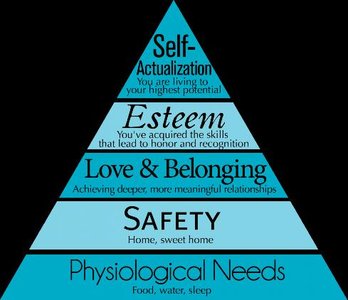
Maslow's model suggests that higher needs are pursued only after lower needs are satisfied, but empirical evidence indicates that people may pursue higher needs even when basic needs are unmet. The hierarchy is influential in management and public administration, despite its lack of empirical support.
Evaluation of Humanistic Models
Strengths: Emphasize positive growth, self-acceptance, and the importance of social support.
Limitations: Hierarchical structure of needs is not empirically validated; needs may be equally important and not rank-ordered.
Research supports the importance of self-esteem, safety, and belonging for mental health, but not the strict hierarchy proposed by Maslow.
Summary Table: Freud vs. Humanistic Approaches
Aspect | Psychoanalytic (Freud) | Humanistic (Rogers, Maslow) |
|---|---|---|
View of Human Nature | Conflict-driven, unconscious motives | Growth-oriented, conscious experience |
Personality Development | Stage-based, psychosexual conflicts | Continuous, self-actualization |
Key Motives | Libido, unconscious drives | Self-actualization, positive self-regard |
Role of Social Environment | Source of moral standards (superego) | Source of unconditional positive regard |
Empirical Support | Limited, case studies | Mixed, hierarchy of needs not validated |
Additional info: Academic context was added to clarify the distinctions between psychoanalytic and humanistic approaches, and to provide a summary table for comparison.
