 Back
BackSensation and Perception: Foundations of Experiencing the World
Study Guide - Smart Notes
 Tailored notes based on your materials, expanded with key definitions, examples, and context.
Sensation and Perception
Introduction to Sensation and Perception
Sensation and perception are fundamental processes that allow organisms to receive, interpret, and respond to information from their environment. Sensation refers to the process of receiving stimulus energies from the external environment and transforming them into neural energy. Perception is the process of organizing and interpreting sensory information so that it makes sense. The brain gives meaning to sensation through perception, enabling us to understand and interact with the world.
Basic Principles of Sensation and Perception
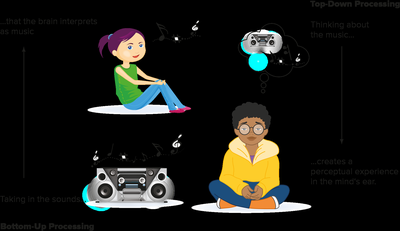
Bottom-Up Processing: Initiated by sensory input; the outside world influences perception.
Top-Down Processing: Initiated by cognitive processing; internal mental states, expectations, and prior understanding influence perception.
Unified Information-Processing System: Sensation and perception work together to create a coherent experience.
Sensory Receptors and Information Flow
Types of Sensory Receptors
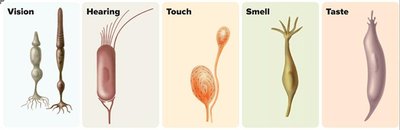
Sensory receptors are specialized cells that selectively detect and transmit sensory information to the brain via distinct neural pathways. The main types of sensory receptors include:
Photoreception: Detection of light, perceived as sight.
Mechanoreception: Detection of pressure, vibration, and movement, perceived as touch, hearing, and equilibrium.
Chemoreception: Detection of chemical stimuli, perceived as smell and taste.
Information Flow for Energy Stimulus
Energy stimulus (e.g., light, sound, chemical) is detected by a sensory receptor cell.
The receptor cell activates a sensory neuron, which transmits the signal to the brain for sensation and perception.
Sensory Thresholds
Absolute Threshold
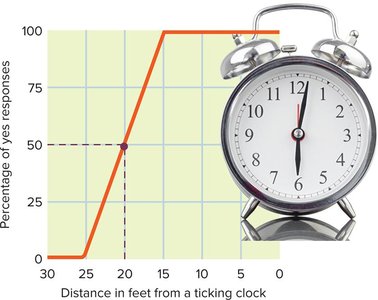
The absolute threshold is the minimum amount of stimulus energy an organism can detect. It varies between individuals and sensory modalities.
Difference Threshold (Just Noticeable Difference, JND)
The difference threshold is the minimum difference in stimulation that a person can detect 50% of the time. The Just Noticeable Difference (JND) increases with stimulus magnitude, as described by Weber’s Law:
Weber’s Law: To be perceived as different, two stimuli must differ by a constant minimum proportion, not a constant amount.
Subliminal Perception
Subliminal perception refers to the influence of information below the level of conscious awareness. Subtle primes can affect behavior, but the scientific validity of subliminal messages is debated.
Signal Detection Theory
Decision-Making in Sensation
Signal detection theory explains how individuals decide whether a stimulus is present or absent under conditions of uncertainty. Key components include:
Information Acquisition: Gathering sensory data.
Criterion: The basis or motive for making a judgment.

Possible outcomes include:
Hit: Correctly detecting a present signal.
Miss: Failing to detect a present signal.
False Alarm: Incorrectly detecting a signal when none is present.
Correct Rejection: Correctly identifying that no signal is present.
Factors Affecting Perception
Attention
Attention is the process of focusing awareness on a narrowed aspect of the environment. It can be selective (e.g., cocktail party effect), shiftable, and influenced by novelty, size, color, movement, and emotions. Inattentional blindness occurs when attention is diverted and important stimuli are missed.

Cultural Effects and Perceptual Set
Cultural Effects: Culture can influence what aspects of a scene are attended to (focal objects vs. context).
Perceptual Set: A predisposition or readiness to perceive something in a particular way, shaped by experience and expectations.
Sensory Adaptation
Sensory adaptation is the change in responsiveness of the sensory system based on the level of surrounding stimulation (e.g., adjusting to a dark room or bright outdoors).
The Visual System
Properties of Light
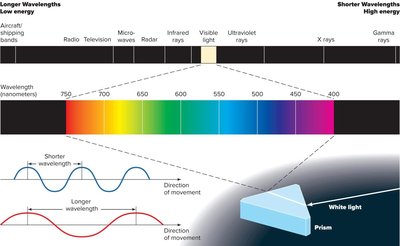
Wavelength: Distance between peaks; perceived as hue (color).
Amplitude: Height of the wave; perceived as brightness.
Purity: Mixture of wavelengths; perceived as saturation.
Structure of the Eye
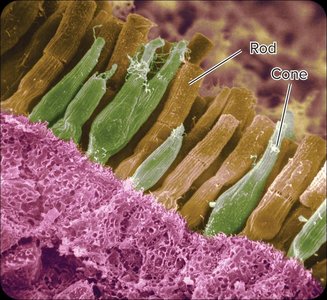
Retina: Contains receptor cells (rods and cones).
Rods: Sensitive to dim light, not color; function well in low illumination (≈120 million in humans).
Cones: Respond to color; operate best under high illumination (≈6 million in humans).
Fovea: Area of the retina populated with cones only, vital for detailed vision.
Blind Spot: Where the optic nerve leaves the eyeball; no photoreceptors present.
Visual Processing Pathway
Light enters the eye and is focused on the retina.
Photoreceptors (rods and cones) convert light into neural signals.
Signals travel via the optic nerve, cross at the optic chiasm, and are relayed through the thalamus to the visual cortex.
Theories of Color Vision
Trichromatic Theory: Three types of cones (red, green, blue) are responsible for color vision. Color-deficient vision occurs when one or more cone types are inoperative.
Opponent-Process Theory: Color perception is controlled by the activity of two opponent systems: a blue-yellow mechanism and a red-green mechanism. Explains afterimages.
Visual Perception
Gestalt Principles
Gestalt psychology emphasizes that perceptions are naturally organized according to certain patterns, and the whole is different from the sum of its parts. Key principles include:
Figure-Ground Relationship: Differentiating an object from its background.
Closure: Filling in gaps to perceive a complete object.
Proximity: Grouping objects that are close together.
Similarity: Grouping objects that are similar.
Depth Perception
Binocular Cues: Disparity and convergence provide depth information using both eyes.
Monocular Cues: Familiar size, overlap, height in field, linear perspective, shading, and texture gradients provide depth information using one eye.
Motion and Perceptual Constancies
Motion: Humans have specialized motion detectors; apparent movement can be perceived even when none exists.
Perceptual Constancies: Recognition that objects do not physically change despite changes in vantage point and viewing conditions (size, shape, and color constancy).
The Auditory System
Properties of Sound
Wavelength: Determines frequency, perceived as pitch.
Amplitude: Perceived as loudness (measured in decibels, dB).
Mixture of Wavelengths: Perceived as timbre or tone saturation.
Structures and Functions of the Ear
Outer Ear: Pinna and external auditory canal; collects sound.
Middle Ear: Eardrum, hammer, anvil, stirrup; amplifies sound.
Inner Ear: Oval window, cochlea, basilar membrane; converts sound waves into neural impulses.
Theories of Hearing
Place Theory: Different areas of the basilar membrane respond to different frequencies (explains high frequencies).
Frequency Theory: Frequency of nerve firing matches frequency of sound (explains low frequencies).
Volley Principle: Groups of neurons fire in rapid succession to exceed individual firing rate limitations.
Auditory Processing
Pathway: Cochlea → auditory nerve → brain stem → temporal lobe.
Sound localization depends on intensity and timing differences between ears.
Other Senses
Skin Senses (Cutaneous Senses)
Touch: Receptors send signals through the spinal cord and brain stem to the thalamus and somatosensory cortex.
Temperature: Thermoreceptors detect warm and cold; simultaneous stimulation can be perceived as hot.
Pain: Detected by mechanical, heat, and chemical receptors; involves fast and slow pathways and is modulated by endorphins.
Chemical Senses
Taste: Detected by receptors on the tongue (papillae); five basic tastes: sweet, sour, bitter, salty, umami. Cultural factors influence taste perception.
Smell (Olfactory Sense): Detected by the olfactory epithelium; processed in the temporal lobe and limbic system.

Kinesthetic and Vestibular Senses
Kinesthetic Sense: Provides information about movement, posture, and orientation through muscle fibers and joints (proprioceptive feedback).
Vestibular Sense: Detects balance and acceleration via the semicircular canals in the inner ear.
Additional info: This guide expands on the provided slides by integrating definitions, examples, and academic context to ensure a comprehensive understanding of sensation and perception for psychology students.
