 Back
BackSentencing in the Criminal Justice System: Purposes, Principles, and Political Context
Study Guide - Smart Notes
 Tailored notes based on your materials, expanded with key definitions, examples, and context.
Sentencing in the Criminal Justice System
Introduction to Sentencing
Sentencing is a critical phase in the criminal justice process, where judges determine the appropriate consequences for individuals found guilty of crimes. The process is guided by legal principles, societal goals, and the need to balance justice, deterrence, and rehabilitation.
The Purpose and Principles of Sentencing
Legal Purposes of Sentencing
Sentencing serves several key purposes, as outlined in section 718 of the Criminal Code:
Protect Society: Ensuring the safety of the public by removing dangerous individuals from society when necessary.
Respect for the Law: Reinforcing societal norms and the rule of law.
Maintenance of a Safe, Just Society: Promoting justice and social order.
These purposes are achieved through three main philosophical approaches:
Utilitarian: Focused on reducing future crime (e.g., deterrence, rehabilitation).
Retributive: Ensuring the punishment is proportionate to the crime (e.g., denunciation, proportionality).
Restorative: Repairing harm and promoting offender accountability (e.g., reparations, promoting responsibility).
Objectives of Sentencing
Deter: Discourage the offender and others from committing crimes.
Separate/Incapacitate: Remove offenders from society to prevent further harm.
Rehabilitate: Address underlying causes of offending behavior.
Denounce: Publicly condemn the criminal act.
Reparations: Compensate victims or the community for harm done.
Promote Responsibility: Encourage offenders to acknowledge and take responsibility for their actions.
Proportionality: Ensure the sentence fits the severity of the crime.
Restraint: Use the least restrictive sentence necessary.
Factors in Judicial Decision-Making
Key Factors Considered by Judges
Judges consider a range of factors when determining sentences, including:
Aggravating Circumstances: Factors that increase the severity of the sentence (e.g., use of a weapon, victim injury).
Mitigating Circumstances: Factors that may reduce the sentence (e.g., remorse, guilty plea, lack of prior record).
Pre-Sentence Reports: Assessments that provide background on the offender (e.g., Gladue reports for Indigenous offenders).
Victim Impact Statements: Statements from victims about the impact of the crime.
Case Law: Previous judicial decisions that guide sentencing consistency.
Psychological Assessments: Evaluations of the offender’s mental health and risk.
Specific Characteristics: Individual factors such as age, family support, and substance use.
Sentencing and Crime Victims
Victims' Rights in Sentencing
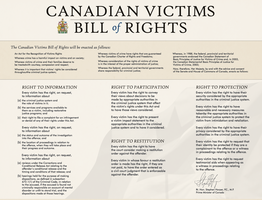
Victims of crime have specific rights during the sentencing process, as outlined in the Canadian Victims Bill of Rights:
Right to Information: Victims can request information about the criminal justice process and the status of the offender.
Right to Participation: Victims may present victim impact statements and participate in proceedings.
Right to Protection: Victims have the right to security and privacy, and to measures that protect them from intimidation or retaliation.
Right to Restitution: Victims can seek financial compensation for losses resulting from the crime.
Right to Remedy: Victims can file complaints if their rights are not respected.
Restorative Approaches
Restorative Justice in Sentencing
Restorative justice focuses on repairing harm caused by crime and involving victims, offenders, and the community in the process. This approach emphasizes accountability, making amends, and reintegrating offenders into society.
Reparations: Offenders may be required to compensate victims or perform community service.
Promoting Responsibility: Encourages offenders to understand the impact of their actions and take steps to make things right.
The Politics of Sentencing
Political Influence on Sentencing Policy
Sentencing policies are influenced by political ideologies and government priorities. Different administrations may emphasize punitive measures or rehabilitation and restorative justice.
Conservative Governments (2006-2016): Often prioritize tougher sentences, mandatory minimums, and public safety.
Liberal Governments (2016-present): May focus more on rehabilitation, restorative justice, and reducing mandatory minimums.
The Effectiveness of Sentencing
Evaluating Sentencing Outcomes
Research indicates that the effectiveness of sentencing varies:
Severity vs. Certainty: Harsher sentences do not necessarily deter crime; the certainty of being caught is a stronger deterrent.
Consistency: Sentencing can be inconsistent, with most offences having only a maximum sentence and outcomes not always matched to offender needs.
Prison Terms: Longer prison terms do not reduce crime rates; mandatory minimums are not effective deterrents.
Corrections: The transition from court to corrections is not always seamless or effective in addressing offender rehabilitation.
Application: You Be The Judge
Case Study: Class v. Thompson
In this exercise, students are asked to weigh various sentencing objectives and factors in a hypothetical case involving robbery with a weapon. Key considerations include:
Denunciation: Publicly condemning the crime.
Deterrence: Discouraging similar offences.
Separation: Protecting society by removing the offender if necessary.
Rehabilitation: Addressing underlying issues such as substance abuse and supporting reintegration.
Reparations: Compensating victims or the community.
Promoting Responsibility: Encouraging the offender to accept responsibility and make amends.
Judges must balance aggravating and mitigating circumstances, pre-sentence reports, victim impact statements, case law, psychological assessments, and the offender’s specific characteristics.
Summary Table: Sentencing Purposes, Objectives, and Factors
Purpose | Objective | Judicial Factors |
|---|---|---|
Protect Society | Separate/Incapacitate | Aggravating Circumstances |
Respect for Law | Denounce | Mitigating Circumstances |
Safe, Just Society | Rehabilitate | Pre-Sentence Report |
Justice | Proportionality | Victim Impact Statements |
Deterrence | Deter | Case Law |
Restorative | Reparations | Psychological Assessments |
Responsibility | Promote Responsibility | Specific Characteristics |
Additional info: These notes synthesize key concepts from criminal justice and sentencing, providing context for psychology students studying the intersection of law, behavior, and societal responses to crime.
