 Back
BackSocial and Personality Development in Adolescence: Mini-Textbook Study Notes
Study Guide - Smart Notes
 Tailored notes based on your materials, expanded with key definitions, examples, and context.
Social and Personality Development in Adolescence
Theories of Social and Personality Development in Adolescence
Adolescence is a critical period for social and personality development, marked by the emergence of romantic interests and the formation of personal identity. Psychoanalytic and psychosocial theories provide frameworks for understanding these changes.
Freud's Perspective: Freud viewed adolescence as the final stage of personality development, with puberty awakening sexual drives. The remainder of life is spent in the genital stage, pursuing satisfactory sexual relationships.
Erikson's Perspective: Erikson emphasized the importance of achieving a sense of personal identity, identifying the central crisis as identity versus role confusion. Adolescents experience a moratorium, a period between childhood and adulthood, during which they must forge a new identity to navigate adult roles.
Marcia’s Theory of Identity Achievement
James Marcia expanded on Erikson’s ideas, proposing that adolescent identity formation involves two key components: crisis and commitment. Marcia identified four identity statuses based on the presence or absence of these components.
Crisis: A period of decision-making when old values and choices are reexamined.
Commitment: The outcome of reevaluation, resulting in dedication to a specific role, value, goal, or ideology.
Commitment Present | Commitment Absent | |
|---|---|---|
Crisis Present | Identity achievement "I want to help people and am good at science, so I decided to be a nurse." | Moratorium "I like psychology and am taking a variety of courses to determine whether I want to major in it or not." |
Crisis Absent | Identity foreclosure "I am going into the military, because that's what everyone in my family does when they finish high school." | Identity diffusion "I haven't given the future a lot of thought. I'm sure something will come along to push me in one direction or another." |

Identity achievement: Crisis and commitment are both present.
Moratorium: Crisis is present, commitment is absent.
Foreclosure: Commitment is present, crisis is absent.
Identity diffusion: Both crisis and commitment are absent.
Research indicates that identity development generally moves toward achievement, but statuses may fluctuate during adolescence and continue into adulthood. Teenagers facing extreme stressors may be best adjusted when adopting foreclosure status.
Self-Concept in Adolescence
Self-concept evolves during adolescence, influenced by inner characteristics, identity status, and layers of social influence. Bronfenbrenner’s model of layered contexts is useful for understanding these elements.
Self-Understanding
Adolescents’ self-concept becomes more abstract and focused on enduring internal characteristics, known as the psychological self. This trend is facilitated by the increasing stability of the Big Five personality traits.
Personality Traits: By late adolescence, teens describe themselves in terms of enduring traits, beliefs, personal philosophy, and moral standards.
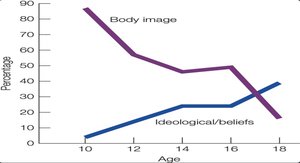
Example: The importance of body image decreases with age, while ideological beliefs become more prominent in self-descriptions.
Differentiated Self-Concepts
Adolescents develop differentiated self-concepts, seeing themselves differently in various roles. This differentiation is linked to reductions in identity diffusion and predicts behavior across domains such as motor skills, physical appearance, academics, and social competence.
Self-Esteem
Self-esteem is influenced by perceived competence in valued domains. Adolescents with high self-esteem tend to experience positive developmental outcomes. Although self-esteem is unstable during adolescence, it generally rises throughout the teen years.
Gender Role Identity
Gender role identity refers to self-perceived feelings of maleness or femaleness and their alignment with assigned sex. Gender expression is the correlation between gender identity and social self-presentation. Parental attitudes and behaviors play a significant role in shaping gender role identity.
Four Basic Gender Roles: Masculine, Feminine, Androgynous, Undifferentiated
Androgynous: Individuals possess both masculine and feminine traits.
Undifferentiated: Individuals lack both masculine and feminine traits.
Masculinity High | Masculinity Low | |
|---|---|---|
Femininity High | Androgynous | Feminine |
Femininity Low | Masculine | Undifferentiated |
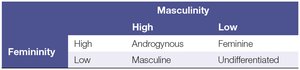
Research Findings: Androgynous and masculine gender role identities are associated with higher self-esteem in both male and female adolescents. Females with feminine identities are more prone to anxiety. Masculinity is protective against depressive symptoms, and a "masculine bias" exists across cultures.
Ethnic-Racial Identity (ERI)
Adolescents of color in predominantly White cultures must develop both individual and ethnic-racial identities. Ethnic-racial identity includes self-identification, commitment to group values, and attitudes about the group. Racial refers to shared external characteristics, while ethnic refers to cultural heritage.
Phinney’s Stages of Ethnic Identity Development
Unexamined Ethnic Identity: Initial stage where ethnic identity is not yet explored.
Ethnic Identity Search: Adolescents actively seek to understand their ethnic background.
Ethnic Identity Achievement: Adolescents develop a secure sense of ethnic identity.
Conflicts may lead to the creation of dual identities—one for interacting with the dominant group and another for their own group.
Bicultural Orientation: Associated with high self-esteem and positive relations with both the dominant culture and one’s own ethnic group. Biculturalism is a protective factor for adolescent well-being and self-efficacy.
Additional info: Bicultural identity does not impede the development of single-group identities and is found to be beneficial for psychological health.
