 Back
BackChapter 15.2
Study Guide - Smart Notes
 Tailored notes based on your materials, expanded with key definitions, examples, and context.
Social Psychology: Key Concepts and Applications
Prosocial Behaviour
Prosocial behaviour refers to actions intended to benefit others. Understanding the factors that influence helping behaviour is central to social psychology.
Definition: Behaviour that benefits another person.
Situational Influences: People are more likely to help in certain situations, such as when they are alone or when the victim is a family member (genetic relation increases likelihood of helping).
Bystander Effect: The phenomenon where individuals are less likely to help when others are present, due to diffusion of responsibility.
Norms of Reciprocity: The expectation that people will help those who have helped them.
Altruism: Selfless acts intended to benefit others without conscious regard for one's own self-interest. Critics argue that if helping makes you feel good, it may not be truly selfless.
Example: Donating anonymously to charity or risking personal safety to help a stranger.
Additional info: Altruism is debated in psychology, with some suggesting all helping behaviour has underlying self-benefit (egoism vs. altruism debate).
Aggression
Aggression encompasses behaviours intended to harm others, and can be classified by motivation and context.
Hostile Aggression: Harmful behaviour driven by anger.
Instrumental Aggression: Aggression used as a means to achieve a goal (not necessarily driven by anger).
Frustration-Aggression Theory: Aggression increases when an individual is prevented from achieving an important goal.
Evolutionary Theory: Aggression may have evolved to aid in reproduction and survival.
Environmental Factors: Heat can increase aggression; for example, lack of air conditioning in prisons or schools may contribute to aggressive incidents.
Culture of Honour: Some cultures endorse aggression to defend one's reputation or honour.
Gender Differences: Women are more likely to engage in verbal and instrumental aggression (e.g., public shaming, exclusion, spreading rumours).
ABC Model of Attitudes
The ABC Model explains attitudes as composed of three components: affective, behavioural, and cognitive. This model helps in understanding how attitudes influence behaviour and decision-making.
Affective: Emotional response or feelings toward an object or issue (e.g., feeling that composting is important).
Behavioural: Actions or observable behaviour toward the object (e.g., composting regularly).
Cognitive: Beliefs or thoughts about the object (e.g., composting reduces CO2 emissions).
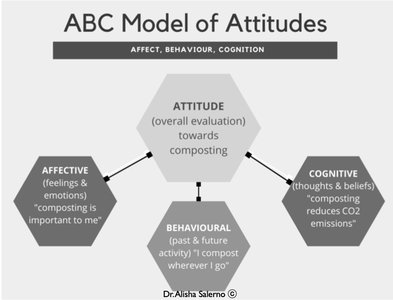
Example: A person who believes composting is good for the environment (cognitive), feels positive about it (affective), and composts regularly (behavioural).
Persuasion and Attitude Change
Persuasion involves changing attitudes to influence behaviour. The Elaboration Likelihood Model (ELM) describes two main routes to persuasion.
Central Route: Involves careful, thoughtful consideration of the arguments (high elaboration).
Peripheral Route: Involves superficial cues such as the speaker's credibility or attractiveness (low elaboration).
Determinants of Route Selection: Source (who delivers the message), message content, and audience characteristics.
Source Credibility: Expertise and trustworthiness of the communicator can enhance persuasion, especially via the peripheral route.
Expert Fallacy: Assuming expertise in one area translates to another, or that experts are always correct, is a logical fallacy.
Communicator Attractiveness: Attractive communicators are often perceived as more credible.
Two-Sided Messages: Presenting both sides of an argument can increase credibility (e.g., "This cake is good, but if you don't like sugar, avoid it").
Attitude Inoculation: Exposing people to weak counterarguments strengthens their original attitudes.
Emotional Appeals: Messages that evoke emotions (especially fear) can be persuasive, but excessive fear may trigger defensive reactions.
Audience Factors: Young adults (18-25), individuals with low self-esteem, lower IQ, low need for cognition, and high self-monitoring are more easily persuaded.
Additional info: The ELM is widely used in advertising and health campaigns to tailor messages for maximum impact.
Cognitive Dissonance
Cognitive dissonance is the psychological discomfort experienced when holding two conflicting beliefs or attitudes. People are motivated to reduce this discomfort by changing their attitudes, beliefs, or behaviours.
Definition: Unpleasant mental tension from holding conflicting thoughts or beliefs.
Reduction: Individuals strive to reduce or eliminate dissonance, often by changing their attitudes or justifying their behaviour.
Example: In a classic study, participants paid $1 to perform a boring task reported enjoying it more than those paid $20, as the lower payment provided less external justification, leading to attitude change.
Prejudice, Stereotypes, and Discrimination
Prejudice, stereotypes, and discrimination are related but distinct concepts that contribute to social inequality and conflict.
Prejudice: Negative attitude or feeling toward an individual based on group membership (e.g., disliking people who own small dogs).
Stereotype: Specific belief or assumption about individuals based on group membership (e.g., believing small dog owners are annoying).
Discrimination: Negative action toward an individual due to group membership (e.g., refusing to hire small dog owners).
Explicit Prejudice: Biases that individuals are aware of and can express openly.
Implicit Prejudice: Unconscious biases that influence behaviour without conscious awareness. The Implicit Associations Test (IAT) is used to measure these biases.
Difference: Prejudice is about feelings, stereotypes are about beliefs, and discrimination is about actions.
Nature and Roots of Prejudice
Adaptive Conservatism: Natural tendency to distrust what is unfamiliar or different.
In-group Bias: Favouring members of one's own group.
Out-group Bias: Treating everyone equally, regardless of group membership.
Scapegoat Hypothesis: Blaming others for personal problems.
Just-world Hypothesis: Belief that people get what they deserve.
Conformity: Adopting the views or behaviours of others.
Scarcity: Prejudice increases when groups compete for limited resources.
Extrinsic vs. Intrinsic Religiosity: Using religion for personal gain (extrinsic) versus genuinely living by religious values (intrinsic).
Perceptual Bias: Studies show people may be more likely to perceive a weapon when shown a Black person compared to a White person, reflecting implicit bias.
Additional info: Prejudice can be reduced through intergroup contact, education, and perspective-taking interventions.
