 Back
BackCrime, Deviance, Institutional Racism, and Precarity: Indigenous and Sociological Perspectives
Study Guide - Smart Notes
 Tailored notes based on your materials, expanded with key definitions, examples, and context.
Crime, Deviance, and the Law: An Indigenous Perspective
Introduction
This section explores the sociological concepts of crime, deviance, and the law, focusing on the experiences of Indigenous peoples in Canada. It highlights the impact of colonization, institutional racism, and the need for justice systems that reflect Indigenous perspectives and holistic approaches.
Processes of Colonization and Institutional Racism
Colonization refers to the historical and ongoing process by which settler societies dominate and marginalize Indigenous peoples, often through legal, social, and economic means.
Institutional Racism is racial prejudice embedded in social, political, and legal institutions, resulting in systemic disadvantages for minority groups.
Examples include the overrepresentation of Indigenous peoples in the criminal justice system, exclusion from traditional laws, and the banning of cultural ceremonies.
Six indicators of institutional racism (Fleras & Elliott, 2003):
Supported by cultural values
Expressed through norms
Approved by the state
Intrusive in interpersonal relations
Codified into discriminatory laws
Excludes minorities from equal participation
Crime, Deviance, and the Law: Indigenous vs. Western Perspectives
Crime in Western systems is defined as an offense against the state, while Indigenous perspectives often see crime as harm between individuals or to the community.
Deviance is behavior that violates social norms but is not necessarily criminal (e.g., body tattoos).
Western legal systems have marginalized Indigenous concepts of justice, often criminalizing traditional practices such as hunting, fishing, and ceremonies.
Indigenous justice emphasizes healing, restoration, and community involvement rather than punishment.
Evidence and Impact of Institutional Racism
Indigenous peoples face higher rates of incarceration, harsher sentences, and are less likely to receive parole compared to non-Indigenous peoples.
Historical policies such as the reserve, pass, and permit systems, and residential schools have contributed to social dysfunction, poverty, and loss of culture.
Movements like the inquiry into Missing and Murdered Indigenous Women and Girls (MMIWG) highlight ongoing violence and systemic neglect.
Indigenous Justice and Holistic Approaches
Traditional Indigenous justice systems focus on healing, accountability, and restoring relationships within the community.
Practices include healing circles, sentencing circles, and the involvement of Elders as knowledge keepers and guides.
Restorative justice is preferred over punitive measures, with an emphasis on repairing harm and reintegrating offenders.
The Four Directions Model: An Indigenous-Based Holistic Research Methodology
The Four Directions Model is a framework used to understand Indigenous approaches to justice, emphasizing the balance of mental, physical, emotional, and spiritual realms.
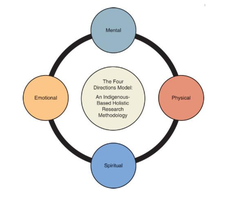
Mental Realm: Focuses on understanding the root causes of wrongful behavior and emphasizes healing and personal growth.
Physical Realm: Stresses accountability and the need for offenders to take responsibility for their actions, often through restorative practices.
Emotional Realm: Involves community support, empathy, and the importance of forgiveness and reconciliation.
Spiritual Realm: Recognizes the role of spirituality and ceremonies in healing and justice.
Summary of Indigenous Justice Findings
Justice is achieved through healing, restoration, and community involvement.
Material compensation may be used to repair harm, but the focus remains on restoring balance and relationships.
Colonial legal systems have disrupted traditional practices, but Indigenous justice traditions persist and offer valuable lessons for broader society.
Precarity and Precarious Employment
Introduction
This section examines the rise of precarious employment in Canada, its forms, and its consequences for individuals and communities. Precarity is understood as a public issue affecting social, economic, and personal well-being.
Defining Precarity and Precarious Employment
Precarity refers to unstable, insecure, and low-paying work arrangements lacking benefits and protections.
Standard Employment Relationship (SER): Traditionally full-time, permanent, with benefits and job security.
Precarious Employment: Includes temporary, part-time, contract, and gig work, often without benefits or job security.
Precarity affects workers across all sectors and social classes, not just low-wage or unskilled jobs.
Trends and Forms of Precarious Employment
Growth in temporary and part-time work, especially in sectors like information, culture, recreation, accommodation, and food services.
Women, visible minorities, recent immigrants, young workers, and older adults are disproportionately affected.
Precarity is increasing even in traditionally stable professions, such as university academics.
Statistical Evidence: Involuntary Part-Time Work
The rate of involuntary part-time work (workers who would prefer full-time employment but cannot find it) varies by age and gender. The data show that women and younger workers are more likely to be involuntarily part-time employed.
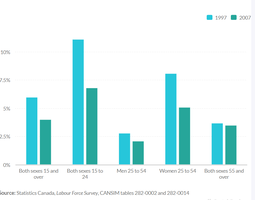
Women aged 25 to 54 have higher rates of involuntary part-time work compared to men.
Younger workers (15 to 24) are most affected by involuntary part-time employment.
Consequences of Precarious Employment (The Precarity Penalty)
Lower Income and Job Security: Precariously employed workers face lower earnings, irregular schedules, and frequent unemployment.
Deskilling: Workers may lose skills due to lack of training or reliance on automation.
Delayed Life Milestones: Insecure employment leads to delays in forming relationships, starting families, and participating in community life.
Social Isolation: Financial instability and unpredictable work hours hinder social connections, especially among racialized workers.
Mental and Physical Health: Precarity is linked to poorer health outcomes and increased stress.
Policy Responses and Social Movements
Recent policy initiatives (e.g., Ontario's Fair Workplace and Better Jobs Act) aimed to improve protections for precarious workers but have faced political challenges.
The "Fight for Fifteen" movement advocates for higher minimum wages, equal pay, better working conditions, and the right to unionize.
Solutions must address the multidimensional and intersectional impacts of precarity, including economic, social, and cultural dimensions.
Summary
Precarious employment is a growing feature of the Canadian labour market, affecting a wide range of workers.
The effects of precarity extend beyond income, impacting health, relationships, and community engagement.
Addressing precarity requires comprehensive policy reforms and collective action to ensure fair and secure work for all.
