 Back
BackMedia Use, Feelings of Being Devalued, and Democratically Corrosive Sentiment in the US: Sociological Perspectives
Study Guide - Smart Notes
 Tailored notes based on your materials, expanded with key definitions, examples, and context.
Media, Social Attitudes, and Democratic Health
Introduction to Democratically Corrosive Sentiment (DCS)
Democratically corrosive sentiments (DCS) refer to attitudes and beliefs that undermine democratic norms and processes. In the US, DCS is operationalized through populist attitudes, conspiracy beliefs, and expectation of election fraud. These sentiments are shaped by both materialist concerns (economic well-being) and identity/cultural factors, with media use playing a significant but complex role.
Populist Attitudes: Belief in a fundamental opposition between 'the people' (pure, good) and 'elites' (corrupt, bad).
Conspiracy Beliefs: General orientation toward believing that powerful groups secretly manipulate events against the public interest.
Expectation of Election Fraud: Anticipation of significant fraud in upcoming elections, combining populist mistrust and conspiracism.
Key Predictors: Political interest, education, right-wing authoritarianism, social dominance orientation, and feelings of being devalued.
Media Use and Its Relationship to DCS
Mass Media: Mainstream vs. Right-Wing
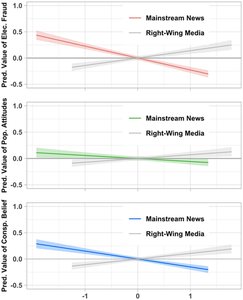
Mass media in the US can be divided into mainstream news (e.g., New York Times, CNN) and right-wing media (e.g., Fox News, Breitbart). These two types have opposite associations with DCS:
Mainstream News: Tends to be inversely associated with DCS, potentially tempering anti-democratic attitudes through responsible journalism.
Right-Wing Media: Positively associated with DCS, often promoting populist and conspiratorial narratives.
Selective Exposure: Individuals may choose media that reinforce their existing beliefs, but mainstream news can also reach those with DCS.
Example: A person who regularly watches right-wing media may be more likely to believe in election fraud and conspiracy theories, while those who consume mainstream news may be less susceptible to these beliefs.
Social Media: Stronger-Tie, Weaker-Tie, and Alt-Tech
Social media platforms differ in their network structures and political impact:
Stronger-Tie Social Media: Platforms like Facebook, WhatsApp, and Snapchat, which emphasize connections among family and friends. These are more strongly associated with DCS due to higher political homophily and safer environments for sharing stigmatized views.
Weaker-Tie Social Media: Platforms like Twitter/X, Instagram, and TikTok, which facilitate broader, interest-based networks. These show little to no association with DCS when controlling for other factors.
Alt-Tech Social Media: Platforms such as Gab, Truth Social, and 4chan/8chan, designed for users with extremist or anti-democratic views. Use of these platforms is strongly associated with DCS.
Example: Engagement with Gab or Truth Social is a strong predictor of conspiracy beliefs and populist attitudes, while general use of Twitter/X is not.
Feelings of Being Devalued (FBD)
Concept and Measurement
Feelings of Being Devalued (FBD) is a new attitudinal measure capturing a generalized sense of decline in status, well-being, or significance, not limited to group identity or economic hardship. FBD is operationalized through agreement with statements such as:
"Today’s society often makes me feel worthless."
"Society exploits people like me."
"People like me are not valued the same way as before."
FBD is a powerful predictor of DCS, outperforming traditional measures like right-wing authoritarianism and social dominance orientation.
Empirical Findings and Correlations
Correlations Among DCS Components and Conspiracy Beliefs
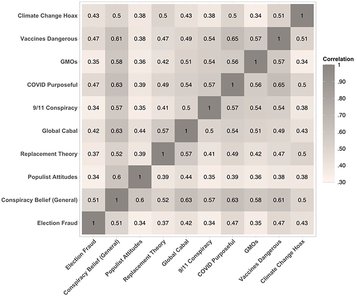
Empirical analysis shows strong correlations among various conspiracy beliefs, populist attitudes, and expectation of election fraud. These relationships highlight the interconnectedness of anti-democratic sentiments.
Variable 1 | Variable 2 | Correlation (r) |
|---|---|---|
General Conspiracy Belief | Expectation of Election Fraud | 0.51 |
Populist Attitudes | General Conspiracy Belief | 0.60 |
Climate Change Hoax | Vaccines Dangerous | 0.43 |
9/11 Conspiracy | Global Cabal | 0.57 |
GMOs | COVID Purposeful | 0.55 |
Key Sociological Concepts and Definitions
Populism: A political ideology emphasizing the antagonism between 'the people' and 'elites'.
Conspiracism: A general tendency to believe that powerful groups secretly manipulate events.
Status Threat: Perceived risk of losing social, economic, or cultural status, often linked to support for populist movements.
Social Dominance Orientation: Preference for hierarchy and inequality among social groups.
Right-Wing Authoritarianism: Adherence to conventional norms, submission to authorities, and aggression toward outgroups.
Summary Table: Media Types and Their Association with DCS
Media Type | Association with DCS | Examples |
|---|---|---|
Mainstream News | Negative | New York Times, CNN |
Right-Wing Media | Positive | Fox News, Breitbart |
Stronger-Tie Social Media | Positive | Facebook, WhatsApp |
Weaker-Tie Social Media | None/Weak | Twitter/X, Instagram |
Alt-Tech Social Media | Strong Positive | Gab, Truth Social |
Conclusion
This study demonstrates that media use, especially attention to right-wing and Alt-Tech social media, is strongly associated with democratically corrosive sentiments in the US. Feelings of being devalued are a powerful attitudinal predictor of DCS, suggesting that both media environment and personal perceptions of status and significance play critical roles in shaping anti-democratic attitudes. These findings have important implications for understanding the sociological dynamics of media, identity, and democracy.
