 Back
BackServices and Settlements: Foundations of Human Geography
Study Guide - Smart Notes
 Tailored notes based on your materials, expanded with key definitions, examples, and context.
Services, Settlements, and Geography
Definition and Types of Services
Services are activities that fulfill human wants or needs and return money to those who provide them. The three main types of services are:
Consumer Services: Provided directly to individual consumers (e.g., hairdressers, retail stores).
Business Services: Facilitate the activities of other businesses (e.g., transportation, IT, finance).
Public Services: Provide security and protection for citizens and businesses (e.g., government employees, police).
Settlements are permanent collections of buildings where people reside, work, and obtain services. Services tend to cluster in settlements, especially in developed countries, reflecting a shift from primary (agriculture, mining) and secondary (manufacturing) sectors to the tertiary (service) sector.

Key Sectors of Consumer Services:
Retail and Wholesale: Includes department stores, grocers, and vehicle sales.
Health and Social Services: Hospitals, doctors’ offices, nursing homes, and social assistance.
Education Services: Public and private educators.
Leisure and Hospitality: Restaurants, bars, lodging, arts, and entertainment.
Key Sectors of Business Services:
Professional Services: Law, management, accounting, architecture, engineering, consulting.
Transportation and Information: Trucking, warehousing, publishing, broadcasting, utilities.
Financial Services (FIRE): Finance, insurance, real estate.
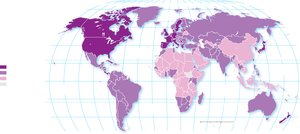
Services are the major contributor to GDP in developed countries, with approximately half of U.S. jobs in consumer services and one-fourth in business services.
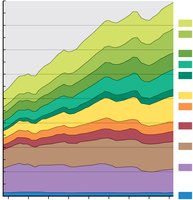
Recent employment growth in the United States has been concentrated in the tertiary (service) sector, especially consumer services.
Distribution of Consumer Services
Central Place Theory
Central place theory is used to determine the most profitable location for a business. A central place is a market center where people exchange goods and services. The market area is the area surrounding a service from which customers are attracted. Two key concepts are:
Range: The maximum distance people are willing to travel to use a service.
Threshold: The minimum number of people needed to support a service.

Hexagons are used in central place theory to approximate circles without leaving gaps, symbolizing market areas efficiently.
Hierarchy of Consumer Services
Central place theory predicts that small settlements have small thresholds and ranges, while large settlements have larger thresholds and ranges. Developed countries often follow the rank-size rule, where the nth largest settlement is 1/n the population of the largest settlement. In contrast, developing countries are more likely to have primate cities, where services are disproportionately concentrated in one city.
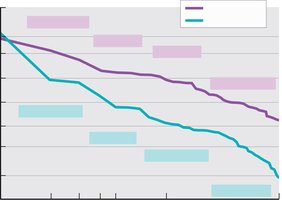
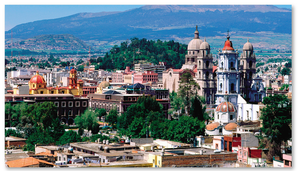
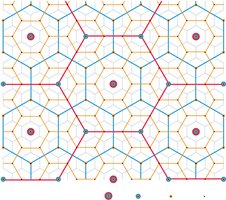
There are many hamlets, fewer villages, even fewer small towns, and only one city in a given region, reflecting the predictions of central place theory.
Market Area Analysis
When determining the site location for a service, four factors are considered:
Define the market area
Estimate the range
Estimate the threshold
Predict the market share
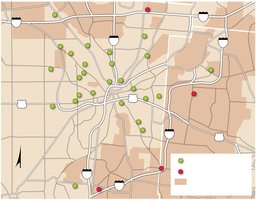
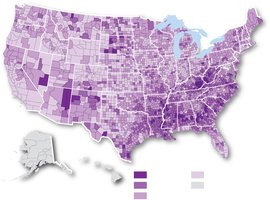
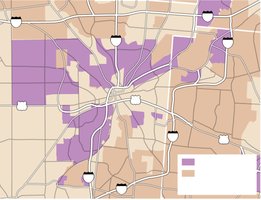
The gravity model predicts the optimal location of a service is directly related to the number of people in the area and inversely related to the distance people must travel to access it. Areas with limited access to affordable and nutritious food are known as food deserts, often found in poorer urban and rural areas.
Periodic and Sharing Services
A periodic market is a collection of individual vendors who come together to offer goods and services in a location on specified days. Sharing services (e.g., Airbnb, Uber, Lyft) have become popular, allowing individuals to share resources and services.

Business Services and Economic Specialization
Hierarchy of Business Services
A global city is a major center for the provision of services in the global economy, such as financial institutions, corporate headquarters, and professional services. Global cities are ranked by their economic, political, cultural, infrastructure, and transportation importance.
Developing countries specialize in two types of business services: offshore financial services (low taxes, privacy) and back-office functions (outsourcing for low wages and English proficiency).
Settlements can be classified by their economic base:
Basic businesses: Export primarily to customers outside the settlement.
Nonbasic businesses: Serve primarily customers living in the same settlement.
The unique cluster of basic businesses in a settlement is its economic base. Talented workers are attracted to cities with job opportunities and cultural amenities.
Services in Rural and Urban Settlements
Types of Rural Settlements
There are two main types of rural settlements:
Clustered rural settlement: Agricultural-based community where families live in close proximity, with fields surrounding the collection of houses and farm buildings. Can be circular or linear.
Dispersed rural settlement: Farmers live on individual farms isolated from neighbors.
Services in Early Urban Settlements
Prehistoric urban settlements engaged in religious, business, and public services. The earliest settlements originated in Mesopotamia, with urbanization peaking during the Roman Empire and reviving in medieval Europe.
Urbanization and Megacities
Urbanization is the process by which the population of urban settlements grows, involving both an increase in the percentage and the number of people living in urban areas. Urban settlements are characterized by larger size, higher density, and social heterogeneity compared to rural settlements.
The percentage of the world living in urban areas has increased, with the pace of urbanization faster in developing countries. Developed countries are generally more urbanized, but most of the world's largest cities are now in developing countries, especially in East and South Asia and Latin America.
A megacity is an urban settlement with a population over 10 million, while a metacity has more than 20 million people. The fastest-growing urban settlements are in developing countries.
