 Back
BackSocial Organization, Government, and Culture in Early Imperial China: Sociological Perspectives
Study Guide - Smart Notes
 Tailored notes based on your materials, expanded with key definitions, examples, and context.
Society and Social Interaction in Early Imperial China
Social Structure and Kinship
Early imperial China was characterized by strong kinship ties and hierarchical social structures. The family was considered the fundamental unit of society, with individual interests subordinated to the collective strength of the kin group.
Kin Group Organization: Grandparents, parents, sons, and daughters-in-law lived and worked together, with property managed by family elders.
Obedience and Hierarchy: Younger members were expected to obey elders, reinforcing social order and stability.
Confucian Values: These values, though prominent in Confucianism, predated Confucius and emphasized filial piety, respect, and communal living.
Example: The Han Dynasty promoted these ideals, shaping social expectations and behavior.
Urbanization and Economic Change
Urbanization accelerated during the Qin and Han dynasties, transforming cities from ritual centers to commercial hubs. Standardization of currency and infrastructure improvements facilitated trade and economic growth.
Commercial Centers: Cities became sites of long-distance trade, with merchants dealing in diverse goods.
Economic Inequality: Wealthy merchants invested in land, reducing fields available to free peasants and increasing rural poverty.
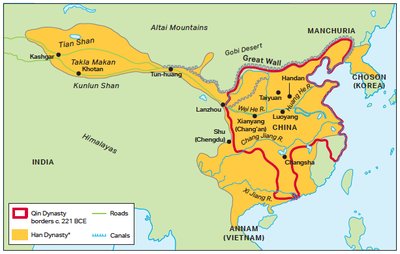
Infrastructure: Emperors constructed canals, roads, and fortifications, centralizing resources and administration.
Example: The thriving commercial economy led to both prosperity and social stratification.
Government and Politics: Bureaucratization and Philosophical Foundations
Bureaucratization and Legalism
The Qin Dynasty marked a shift toward bureaucratic governance, influenced by the philosophy of Legalism. This system emphasized clear laws, hierarchy, and nondiscriminatory incentives and punishments.
Bureaucratization: The process of creating systems, rules, and hierarchy to run organizations efficiently.
Legalism: Advocated absolute monarchy, rule by law, and strong incentives, challenging aristocratic privilege.
Military Organization: Bureaucratization extended to the military, shifting from cavalry to infantry and standardized procedures.
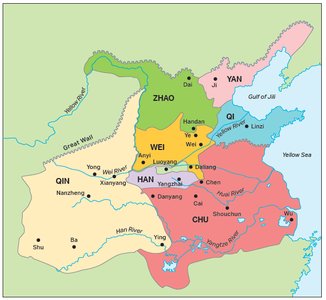
Example: The Qin Dynasty unified China, standardized tools, measures, and script, and centralized power.
Confucianism and Governance
Confucianism, widely adopted in the Han Dynasty, emphasized moral leadership, filial piety, and the importance of public trust in rulers. It advocated for benevolent governance and the cultivation of virtue.
Filial Piety: Respect for elders and family was central to social harmony.
Government Principles: Sincerity, caution in spending, love for people, and wise employment of talent were key.
Public Trust: Confucius argued that the confidence of the people in their ruler was more important than military or material sufficiency.
Nonviolence: Confucian governance discouraged the use of force, promoting moral example instead.
Example: The Analects record Confucius' advice to rulers, prioritizing faith and virtue over coercion.
Daoism and Rulership
Daoism offered an alternative vision of governance, emphasizing restraint, non-compulsion, and harmony with the people. Daoist rulers were encouraged to act subtly, allowing subjects to feel autonomous.
Restraint: Wise rulers practiced self-restraint and avoided unnecessary actions.
Non-Compulsion: Daoist governance relied on persuasion rather than force.
Harmony: The ideal ruler fostered quietness and self-rule among the people.
Example: The Tao Te Ching describes rulers who are barely noticed, yet effective.
Culture: Standardization and Social Order
Standardization and Unity
The Qin Dynasty initiated widespread standardization to unify China, including tools, measures, and written script. This facilitated communication, administration, and economic integration.
Standardization: Uniformity in tools, measures, and script promoted efficiency and cohesion.
Social Harmony: The emperor's achievements were celebrated for bringing prosperity and order.
Example: Qin Shihuangdi's inscriptions emphasized the new age of unity and rectified rules.
Alienation and Participation
Despite efficient administration, the bureaucratic system distanced ordinary people from government decision-making. Unlike democratic systems in Athens or Rome, early imperial China was highly centralized.
Alienation: Most people were removed from political participation, with decisions made by the emperor and bureaucracy.
Comparison: In contrast, classical Athens and Rome allowed some degree of public involvement.
Example: The Han Dynasty's bureaucracy enabled large-scale projects but limited popular influence.
Social Stratification and Inequality
Economic Stratification
The rise of commerce and urbanization led to increased social stratification. Wealthy merchants acquired land, reducing opportunities for free peasants and exacerbating rural poverty.
Merchant Wealth: Some merchants became landowners, concentrating wealth and power.
Rural Poverty: Economic changes brought inequality to the countryside.
Example: The commercial economy of the Han Dynasty contributed to social divisions.
Political Stratification
Legalist and Confucian philosophies reinforced hierarchical social and political structures, assigning roles based on merit, loyalty, and virtue.
Hierarchy: Ministers and officials were expected to obey superiors and serve the state loyally.
Role Assignment: Honorable and humble, stupid and wise, each found their proper place in society.
Example: Han Fei Tzu's writings describe the ideal minister's relationship to the sovereign.
Summary Table: Philosophical Approaches to Governance
Philosophy | Key Principles | Governance Style | Social Impact |
|---|---|---|---|
Legalism | Rule by law, absolute monarchy, nondiscriminatory incentives | Centralized, bureaucratic, strict | Efficient administration, limited aristocratic power |
Confucianism | Filial piety, moral leadership, public trust | Benevolent, hierarchical, virtue-based | Social harmony, respect for elders, limited popular participation |
Daoism | Restraint, non-compulsion, harmony | Subtle, non-interventionist, persuasive | Autonomy, quietness, minimal government interference |
