
A delivery service tracks the weights of its packages. A sample of 20 packages has a variance of 4.5 lbs2. Construct a 95% conf. int. for the population variance. Assume a normal distribution.
Table of contents
- 1. Intro to Stats and Collecting Data1h 14m
- 2. Describing Data with Tables and Graphs1h 56m
- 3. Describing Data Numerically2h 5m
- 4. Probability2h 16m
- 5. Binomial Distribution & Discrete Random Variables3h 6m
- 6. Normal Distribution and Continuous Random Variables2h 11m
- 7. Sampling Distributions & Confidence Intervals: Mean3h 23m
- Sampling Distribution of the Sample Mean and Central Limit Theorem19m
- Distribution of Sample Mean - Excel23m
- Introduction to Confidence Intervals15m
- Confidence Intervals for Population Mean1h 18m
- Determining the Minimum Sample Size Required12m
- Finding Probabilities and T Critical Values - Excel28m
- Confidence Intervals for Population Means - Excel25m
- 8. Sampling Distributions & Confidence Intervals: Proportion2h 10m
- 9. Hypothesis Testing for One Sample5h 8m
- Steps in Hypothesis Testing1h 6m
- Performing Hypothesis Tests: Means1h 4m
- Hypothesis Testing: Means - Excel42m
- Performing Hypothesis Tests: Proportions37m
- Hypothesis Testing: Proportions - Excel27m
- Performing Hypothesis Tests: Variance12m
- Critical Values and Rejection Regions28m
- Link Between Confidence Intervals and Hypothesis Testing12m
- Type I & Type II Errors16m
- 10. Hypothesis Testing for Two Samples5h 37m
- Two Proportions1h 13m
- Two Proportions Hypothesis Test - Excel28m
- Two Means - Unknown, Unequal Variance1h 3m
- Two Means - Unknown Variances Hypothesis Test - Excel12m
- Two Means - Unknown, Equal Variance15m
- Two Means - Unknown, Equal Variances Hypothesis Test - Excel9m
- Two Means - Known Variance12m
- Two Means - Sigma Known Hypothesis Test - Excel21m
- Two Means - Matched Pairs (Dependent Samples)42m
- Matched Pairs Hypothesis Test - Excel12m
- Two Variances and F Distribution29m
- Two Variances - Graphing Calculator16m
- 11. Correlation1h 24m
- 12. Regression3h 33m
- Linear Regression & Least Squares Method26m
- Residuals12m
- Coefficient of Determination12m
- Regression Line Equation and Coefficient of Determination - Excel8m
- Finding Residuals and Creating Residual Plots - Excel11m
- Inferences for Slope31m
- Enabling Data Analysis Toolpak1m
- Regression Readout of the Data Analysis Toolpak - Excel21m
- Prediction Intervals13m
- Prediction Intervals - Excel19m
- Multiple Regression - Excel29m
- Quadratic Regression15m
- Quadratic Regression - Excel10m
- 13. Chi-Square Tests & Goodness of Fit2h 21m
- 14. ANOVA2h 28m
8. Sampling Distributions & Confidence Intervals: Proportion
Confidence Intervals for Population Variance
Problem 7.3.9
Textbook Question
Body Temperature Data Set 5 “Body Temperatures” in Appendix B includes a sample of 106 body temperatures having a mean of and a standard deviation of 0.62F (for day 2 at 12 AM). Construct a 95% confidence interval estimate of the standard deviation of the body temperatures for the entire population.
Verified step by step guidance1
Step 1: Understand the problem. We are tasked with constructing a 95% confidence interval for the population standard deviation (σ) based on a sample of 106 body temperatures. The sample standard deviation (s) is given as 0.62°F.
Step 2: Recall the formula for the confidence interval of the population standard deviation. The confidence interval is based on the chi-square distribution and is given by: \( \sqrt{\frac{(n-1)s^2}{\chi^2_{\text{upper}}}} \leq \sigma \leq \sqrt{\frac{(n-1)s^2}{\chi^2_{\text{lower}}}} \), where \( n \) is the sample size, \( s \) is the sample standard deviation, and \( \chi^2_{\text{upper}} \) and \( \chi^2_{\text{lower}} \) are the critical values of the chi-square distribution for the given confidence level.
Step 3: Identify the degrees of freedom (df) and the critical values. The degrees of freedom are \( df = n - 1 \), where \( n \) is the sample size. For a 95% confidence level, find the critical values \( \chi^2_{\text{lower}} \) and \( \chi^2_{\text{upper}} \) from the chi-square distribution table or using statistical software.
Step 4: Plug the values into the formula. Substitute \( n = 106 \), \( s = 0.62 \), and the critical values \( \chi^2_{\text{lower}} \) and \( \chi^2_{\text{upper}} \) into the confidence interval formula to calculate the lower and upper bounds for \( \sigma \).
Step 5: Interpret the result. The resulting interval provides a range of plausible values for the population standard deviation of body temperatures at a 95% confidence level. This means we are 95% confident that the true population standard deviation lies within this interval.
Verified video answer for a similar problem:This video solution was recommended by our tutors as helpful for the problem above
Video duration:
6mPlay a video:
0 Comments
Key Concepts
Here are the essential concepts you must grasp in order to answer the question correctly.
Confidence Interval
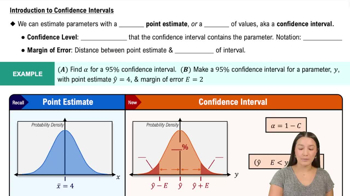
A confidence interval is a range of values, derived from a data set, that is likely to contain the true population parameter with a specified level of confidence, typically expressed as a percentage. For example, a 95% confidence interval suggests that if we were to take many samples and construct intervals in the same way, approximately 95% of those intervals would contain the true population mean or standard deviation.
Recommended video:
Introduction to Confidence Intervals
Standard Deviation
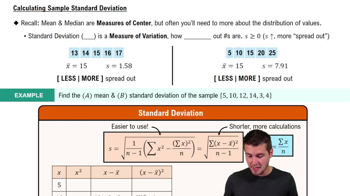
Standard deviation is a measure of the amount of variation or dispersion in a set of values. A low standard deviation indicates that the values tend to be close to the mean, while a high standard deviation indicates that the values are spread out over a wider range. In the context of the body temperature data, it helps quantify how much individual body temperatures deviate from the average temperature.
Recommended video:
Guided course
Calculating Standard Deviation
Chi-Square Distribution
The Chi-square distribution is a statistical distribution that is commonly used in hypothesis testing and constructing confidence intervals for variance and standard deviation. When estimating the standard deviation of a population from a sample, the Chi-square distribution helps determine the critical values needed to construct the confidence interval, particularly when the sample size is small or the population variance is unknown.
Recommended video:
Guided course
Mean & Standard Deviation of Binomial Distribution
Watch next
Master Constructing Confidence Intervals for Variance or Standard Deviation with a bite sized video explanation from Patrick
Start learningRelated Videos
Related Practice
Multiple Choice
25
views
