

Use the given information to find the number of degrees of freedom, the critical values X2L and X2R, and the confidence interval estimate of σ. It is reasonable to assume that a simple random sample has been selected from a population with a normal distribution:
Nicotine in Menthol Cigarettes 95% confidence; n = 25, s = 0.24 mg
Verified step by step guidance
1
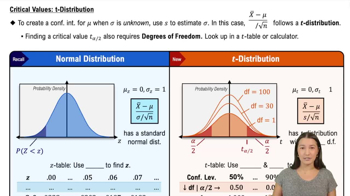
Step 1: Determine the degrees of freedom (df). The degrees of freedom for a chi-square distribution is calculated as df = n - 1, where n is the sample size. In this case, n = 25, so df = 25 - 1.
Step 2: Identify the critical values X2L and X2R. For a 95% confidence level, the chi-square critical values are found using a chi-square table or statistical software. Use the degrees of freedom (df = 24) and the confidence level (95%) to locate the values such that the area in the tails is 2.5% each (0.025 in the left tail and 0.025 in the right tail).
Step 3: Calculate the confidence interval for the population standard deviation (σ). The formula for the confidence interval of σ is: \( \sqrt{ \frac{(n-1)s^2}{X^2_R} } \leq \sigma \leq \sqrt{ \frac{(n-1)s^2}{X^2_L} } \), where \( X^2_R \) and \( X^2_L \) are the critical values, \( n \) is the sample size, and \( s \) is the sample standard deviation.
Step 4: Substitute the values into the formula. Use \( n = 25 \), \( s = 0.24 \), and the critical values \( X^2_R \) and \( X^2_L \) obtained from the chi-square table. Compute the numerator \( (n-1)s^2 \) and divide by the respective critical values.
Step 5: Take the square root of the results from Step 4 to find the lower and upper bounds of the confidence interval for \( \sigma \). This will give the range within which the population standard deviation is likely to fall with 95% confidence.
Verified video answer for a similar problem:
This video solution was recommended by our tutors as helpful for the problem above
Video duration:
7m
Play a video:
0 Comments
Key Concepts
Here are the essential concepts you must grasp in order to answer the question correctly.
Degrees of Freedom
Degrees of freedom (df) refer to the number of independent values or quantities that can vary in an analysis without violating any constraints. In the context of a sample, df is typically calculated as the sample size minus one (n - 1). This concept is crucial for determining the appropriate statistical distribution to use when conducting hypothesis tests or constructing confidence intervals.
The Chi-Square distribution is a statistical distribution that is commonly used in hypothesis testing, particularly for tests involving variance and goodness-of-fit. It is defined by its degrees of freedom and is positively skewed. Critical values from the Chi-Square distribution are used to determine the boundaries for confidence intervals and hypothesis tests, especially when assessing the variability of a sample.
Mean & Standard Deviation of Binomial Distribution
Confidence Interval for Standard Deviation
A confidence interval for the standard deviation (σ) provides a range of values within which the true population standard deviation is likely to fall, based on sample data. For a normally distributed population, this interval can be calculated using the sample standard deviation and the Chi-Square distribution. The confidence level, such as 95%, indicates the probability that the interval contains the true parameter.