

Finding Critical Values In Exercises 17–20, refer to the information in the given exercise and use a 0.05 significance level for the following.
a. Find the critical value(s). b. Should we reject H0 or should we fail to reject H0?
Exercise 16
Verified step by step guidance
1
Step 1: Identify the type of hypothesis test being conducted (e.g., one-tailed or two-tailed). This is determined by the alternative hypothesis (H1). If H1 specifies a direction (e.g., greater than or less than), it is a one-tailed test. If it does not specify a direction (e.g., not equal to), it is a two-tailed test.
Step 2: Determine the degrees of freedom (if applicable). For example, in a t-test, the degrees of freedom are typically calculated as df = n - 1, where n is the sample size.
Step 3: Use the significance level (α = 0.05) and the type of test (one-tailed or two-tailed) to find the critical value(s) from the appropriate statistical table (e.g., z-table for a z-test, t-table for a t-test, or chi-square table for a chi-square test). For a two-tailed test, divide α by 2 to find the critical values for both tails.
Step 4: Compare the test statistic (calculated from the sample data) to the critical value(s). If the test statistic falls in the critical region (beyond the critical value(s)), reject the null hypothesis (H0). Otherwise, fail to reject H0.
Step 5: Conclude the hypothesis test by interpreting the result in the context of the problem. For example, if H0 is rejected, state that there is sufficient evidence to support the alternative hypothesis (H1). If H0 is not rejected, state that there is insufficient evidence to support H1.
Verified video answer for a similar problem:
This video solution was recommended by our tutors as helpful for the problem above
Video duration:
3m
Play a video:
0 Comments
Key Concepts
Here are the essential concepts you must grasp in order to answer the question correctly.
Critical Values
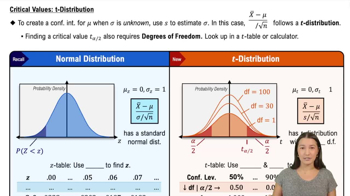
Critical values are the threshold points that define the boundaries for rejecting the null hypothesis in hypothesis testing. They are determined based on the significance level (alpha), which indicates the probability of making a Type I error. For a significance level of 0.05, critical values can be found using statistical tables or software, depending on the distribution being analyzed (e.g., normal, t-distribution).
The null hypothesis (H0) is a statement that there is no effect or no difference, and it serves as the default assumption in hypothesis testing. Researchers aim to gather evidence against H0 to support an alternative hypothesis (H1). The decision to reject or fail to reject H0 is based on the comparison of test statistics to critical values.
The significance level, denoted as alpha (α), is the probability threshold set by the researcher for determining whether to reject the null hypothesis. A common significance level is 0.05, which implies a 5% risk of concluding that a difference exists when there is none (Type I error). This level helps in making decisions based on the p-value obtained from statistical tests.