[NW] Television Stations and Life Expectancy Based on data obtained from the CIA World Factbook, the linear correlation coefficient between the number of television stations in a country and the life expectancy of residents of the country is 0.599. What does this correlation imply? Do you believe that the more television stations a country has, the longer its population can expect to live? Why or why not? What is a likely lurking variable between number of televisions and life expectancy?
Table of contents
- 1. Intro to Stats and Collecting Data1h 14m
- 2. Describing Data with Tables and Graphs1h 55m
- 3. Describing Data Numerically2h 5m
- 4. Probability2h 16m
- 5. Binomial Distribution & Discrete Random Variables3h 6m
- 6. Normal Distribution and Continuous Random Variables2h 11m
- 7. Sampling Distributions & Confidence Intervals: Mean3h 23m
- Sampling Distribution of the Sample Mean and Central Limit Theorem19m
- Distribution of Sample Mean - Excel23m
- Introduction to Confidence Intervals15m
- Confidence Intervals for Population Mean1h 18m
- Determining the Minimum Sample Size Required12m
- Finding Probabilities and T Critical Values - Excel28m
- Confidence Intervals for Population Means - Excel25m
- 8. Sampling Distributions & Confidence Intervals: Proportion1h 25m
- 9. Hypothesis Testing for One Sample3h 57m
- 10. Hypothesis Testing for Two Samples4h 50m
- Two Proportions1h 13m
- Two Proportions Hypothesis Test - Excel28m
- Two Means - Unknown, Unequal Variance1h 3m
- Two Means - Unknown Variances Hypothesis Test - Excel12m
- Two Means - Unknown, Equal Variance15m
- Two Means - Unknown, Equal Variances Hypothesis Test - Excel9m
- Two Means - Known Variance12m
- Two Means - Sigma Known Hypothesis Test - Excel21m
- Two Means - Matched Pairs (Dependent Samples)42m
- Matched Pairs Hypothesis Test - Excel12m
- 11. Correlation1h 24m
- 12. Regression1h 50m
- 13. Chi-Square Tests & Goodness of Fit2h 21m
- 14. ANOVA1h 57m
11. Correlation
Correlation Coefficient
Problem 12.3.27
Textbook Question
Why don’t we conduct inference on the linear correlation coefficient?
Verified step by step guidance1
Understand that the linear correlation coefficient, often denoted as \(r\), measures the strength and direction of a linear relationship between two variables.
Recognize that \(r\) is a descriptive statistic calculated from sample data, summarizing the degree of linear association.
Note that conducting inference directly on \(r\) is problematic because its sampling distribution is not normally distributed, especially for small sample sizes or when the true correlation is far from zero.
Learn that to perform inference about the population correlation coefficient \(\rho\), we typically apply a transformation to \(r\), such as Fisher's \(z\)-transformation, which converts \(r\) into a variable that is approximately normally distributed.
Therefore, instead of conducting inference directly on \(r\), we use Fisher's \(z\)-transformation to create confidence intervals or perform hypothesis tests about \(\rho\).
Verified video answer for a similar problem:This video solution was recommended by our tutors as helpful for the problem above
Video duration:
2mPlay a video:
Was this helpful?
Key Concepts
Here are the essential concepts you must grasp in order to answer the question correctly.
Linear Correlation Coefficient
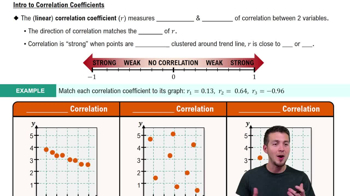
The linear correlation coefficient, often denoted as r, measures the strength and direction of a linear relationship between two variables. It ranges from -1 to 1, where values close to ±1 indicate strong linear association, and values near 0 suggest little or no linear relationship.
Recommended video:
Guided course
Correlation Coefficient
Sampling Distribution of the Correlation Coefficient
The sampling distribution of the correlation coefficient is not normally distributed, especially for small samples or when the true correlation is near ±1. This non-normality complicates direct inference, making standard methods like confidence intervals or hypothesis tests less reliable without transformation.
Recommended video:
Guided course
Correlation Coefficient
Fisher’s Z-Transformation
Fisher’s Z-transformation converts the correlation coefficient into a variable that is approximately normally distributed, enabling valid inference. This transformation stabilizes variance and allows for constructing confidence intervals and hypothesis testing about the population correlation.
Recommended video:
Guided course
Z-Scores From Given Probability - TI-84 (CE) Calculator
Watch next
Master Correlation Coefficient with a bite sized video explanation from Patrick
Start learningRelated Videos
Related Practice
Textbook Question
3
views