What does it mean to say that the linear correlation coefficient between two variables equals 1? What would the scatter diagram look like?
Verified step by step guidance
1
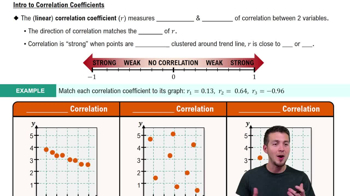
Understand that the linear correlation coefficient, often denoted as \(r\), measures the strength and direction of a linear relationship between two variables.
When \(r = 1\), it means there is a perfect positive linear relationship between the two variables. This implies that as one variable increases, the other variable increases in a perfectly predictable way.
Mathematically, this means all data points lie exactly on a straight line with a positive slope. The equation of this line can be written as \(y = mx + b\), where \(m > 0\).
In terms of the scatter diagram, the points will form a straight line slanting upwards from left to right, showing no deviation from this line.
This perfect linear relationship indicates no variability around the line, so the scatter plot will have zero scatter or spread around the line.
Verified video answer for a similar problem:
This video solution was recommended by our tutors as helpful for the problem above
Video duration:
3m
Play a video:
0 Comments
Key Concepts
Here are the essential concepts you must grasp in order to answer the question correctly.
Linear Correlation Coefficient
The linear correlation coefficient, often denoted as r, measures the strength and direction of a linear relationship between two variables. Its value ranges from -1 to 1, where 1 indicates a perfect positive linear relationship, -1 a perfect negative linear relationship, and 0 no linear relationship.
When the correlation coefficient equals 1, it means that all data points lie exactly on a straight line with a positive slope. This indicates a perfect positive linear relationship, where increases in one variable correspond to proportional increases in the other without any deviation.
Empirical Rule of Standard Deviation and Range Rule of Thumb
Scatter Diagram Representation
A scatter diagram plots paired data points on a coordinate plane. For r = 1, the scatter plot shows all points aligned perfectly along a straight line slanting upwards, reflecting the exact linear relationship without any scatter or spread around the line.

 3:26 minutes
 Verified step by step guidance
 05:43
05:43