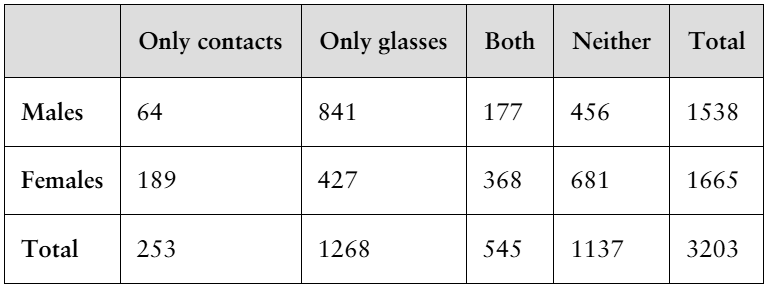
26. Eye Survey The table shows the results of a survey that asked 3203 people whether they wore contacts or glasses. A person is selected at random from the sample. Find the probability of each event. a. The person wears only contacts or only glasses.
Verified step by step guidance
1
Step 1: Identify the relevant data from the table. The table provides the number of people who wear only contacts, only glasses, both, or neither. To find the probability of a person wearing only contacts or only glasses, focus on the 'Only contacts' and 'Only glasses' columns.
Step 2: Add the total number of people who wear only contacts and only glasses. From the table, the total for 'Only contacts' is 253, and the total for 'Only glasses' is 1268. Add these values together to get the total number of people who wear either only contacts or only glasses.
Step 3: Determine the total number of people surveyed. From the table, the total number of people surveyed is 3203.
Step 4: Calculate the probability of the event. The probability is calculated as the ratio of the number of people who wear only contacts or only glasses to the total number of people surveyed. Use the formula: \( P = \frac{\text{Number of people wearing only contacts or only glasses}}{\text{Total number of people surveyed}} \).
Step 5: Simplify the fraction obtained in Step 4 to express the probability in its simplest form or as a decimal, if required.
Verified video answer for a similar problem:
This video solution was recommended by our tutors as helpful for the problem above
Video duration:
2m
Play a video:
0 Comments
Key Concepts
Here are the essential concepts you must grasp in order to answer the question correctly.
Probability
Probability is a measure of the likelihood that an event will occur, expressed as a number between 0 and 1. In this context, it involves calculating the chance of randomly selecting a person who wears only contacts or only glasses from the total surveyed population. The probability can be determined by dividing the number of favorable outcomes by the total number of outcomes.
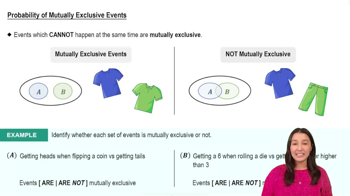
Mutually exclusive events are events that cannot occur at the same time. In this survey, wearing only contacts and wearing only glasses are mutually exclusive; a person cannot wear both at the same time. Understanding this concept is crucial for accurately calculating the probability of selecting someone who wears either only contacts or only glasses.
Total outcomes refer to the complete set of possible results in a probability scenario. In this case, the total number of surveyed individuals is 3203, which serves as the denominator when calculating probabilities. Knowing the total outcomes is essential for determining the probability of specific events, such as wearing only contacts or only glasses.