26. Eye Survey The table shows the results of a survey that asked 3203 people whether they wore contacts or glasses. A person is selected at random from the sample. Find the probability of each event. d. The person is male or does not wear glasses.
Verified step by step guidance
1
Step 1: Understand the problem. We are tasked with finding the probability that a randomly selected person is either male or does not wear glasses. This involves using the addition rule for probabilities and analyzing the table provided.
Step 2: Identify the relevant groups. From the table, the total number of males is 1538, and the total number of people who do not wear glasses includes those who wear only contacts (253) and those who wear neither (1137).
Step 3: Apply the addition rule for probabilities. The formula is P(A or B) = P(A) + P(B) - P(A and B), where A is 'male' and B is 'does not wear glasses'.
Step 4: Calculate P(A), P(B), and P(A and B). P(A) is the probability of selecting a male, which is the number of males divided by the total number of people (1538/3203). P(B) is the probability of not wearing glasses, which is the sum of people who wear only contacts and those who wear neither divided by the total number of people ((253 + 1137)/3203). P(A and B) is the probability of being male and not wearing glasses, which is the sum of males who wear only contacts and males who wear neither divided by the total number of people ((64 + 456)/3203).
Step 5: Substitute the values into the addition rule formula. Combine the probabilities calculated in Step 4 to find P(male or does not wear glasses).
Verified video answer for a similar problem:
This video solution was recommended by our tutors as helpful for the problem above
Video duration:
4m
Play a video:
0 Comments
Key Concepts
Here are the essential concepts you must grasp in order to answer the question correctly.
Probability
Probability is a measure of the likelihood that an event will occur, expressed as a number between 0 and 1. In this context, it involves calculating the chance of selecting a person who is either male or does not wear glasses from the total sample of 3203 individuals. Understanding how to compute probabilities using the total number of favorable outcomes divided by the total number of possible outcomes is essential.
The union of events refers to the occurrence of at least one of the events in question. In this scenario, we are interested in the union of two events: being male and not wearing glasses. The probability of the union can be calculated using the formula P(A ∪ B) = P(A) + P(B) - P(A ∩ B), which accounts for any overlap between the two events.
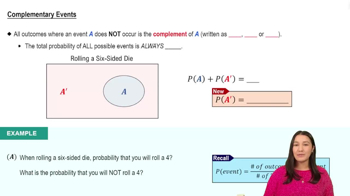
Complementary events are two outcomes of a situation that are mutually exclusive and together cover all possible outcomes. In this case, the event of not wearing glasses can be understood as the complement of wearing glasses. Recognizing complementary events helps in calculating probabilities more efficiently, especially when determining the likelihood of an event not occurring.

 4:56 minutes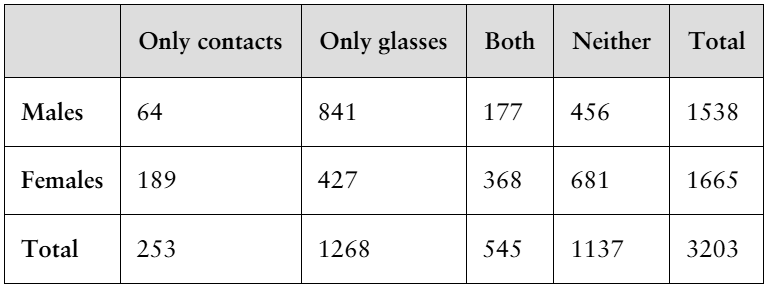
 Verified step by step guidance
 5:37
5:37