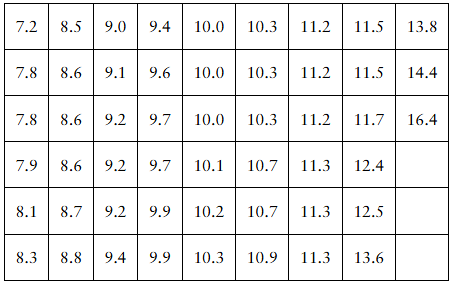
[DATA] Carpoolers The following data represent the percentage of workers who carpool to work for the 50 states plus Washington, D.C. Note: The minimum observation of 7.2% corresponds to Maine and the maximum observation of 16.4% corresponds to Hawaii. a. Find the five-number summary. b. Construct a boxplot. c. Comment on the shape of the distribution.
Verified step by step guidance
1
Step 1: Organize the data in ascending order (already provided) to facilitate finding the five-number summary.
Step 2: Identify the minimum value, which is the smallest data point: \$7.2$%.
Step 3: Identify the maximum value, which is the largest data point: \$16.4$%.
Step 4: Find the median (Q2), which is the middle value of the ordered data. Since there are 51 data points (50 states plus D.C.), the median is the 26th value in the ordered list.
Step 5: Find the first quartile (Q1), which is the median of the lower half of the data (values 1 through 25), and the third quartile (Q3), which is the median of the upper half of the data (values 27 through 51).
Verified video answer for a similar problem:
This video solution was recommended by our tutors as helpful for the problem above
Video duration:
10m
Play a video:
0 Comments
Key Concepts
Here are the essential concepts you must grasp in order to answer the question correctly.
Five-Number Summary
The five-number summary consists of the minimum, first quartile (Q1), median, third quartile (Q3), and maximum values of a data set. It provides a concise overview of the distribution's center, spread, and range, helping to identify outliers and the overall data shape.
A boxplot visually represents the five-number summary using a box and whiskers. The box spans from Q1 to Q3 with a line at the median, while whiskers extend to the minimum and maximum values within 1.5 times the interquartile range. It helps detect skewness and outliers in the data.
The shape of a distribution describes how data values are spread, including symmetry or skewness. Skewness indicates whether data tails off more to one side; right skew means a longer tail on the right, left skew on the left. Understanding shape aids in interpreting data behavior and choosing appropriate statistical methods.