Explain how the value of n, the number of trials in a binomial experiment, affects the shape of the distribution of a binomial random variable.
Verified step by step guidance
1
Recall that a binomial distribution models the number of successes in \( n \) independent trials, each with the same probability of success \( p \). The parameter \( n \) represents the number of trials.
Understand that when \( n \) is small, the binomial distribution tends to be more discrete and can appear skewed, especially if \( p \) is not close to 0.5. The distribution may have a few distinct peaks or be heavily weighted toward one side.
As \( n \) increases, the binomial distribution becomes smoother and more symmetric, especially when \( p \) is near 0.5. This is because the number of possible outcomes increases, and the probabilities spread out over a wider range of values.
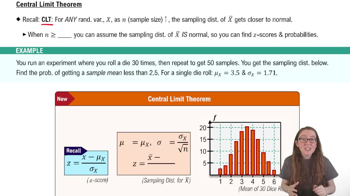
For large \( n \), the binomial distribution approaches a normal distribution shape due to the Central Limit Theorem. This means it looks bell-shaped and symmetric, with mean \( \mu = n p \) and variance \( \sigma^2 = n p (1-p) \).
In summary, increasing \( n \) changes the binomial distribution from a discrete, possibly skewed shape to a smoother, more symmetric, and approximately normal shape.
Verified video answer for a similar problem:
This video solution was recommended by our tutors as helpful for the problem above
Video duration:
1m
Play a video:
0 Comments
Key Concepts
Here are the essential concepts you must grasp in order to answer the question correctly.
Binomial Distribution
The binomial distribution models the number of successes in a fixed number of independent trials, each with the same probability of success. It is defined by two parameters: n (number of trials) and p (probability of success). Understanding this distribution is essential to analyze how changes in n affect its shape.
Mean & Standard Deviation of Binomial Distribution
Effect of Number of Trials (n) on Distribution Shape
As the number of trials n increases, the binomial distribution's shape changes from skewed to more symmetric and bell-shaped, especially when p is near 0.5. Larger n values lead to a distribution that resembles a normal distribution due to the Central Limit Theorem.
Finding Binomial Probabilities Using TI-84 Example 1
Central Limit Theorem and Normal Approximation
The Central Limit Theorem states that as n becomes large, the binomial distribution approaches a normal distribution with mean np and variance np(1-p). This approximation helps explain why the distribution's shape becomes smoother and more symmetric with increasing n.

 1:42 minutes
 Verified step by step guidance

 03:28
03:28