Explain how the value of p, the probability of success, affects the shape of the distribution of a binomial random variable.
Verified step by step guidance
1
Recall that a binomial random variable represents the number of successes in a fixed number of independent trials, each with the same probability of success \(p\).
Understand that the shape of the binomial distribution depends heavily on the value of \(p\), which ranges between 0 and 1.
When \(p\) is close to 0, the distribution is skewed to the right, meaning most of the probability mass is concentrated near 0 successes.
When \(p\) is close to 1, the distribution is skewed to the left, with most of the probability mass near the maximum number of successes.
When \(p\) is around 0.5, the distribution tends to be symmetric and bell-shaped, centered around the mean \(np\), where \(n\) is the number of trials.
Verified video answer for a similar problem:
This video solution was recommended by our tutors as helpful for the problem above
Video duration:
1m
Play a video:
0 Comments
Key Concepts
Here are the essential concepts you must grasp in order to answer the question correctly.
Binomial Distribution
The binomial distribution models the number of successes in a fixed number of independent trials, each with the same probability of success p. It is characterized by parameters n (number of trials) and p (probability of success), and its shape depends on these values.
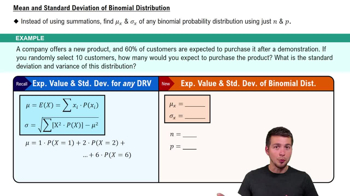
Mean & Standard Deviation of Binomial Distribution
Probability of Success (p)
The parameter p represents the likelihood of success in each trial. When p is near 0 or 1, the distribution is skewed, concentrating probabilities near 0 or n successes. When p is around 0.5, the distribution is more symmetric and bell-shaped.
The shape of the binomial distribution changes with p: for p < 0.5, it is right-skewed; for p > 0.5, it is left-skewed; and for p = 0.5, it is symmetric. This reflects how the probabilities of different numbers of successes are distributed across possible outcomes.

 1:08 minutes
 Verified step by step guidance
 03:28
03:28