[DATA] Homeruns Go to www.pearsonhighered.com/sullivanstats to obtain the data file 12_2_24 using the file format of your choice for the version of the text you are using. The variable “TrueDist” represents the distance, in feet, that the homerun traveled for all homeruns hit in the 2014 season. f. Use a normal model to determine the first and third quartiles. Compare this result to the quartiles found in part (c).
Verified step by step guidance
1
Step 1: Identify the mean (\$\(\mu\)\$) and standard deviation (\$\(\sigma\)\$) of the homerun distances from the data set. These are the parameters needed to define the normal distribution model.
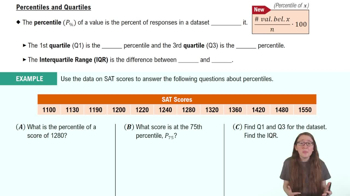
Step 2: Recall that the first quartile (Q1) corresponds to the 25th percentile and the third quartile (Q3) corresponds to the 75th percentile of the distribution.
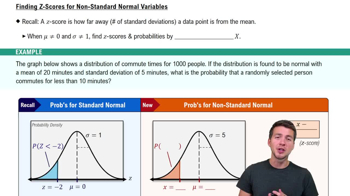
Step 3: Use the standard normal distribution to find the z-scores corresponding to the 25th percentile and the 75th percentile. These z-scores are typically \$z_{0.25} = -0.674\$ and \$z_{0.75} = 0.674\$ approximately.
Step 4: Convert these z-scores back to the original scale of homerun distances using the formula:
\$Q = \(\mu\) + z \(\times\) \(\sigma\)\$
where \$Q\$ is the quartile value, \$\(\mu\)\$ is the mean, \$\(\sigma\)\$ is the standard deviation, and \$z\$ is the z-score for the desired percentile.
Step 5: Compare the quartiles obtained from the normal model to the quartiles calculated directly from the data in part (c). Discuss any differences and consider reasons such as data skewness or deviations from normality.
Verified video answer for a similar problem:
This video solution was recommended by our tutors as helpful for the problem above
Video duration:
2m
Play a video:
0 Comments
Key Concepts
Here are the essential concepts you must grasp in order to answer the question correctly.
Normal Distribution
The normal distribution is a symmetric, bell-shaped probability distribution characterized by its mean and standard deviation. It is used to model many natural phenomena and allows for the calculation of probabilities and percentiles, such as quartiles, assuming the data follows this pattern.
Finding Z-Scores for Non-Standard Normal Variables
Quartiles
Quartiles divide a data set into four equal parts, with the first quartile (Q1) marking the 25th percentile and the third quartile (Q3) marking the 75th percentile. They provide insights into the spread and center of the data, helping to understand its distribution and variability.
When data is assumed to be normally distributed, quartiles can be estimated using the mean and standard deviation along with z-scores corresponding to the 25th and 75th percentiles. This method provides theoretical quartiles to compare against empirical quartiles calculated directly from the data.

 2:33 minutes
 Verified step by step guidance
 03:17
03:17