b. Shade the region that represents P(22 ≤ X ≤ 27) and find the probability.
Verified step by step guidance
1
For part (a), start by drawing a horizontal axis representing the variable X. Mark the mean (μ = 20) at the center of the axis. Then, sketch the bell-shaped normal curve centered at μ = 20, ensuring it is symmetric about this point.
Label the standard deviations on the horizontal axis. Since σ = 3, mark points at μ - 3σ, μ - 2σ, μ - σ, μ, μ + σ, μ + 2σ, and μ + 3σ, which correspond to 11, 14, 17, 20, 23, 26, and 29 respectively.
For part (b), identify the region between X = 22 and X = 27 on the horizontal axis. Shade the area under the normal curve between these two values. This shaded area represents the probability P(22 ≤ X ≤ 27).
Convert the raw scores 22 and 27 to their corresponding z-scores using the formula: \(z = \frac{X - \mu}{\sigma}\). Calculate \(z_1 = \frac{22 - 20}{3}\) and \(z_2 = \frac{27 - 20}{3}\).
Use the standard normal distribution table or a calculator to find the probabilities corresponding to \(z_1\) and \(z_2\). The probability P(22 ≤ X ≤ 27) is then \(P(z_2) - P(z_1)\), which is the difference between the cumulative probabilities at these z-scores.
Verified video answer for a similar problem:
This video solution was recommended by our tutors as helpful for the problem above
Video duration:
3m
Play a video:
0 Comments
Key Concepts
Here are the essential concepts you must grasp in order to answer the question correctly.
Normal Distribution
The normal distribution is a continuous probability distribution characterized by its bell-shaped curve, symmetric about the mean (μ). It is defined by two parameters: the mean (μ), which locates the center, and the standard deviation (σ), which measures the spread. Many natural phenomena follow this distribution, making it fundamental in statistics.
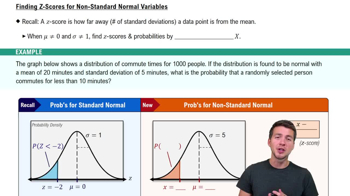
Finding Z-Scores for Non-Standard Normal Variables
Standardization and Z-Scores
Standardization converts a normal random variable X into a standard normal variable Z by subtracting the mean and dividing by the standard deviation: Z = (X - μ) / σ. This process allows us to use standard normal tables to find probabilities for any normal distribution by referencing the standard normal curve.
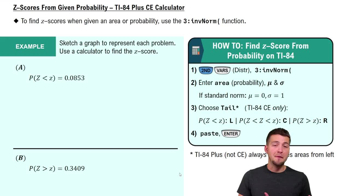
Z-Scores From Given Probability - TI-84 (CE) Calculator
Probability under the Normal Curve
The probability that a normal variable falls within a certain range corresponds to the area under the curve between those values. To find P(22 ≤ X ≤ 27), we calculate the area under the normal curve between these points, often using Z-scores and standard normal distribution tables or software.

 3:04 minutes
 Verified step by step guidance
 03:17
03:17