Explain why P(X < 30) should be reported as < 0.0001 if X is a normal random variable with mean 100 and standard deviation 15.
Verified step by step guidance
1
Identify the distribution of the random variable \(X\). Here, \(X\) is normally distributed with mean \(\mu = 100\) and standard deviation \(\sigma = 15\).
Convert the value 30 to a standard normal variable \(Z\) using the formula \(Z = \frac{X - \mu}{\sigma}\). So, calculate \(Z = \frac{30 - 100}{15}\).
Interpret the \(Z\)-score: since 30 is far below the mean of 100, the \(Z\)-score will be a large negative number, indicating a value far in the left tail of the normal distribution.
Use standard normal distribution tables or software to find \(P(Z < z)\) for the calculated \(Z\)-score. Because the \(Z\)-score is very low, this probability will be extremely small.
Since probabilities less than 0.0001 are often reported as \(< 0.0001\) due to rounding and practical significance, \(P(X < 30)\) should be reported as \(< 0.0001\) to reflect the rarity of such an event.
Verified video answer for a similar problem:
This video solution was recommended by our tutors as helpful for the problem above
Video duration:
2m
Play a video:
0 Comments
Key Concepts
Here are the essential concepts you must grasp in order to answer the question correctly.
Normal Distribution
The normal distribution is a continuous probability distribution characterized by its symmetric bell-shaped curve, defined by its mean and standard deviation. It models many natural phenomena and allows calculation of probabilities for ranges of values.
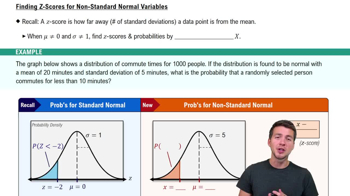
Finding Z-Scores for Non-Standard Normal Variables
Standardization (Z-Score)
Standardization converts a normal random variable to a standard normal variable by subtracting the mean and dividing by the standard deviation. This Z-score allows use of standard normal tables to find probabilities associated with any value.
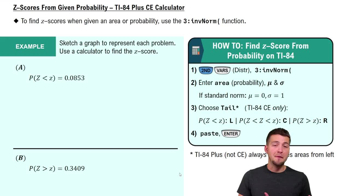
Z-Scores From Given Probability - TI-84 (CE) Calculator
Tail Probability and Reporting Small Probabilities
When a value lies far in the tail of the distribution, the probability of observing such an extreme value is very small. Probabilities less than 0.0001 are often reported as '< 0.0001' to indicate extreme rarity and limitations in numerical precision.