Suppose you live in a town with two hospitals—one large and the other small. On a given day in one of the hospitals, 60% of the babies who were born were girls. Which one do you think it is? Or, is it impossible to tell. Support your decision?
Table of contents
- 1. Intro to Stats and Collecting Data1h 14m
- 2. Describing Data with Tables and Graphs1h 56m
- 3. Describing Data Numerically2h 5m
- 4. Probability2h 17m
- 5. Binomial Distribution & Discrete Random Variables3h 6m
- 6. Normal Distribution and Continuous Random Variables2h 11m
- 7. Sampling Distributions & Confidence Intervals: Mean3h 23m
- Sampling Distribution of the Sample Mean and Central Limit Theorem19m
- Distribution of Sample Mean - ExcelBonus23m
- Introduction to Confidence Intervals15m
- Confidence Intervals for Population Mean1h 18m
- Determining the Minimum Sample Size Required12m
- Finding Probabilities and T Critical Values - ExcelBonus28m
- Confidence Intervals for Population Means - ExcelBonus25m
- 8. Sampling Distributions & Confidence Intervals: Proportion2h 10m
- 9. Hypothesis Testing for One Sample5h 8m
- Steps in Hypothesis Testing1h 6m
- Performing Hypothesis Tests: Means1h 4m
- Hypothesis Testing: Means - ExcelBonus42m
- Performing Hypothesis Tests: Proportions37m
- Hypothesis Testing: Proportions - ExcelBonus27m
- Performing Hypothesis Tests: Variance12m
- Critical Values and Rejection Regions28m
- Link Between Confidence Intervals and Hypothesis Testing12m
- Type I & Type II Errors16m
- 10. Hypothesis Testing for Two Samples5h 37m
- Two Proportions1h 13m
- Two Proportions Hypothesis Test - ExcelBonus28m
- Two Means - Unknown, Unequal Variance1h 3m
- Two Means - Unknown Variances Hypothesis Test - ExcelBonus12m
- Two Means - Unknown, Equal Variance15m
- Two Means - Unknown, Equal Variances Hypothesis Test - ExcelBonus9m
- Two Means - Known Variance12m
- Two Means - Sigma Known Hypothesis Test - ExcelBonus21m
- Two Means - Matched Pairs (Dependent Samples)42m
- Matched Pairs Hypothesis Test - ExcelBonus12m
- Two Variances and F Distribution29m
- Two Variances - Graphing CalculatorBonus16m
- 11. Correlation1h 24m
- 12. Regression3h 33m
- Linear Regression & Least Squares Method26m
- Residuals12m
- Coefficient of Determination12m
- Regression Line Equation and Coefficient of Determination - ExcelBonus8m
- Finding Residuals and Creating Residual Plots - ExcelBonus11m
- Inferences for Slope31m
- Enabling Data Analysis ToolpakBonus1m
- Regression Readout of the Data Analysis Toolpak - ExcelBonus21m
- Prediction Intervals13m
- Prediction Intervals - ExcelBonus19m
- Multiple Regression - ExcelBonus29m
- Quadratic Regression15m
- Quadratic Regression - ExcelBonus10m
- 13. Chi-Square Tests & Goodness of Fit2h 21m
- 14. ANOVA2h 29m
4. Probability
Basic Concepts of Probability
Problem 5.7.32a
Textbook Question
Lingo
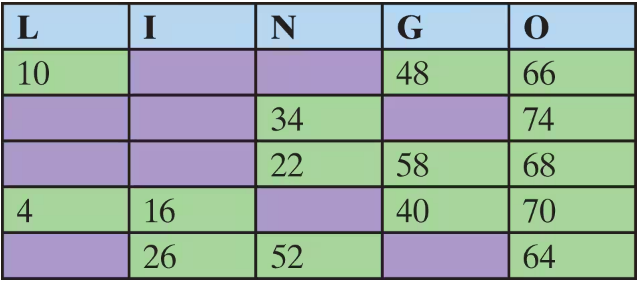
In the gameshow Lingo, the team that correctly guesses a mystery word gets a chance to pull two Lingo balls from a bin. Balls in the bin are labeled with numbers that match the numbers still on the team's Lingo board. There are also three prize balls and three red "stopper" balls in the bin. If a stopper ball is drawn first, the team loses its second draw. To form a Lingo, the team needs five numbers in a row—vertically, horizontally, or diagonally. Consider the sample Lingo board below for a team that has just guessed a mystery word.

a. What is the probability that the first ball selected is on the Lingo board?
Verified step by step guidance1
Step 1: Identify the total number of balls in the bin. This includes all the numbers still on the team's Lingo board, plus the three prize balls and the three red stopper balls.
Step 2: Count the number of green-highlighted numbers on the Lingo board, as these represent the numbers still on the board and thus the balls that match the board.
Step 3: Calculate the total number of balls by adding the count of green numbers, the 3 prize balls, and the 3 stopper balls.
Step 4: The probability that the first ball selected is on the Lingo board is the ratio of the number of green balls (numbers on the board) to the total number of balls in the bin.
Step 5: Express this probability as a fraction or decimal using the formula: \(\text{Probability} = \frac{\text{Number of green balls}}{\text{Total number of balls}}\).
Verified video answer for a similar problem:This video solution was recommended by our tutors as helpful for the problem above
Video duration:
1mPlay a video:
0 Comments
Key Concepts
Here are the essential concepts you must grasp in order to answer the question correctly.
Probability
Probability measures the likelihood of an event occurring, expressed as a ratio of favorable outcomes to total possible outcomes. It ranges from 0 (impossible event) to 1 (certain event). In this question, probability helps determine the chance of drawing a ball that matches a number on the Lingo board.
Recommended video:
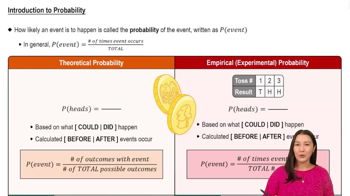
Introduction to Probability
Sample Space and Favorable Outcomes
The sample space is the set of all possible outcomes in an experiment, while favorable outcomes are those that meet the event criteria. Here, the sample space includes all balls in the bin, and favorable outcomes are balls labeled with numbers currently on the Lingo board.
Recommended video:
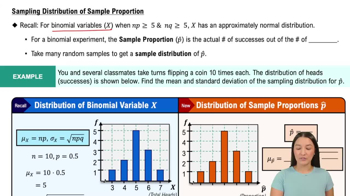
Sampling Distribution of Sample Proportion
Counting and Identifying Relevant Elements
Accurately counting the number of balls on the Lingo board and the total balls in the bin is essential. This involves identifying which numbers are still active on the board (highlighted in green) and understanding the total composition of the bin, including prize and stopper balls.
Recommended video:
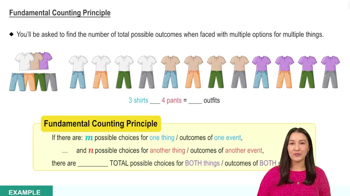
Fundamental Counting Principle
Related Videos
Related Practice
Textbook Question