Hurricanes Use the results of Problem 14 in Section 12.3 to answer the following questions: d. Construct a 95% prediction interval for the wind speed found in part (c).
Verified step by step guidance
1
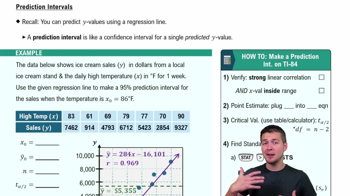
Recall that a prediction interval estimates the range in which a single future observation is expected to fall, with a certain level of confidence (here, 95%).
Identify the predicted value \( \hat{y} \) from part (c), which is the estimated wind speed for the given predictor value.
Find the standard error of the prediction, which accounts for both the variability of the estimate and the variability of individual observations. The formula is:
\[
SE_{pred} = s \sqrt{1 + \frac{1}{n} + \frac{(x_0 - \bar{x})^2}{\sum (x_i - \bar{x})^2}}
\]
where:
- \( s \) is the standard error of the regression,
- \( n \) is the sample size,
- \( x_0 \) is the predictor value for the prediction,
- \( \bar{x} \) is the mean of the predictor values,
- \( x_i \) are the observed predictor values.
Determine the critical t-value \( t^* \) for a 95% confidence level with \( n - 2 \) degrees of freedom (since this is a simple linear regression).
Construct the 95% prediction interval using the formula:
\[
\hat{y} \pm t^* \times SE_{pred}
\]
This interval gives the range where the wind speed for a new observation is expected to lie with 95% confidence.
Verified video answer for a similar problem:
This video solution was recommended by our tutors as helpful for the problem above
Video duration:
7m
Play a video:
0 Comments
Key Concepts
Here are the essential concepts you must grasp in order to answer the question correctly.
Prediction Interval
A prediction interval estimates the range within which a single future observation is expected to fall, with a specified level of confidence (e.g., 95%). Unlike confidence intervals for the mean, prediction intervals account for both the uncertainty in estimating the mean and the variability of individual data points.
Regression analysis models the relationship between a dependent variable and one or more independent variables. It provides an equation to predict values and assess how changes in predictors affect the response, which is essential for constructing prediction intervals based on predicted values.
The confidence level (e.g., 95%) indicates the proportion of similarly constructed intervals that would contain the true value if the experiment were repeated many times. It reflects the reliability of the interval estimate, helping to understand the uncertainty associated with predictions.