Invest in Education Use the results of Problem 17 in Section 12.3 to answer the following questions: b. Construct a 95% confidence interval for the mean annual ROI found in part (a).
Verified step by step guidance
1
Identify the sample mean \( \bar{x} \) and the sample standard deviation \( s \) from the results of part (a) or Problem 17 in Section 12.3. These values represent the estimated mean annual ROI and its variability.
Determine the sample size \( n \), which is the number of observations or data points used to calculate the sample mean and standard deviation.
Select the appropriate critical value for a 95% confidence interval. Since the population standard deviation is unknown and the sample size is likely small, use the t-distribution with \( n - 1 \) degrees of freedom. The critical value \( t^* \) corresponds to the 97.5th percentile of the t-distribution (because 95% confidence leaves 2.5% in each tail).
Calculate the standard error of the mean (SEM) using the formula:
\[ \text{SEM} = \frac{s}{\sqrt{n}} \]
Construct the 95% confidence interval using the formula:
\[ \left( \bar{x} - t^* \times \text{SEM}, \quad \bar{x} + t^* \times \text{SEM} \right) \]
This interval estimates the range in which the true mean annual ROI lies with 95% confidence.
Verified video answer for a similar problem:
This video solution was recommended by our tutors as helpful for the problem above
Video duration:
7m
Play a video:
0 Comments
Key Concepts
Here are the essential concepts you must grasp in order to answer the question correctly.
Confidence Interval
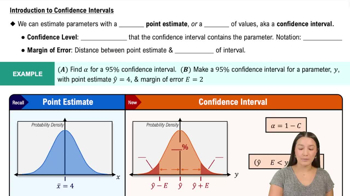
A confidence interval estimates the range within which a population parameter, like the mean, is likely to fall. A 95% confidence interval means we are 95% confident the true mean lies within this range, based on sample data.
The mean annual ROI is the average yearly return earned on an investment. It summarizes the central tendency of the investment’s performance over a period, serving as the parameter to estimate with the confidence interval.
The standard error measures the variability of the sample mean and depends on the sample’s standard deviation and size. Larger samples reduce the standard error, leading to narrower confidence intervals and more precise estimates.